

Investment Strategy Brief
2025 in the Rear View:
Growth and Risks Ahead
January 4, 2026

Executive Summary
- Despite a volatile start to 2025, major asset classes realized strong returns for the full year.
- The strongest performance came from international stocks, a reminder that the U.S. is not the only game in town.
- Growth should accelerate in 2026, though several risks from inflation to the big bet on artificial intelligence (AI) warrant close monitoring.
- Most equities are now above fair value, with the largest excess valuations still concentrated in U.S. large caps.
- While economic growth should accelerate in 2026, lurking risks and disparate valuations justify active rebalancing and diversification.
After early-year downside, equity markets rebounded while bond markets settled into lower rates
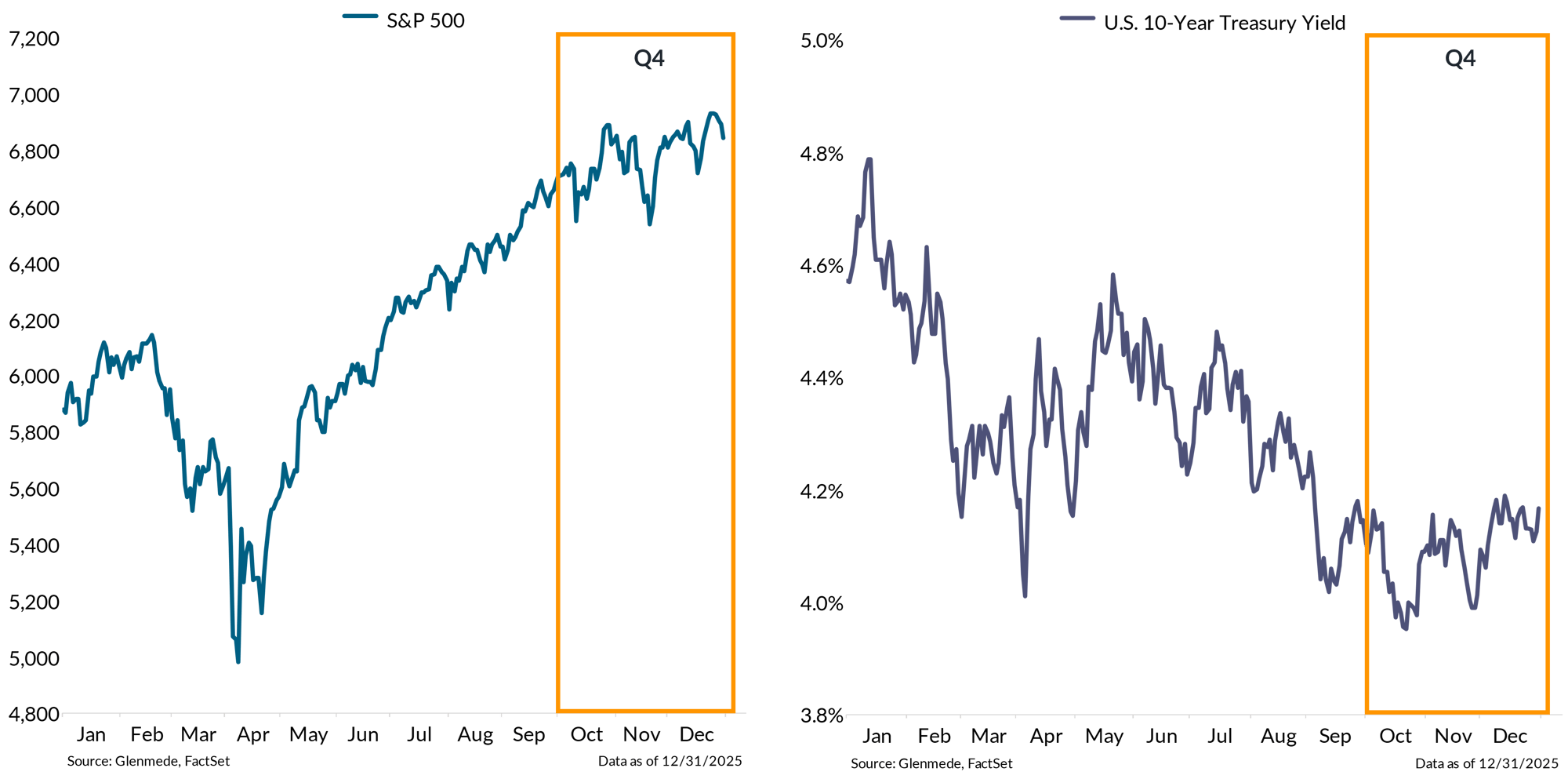
Shown in the left panel is the S&P 500, which is a market capitalization weighted index of U.S. large cap stocks. Shown in the right panel is the yield on 10-year U.S. Treasury bonds. Past performance may not be indicative of future results. One cannot invest directly in an index.
- After early-year downside, the S&P 500 rebounded and continued to climb in Q4, supported by improving market sentiment and easing financial conditions.
- The U.S. 10-Year Treasury yield drifted lower amid three consecutive rate cuts by the Federal Reserve.
Major asset classes realized strong returns in 2025, led by international equities
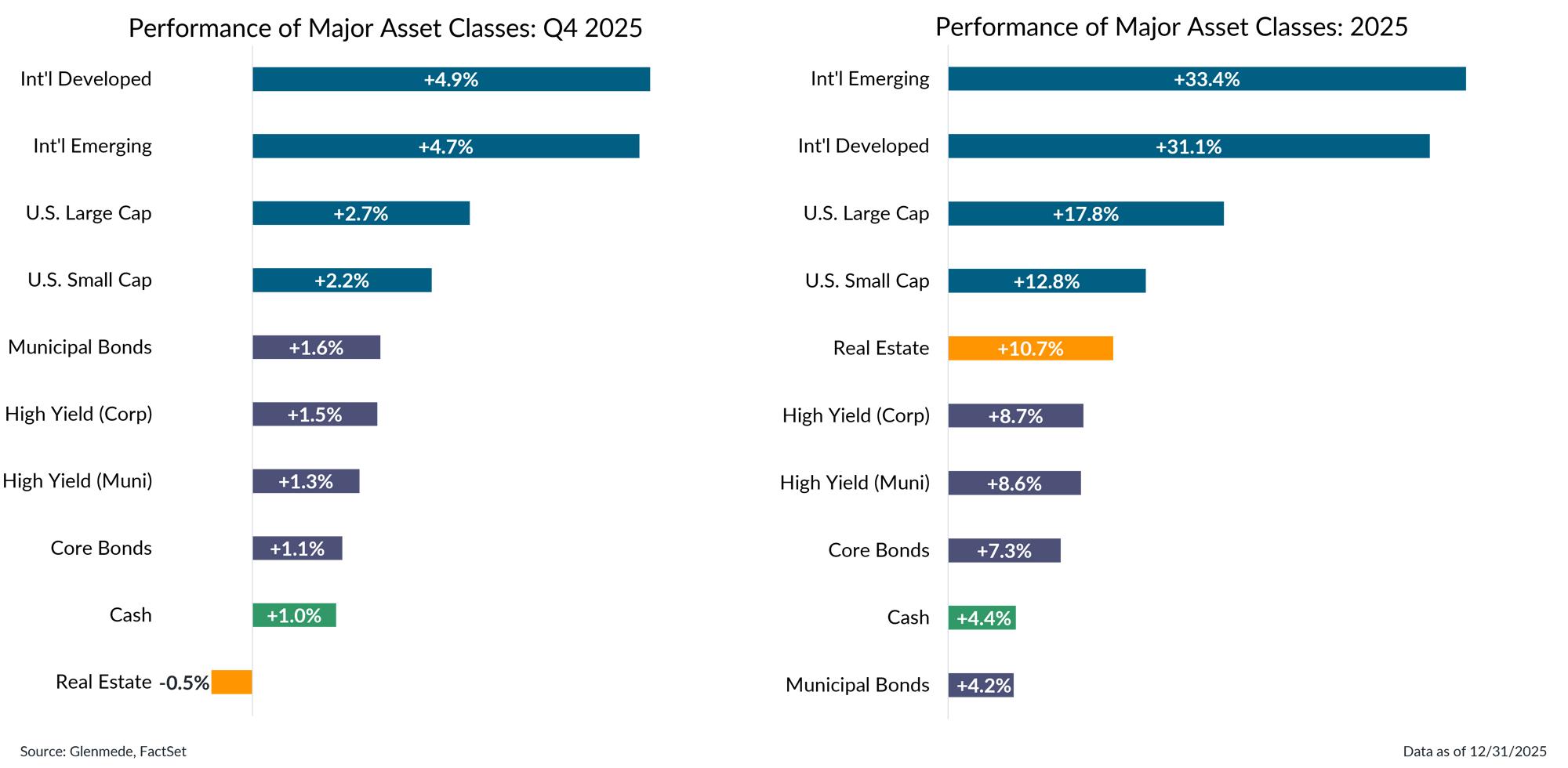
Shown are Q4 2025 and calendar year 2025 total returns for various asset classes represented by the following indices: U.S. Large Cap (S&P 500), U.S. Small Cap (Russell 2000), Int’l Developed (MSCI EAFE), Int’l Emerging (MSCI EM), Real Estate (FTSE EPRA/NAREIT Developed), Core Bonds (Bloomberg U.S. Aggregate), Municipal Bonds (Bloomberg Municipal), High Yield (Corp) (Bloomberg U.S. High Yield Ba to B), High Yield (Muni) (Bloomberg Municipal High Yield), Cash (FTSE 3-Month Treasury Bills). Past performance may not be indicative of future results. One cannot invest directly in an index.
- The majority of major asset classes delivered positive returns in Q4, with most equity asset classes delivering mid-single-digit returns.
- International and emerging markets led year-to-date performance in 2025, supported by improving fundamentals and a weakening dollar.
Despite double-digit returns, U.S. equities posted one of their weakest years of relative performance in 2025
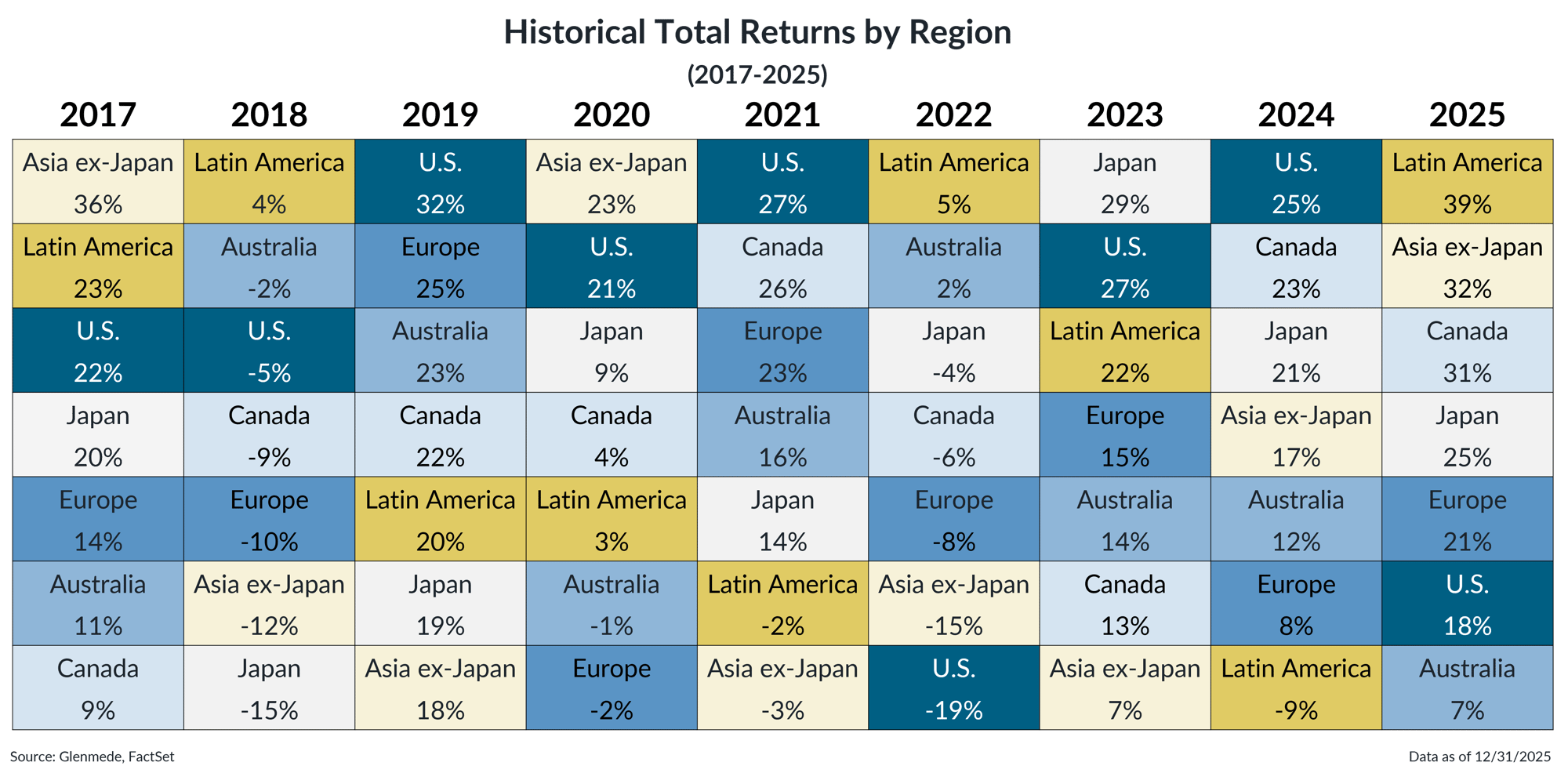
Shown are historical annual total returns for several MSCI equity indices: U.S. (MSCI USA), Europe (MSCI Europe), Canada (MSCI Canada), Australia (MSCI Australia), Asia ex Japan (MSCI All Country Asia ex Japan), Japan (MSCI Japan), and Latin America (MSCI Emerging Markets Latin America). MSCI indices are free float–adjusted, market capitalization weighted benchmarks designed to measure equity market performance across developed and emerging markets. Past performance may not be indicative of future results. One cannot invest directly in an index.
- U.S. equities posted double-digit gains in 2025 but trailed most other regions, marking one of their weakest relative performance years in nearly a decade.
- Regional performance has been highly variable over the past nine years, highlighting the cyclical nature of equity markets.
Growth should accelerate in 2026, though several risks warrant close monitoring
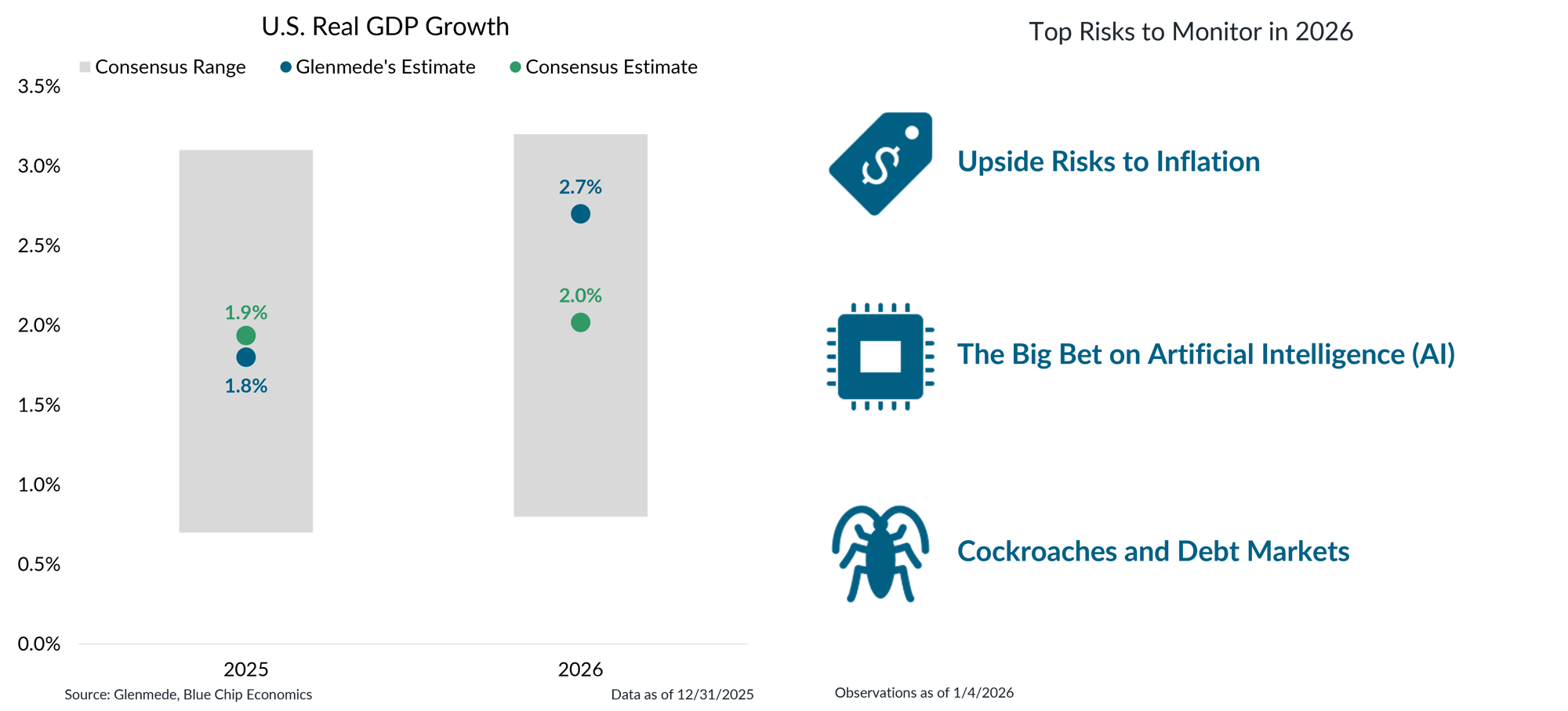
Shown on the left in gray is a range of annual U.S. real GDP growth estimates from economists, alongside the average consensus estimate and Glenmede’s own projections. Statements on the right reflect Glenmede’s opinions, which may change after the date of publication. Actual results may differ materially from projections.
- Economic growth should accelerate to 2.7% in 2026 as the impact of tariffs fades and fiscal stimulus from the One Big Beautiful Bill Act (OBBBA) ramps up.
- However, several risks warrant close monitoring, including fiscal policy-induced inflation pressures, overinvestment in AI, and stress in debt markets.
Most equities are now above fair value, with the largest excess valuations still concentrated in U.S. large caps
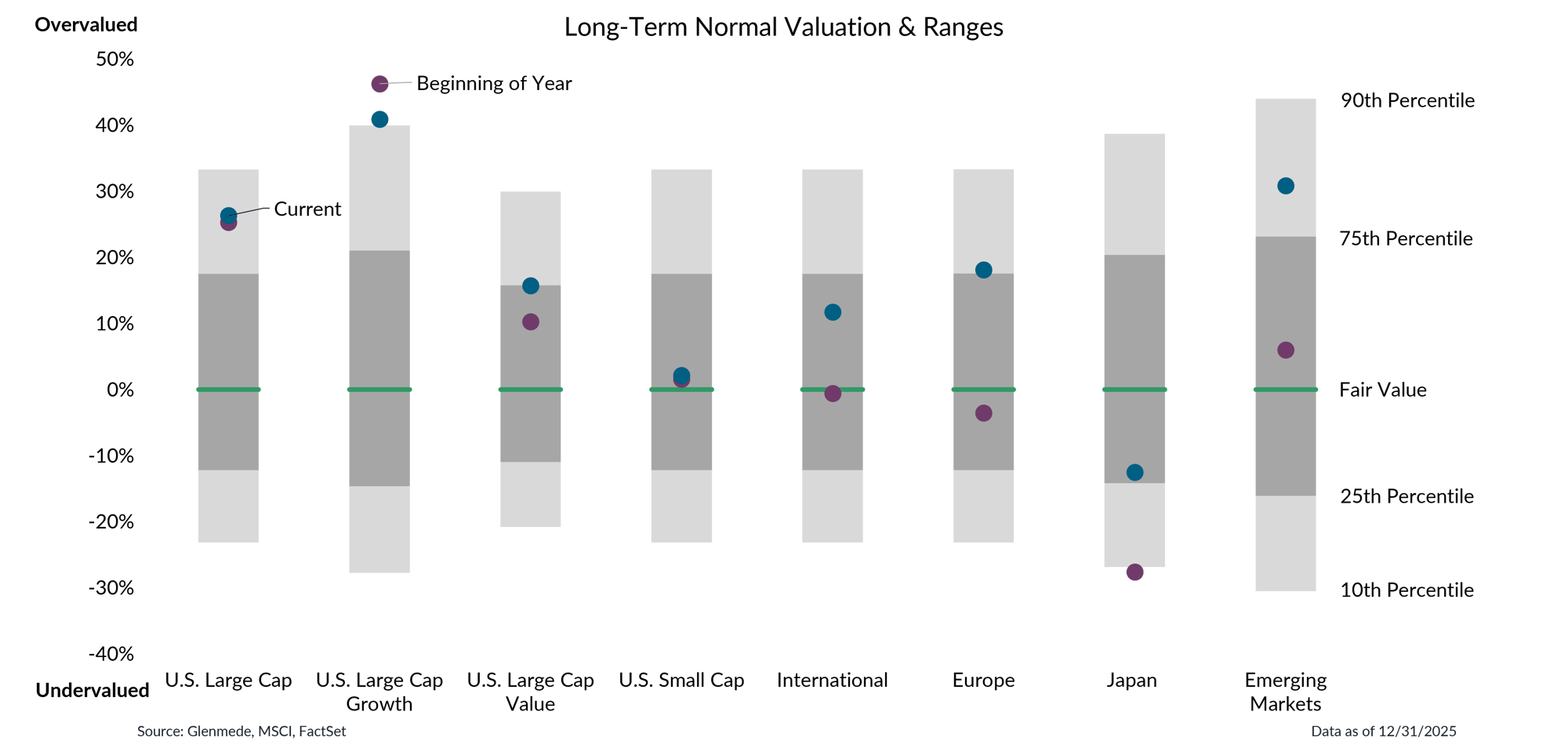
Data shown are Glenmede’s estimates of long-term fair value for U.S. Large Cap (MSCI USA), U.S. Large Cap Growth (MSCI USA Growth), U.S. Large Cap Value (MSCI USA Value), U.S. Small Cap (MSCI USA Small), International (MSCI All Country World ex-U.S.), Europe (MSCI Europe), Japan (MSCI Japan), and Emerging Markets (MSCI EM) based on normalized earnings, normalized cash flows, dividend yield, and book value for each index. Blue dots represent current valuation levels, and purple dots represent valuation levels at the beginning of 2025. Glenmede’s estimates of fair value are arrived at in good faith, but longer-term targets for valuation may be uncertain. One cannot invest directly in an index.
- The majority of equities are now above fair value, with large cap stocks trading near the 85th percentile. However, those premium valuations are being driven by 90th percentile valuations on growth equities.
- In contrast, small caps are currently priced closer to long-term fair value, offering a more favorable risk-reward profile than their large cap counterparts.
Upcoming Webinar:
Strategy for a Year of Opportunity, Risks, and Altered Tax Policy
Thoughtful preparation can help you navigate a year defined by opportunity, growing risks, and meaningful shifts in tax law. Join Jason D. Pride, CFA, Chief of Investment Strategy & Research, and Mark R. Parthemer, JD, AEP, ACTEC Fellow, Chief Wealth Strategist, as they explore the following:
- Economic growth and evolving risks
- The impact of tax law changes
- How to position portfolios and support effective tax planning
Wednesday, January 7, 2026
11:00 AM ET

For more in-depth information on this topic, please reach out to your Glenmede Relationship Manager.

This material is provided solely for informational and/or educational purposes and is not intended as personalized investment advice. When provided to a client, advice is based on the client’s unique circumstances and may differ substantially from any general recommendations, suggestions or other considerations included in this material. Any opinions, recommendations, expectations or projections herein are based on information available at the time of publication and may change thereafter. Information obtained from third-party sources is assumed to be reliable but may not be independently verified, and the accuracy thereof is not guaranteed. Any company, fund or security referenced herein is provided solely for illustrative purposes and should not be construed as a recommendation to buy, hold or sell it. Outcomes (including performance) may differ materially from any expectations and projections noted herein due to various risks and uncertainties. Any reference to risk management or risk control does not imply that risk can be eliminated. All investments have risk. Clients are encouraged to discuss any matter discussed herein with their Glenmede representative.