

Investment Strategy Brief
AI Capex: Naughty or Nice?
December 21, 2025
Executive Summary
- The top 7 stocks now spend more on capital expenditures (capex) than any top 7 in history, a trend industry analysts expect to persist.
- The internet buildout in the late-1990s is a cautionary tale of big capex cycles that misjudged demand.
- Today’s AI buildout is led by stronger firms, but more of the spending is on items that quickly become obsolete.
- AI hyperscalers are increasingly using debt and special purpose vehicles to finance capex.
- Investors should exercise caution chasing the AI innovation theme and emphasize regular rebalancing and portfolio diversification.
The top 7 stocks now spend more on capex than any top 7 in history, a trend industry analysts expect to persist
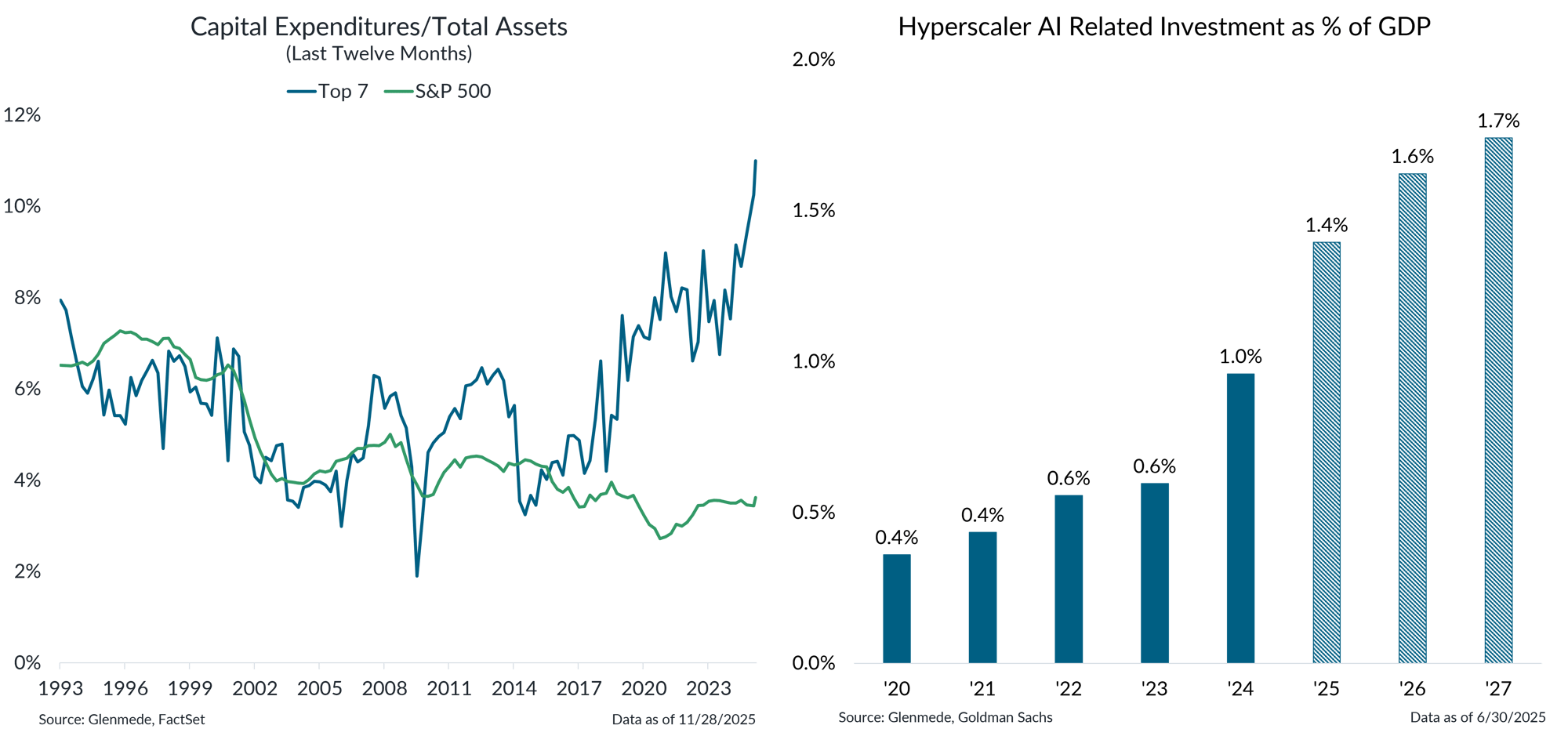
Data shown on the left represent average capital expenditures as a share of total assets, measured on a last-twelve-months basis, for two groups of stocks: the largest seven companies in the S&P 500 at each point in time (blue) and all index constituents (green). Both lines reflect equally weighted averages of their respective groups. Data shown on the right are the total capital expenditures from Oracle, Meta, Google, Amazon, and Microsoft as a share of U.S. gross domestic product (GDP). Solid bars represent actual figures while hashed bars represent projections. This visual should not be interpreted as a recommendation to buy, hold, or sell any specific securities. Past performance may not be indicative of future results. One cannot invest directly in an index. Actual results may differ materially from expectations.
- A big part of the Magnificent 7’s rise to dominance has been their history of running asset light, low capex intensity business models.
- That characterization of these businesses has changed over the past year. The Mag 7 are now deploying capital expenditures at a rate well beyond prior market leaders and are expected to continue that trend around the buildout of artificial intelligence capabilities.
The internet buildout in the late-90s is a cautionary tale of big capex cycles that misjudged demand
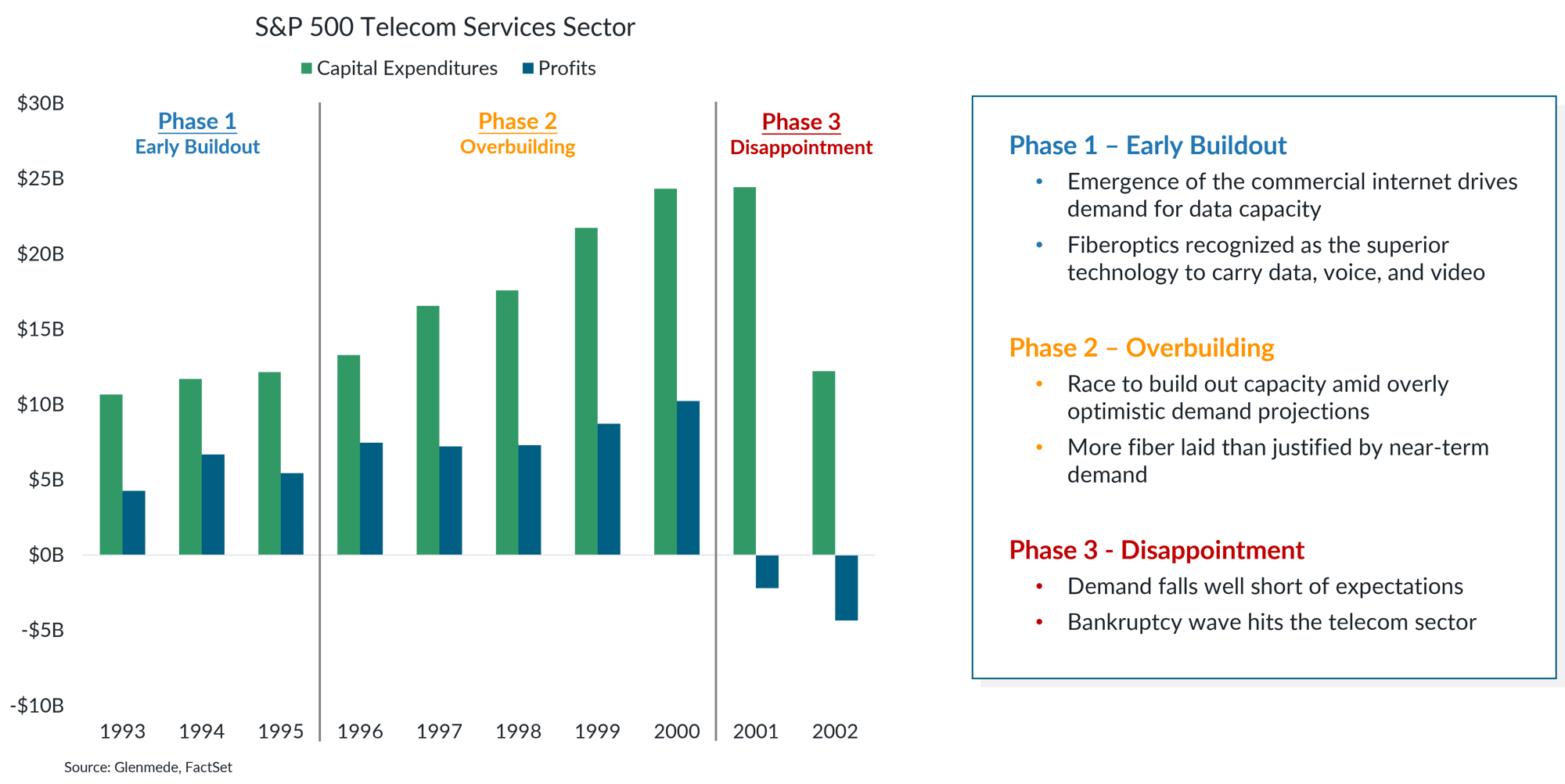
Data shown on the left are the aggregate capital expenditures (green) and net income excluding extraordinary items (blue) in billions of U.S. dollars for the S&P 500’s telecommunications services sector. The S&P 500 is a market capitalization weighted index of U.S. large cap stocks. Past performance may not be indicative of future results. One cannot invest directly in an index.
- Telecom companies aggressively built out fiberoptic network infrastructure in the late 1990s in anticipation of explosive internet demand that ultimately failed to materialize.
- The mismatch between capacity and demand led to collapsing profits, widespread bankruptcies, and disappointing returns for investors, offering a reminder of how capex booms can overshoot real economic needs.
Today’s AI buildout is led by stronger firms, but more of the spending is on items that quickly become obsolete
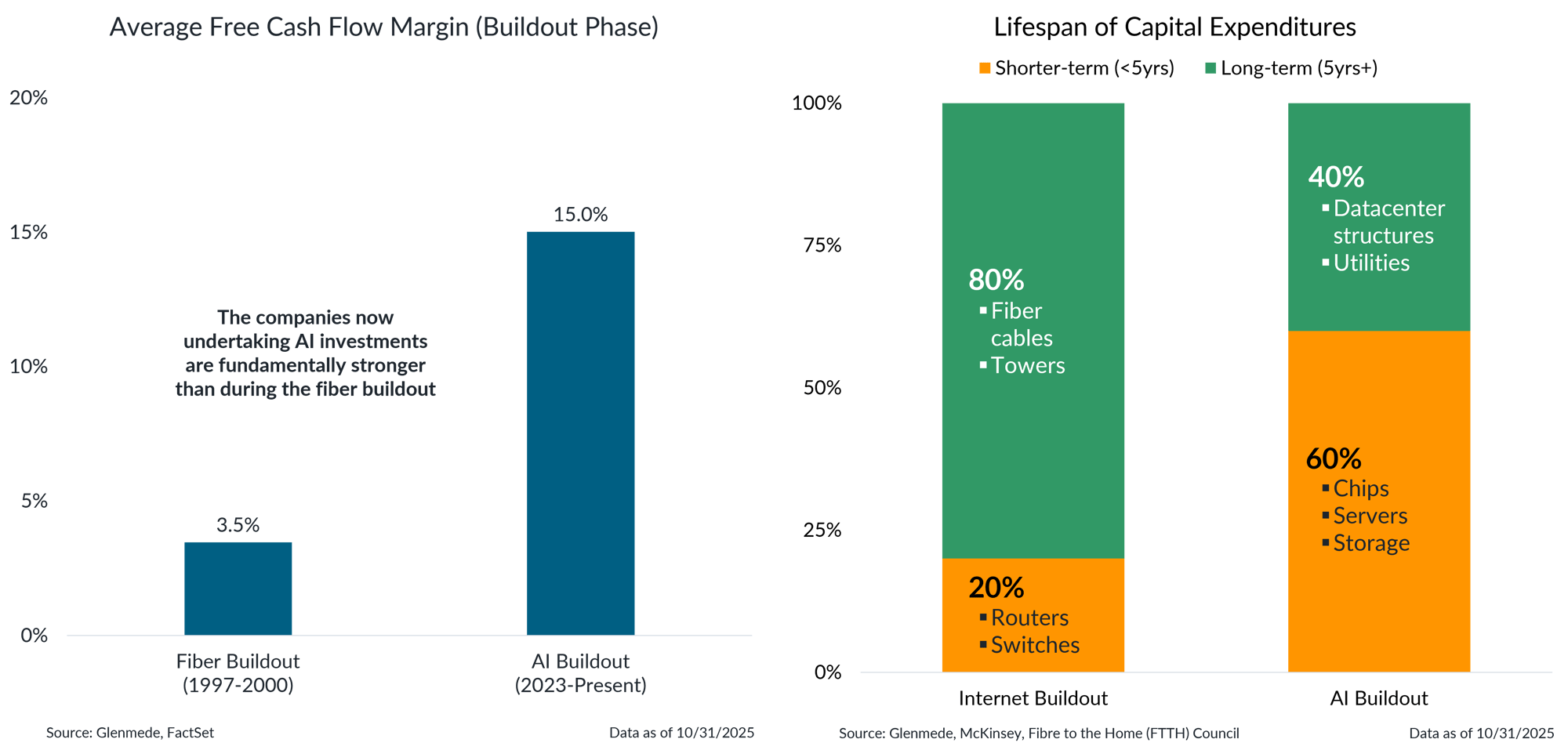
Data shown on the left are the average free cash flow margins for the companies involved in the fiber buildout (S&P 500’s telecommunications services sector from 1997 through 2000) and the AI buildout (Oracle, Meta, Google, Amazon, and Microsoft from 2023 to present). Data shown on the right represent a general overview of the lifespan of the various costs for building fiberoptic infrastructure and datacenters. The S&P 500 is a market capitalization weighted index of U.S. large cap stocks. This visual should not be interpreted as a recommendation to buy, hold, or sell any specific securities. Past performance may not be indicative of future results. One cannot invest directly in an index.
- This AI capex cycle has a few key differences to the buildout of fiberoptic networks. The companies now undertaking AI investments are doing so on top of fundamentally stronger underlying business models than during the fiber buildout.
- However, the investments being deployed may have shorter useful lives. While most fiber laid in the 1990s remains in service, computer chips quickly become obsolete and demand constant replacement.
AI hyperscalers are increasingly using debt and special purpose vehicles to finance capex
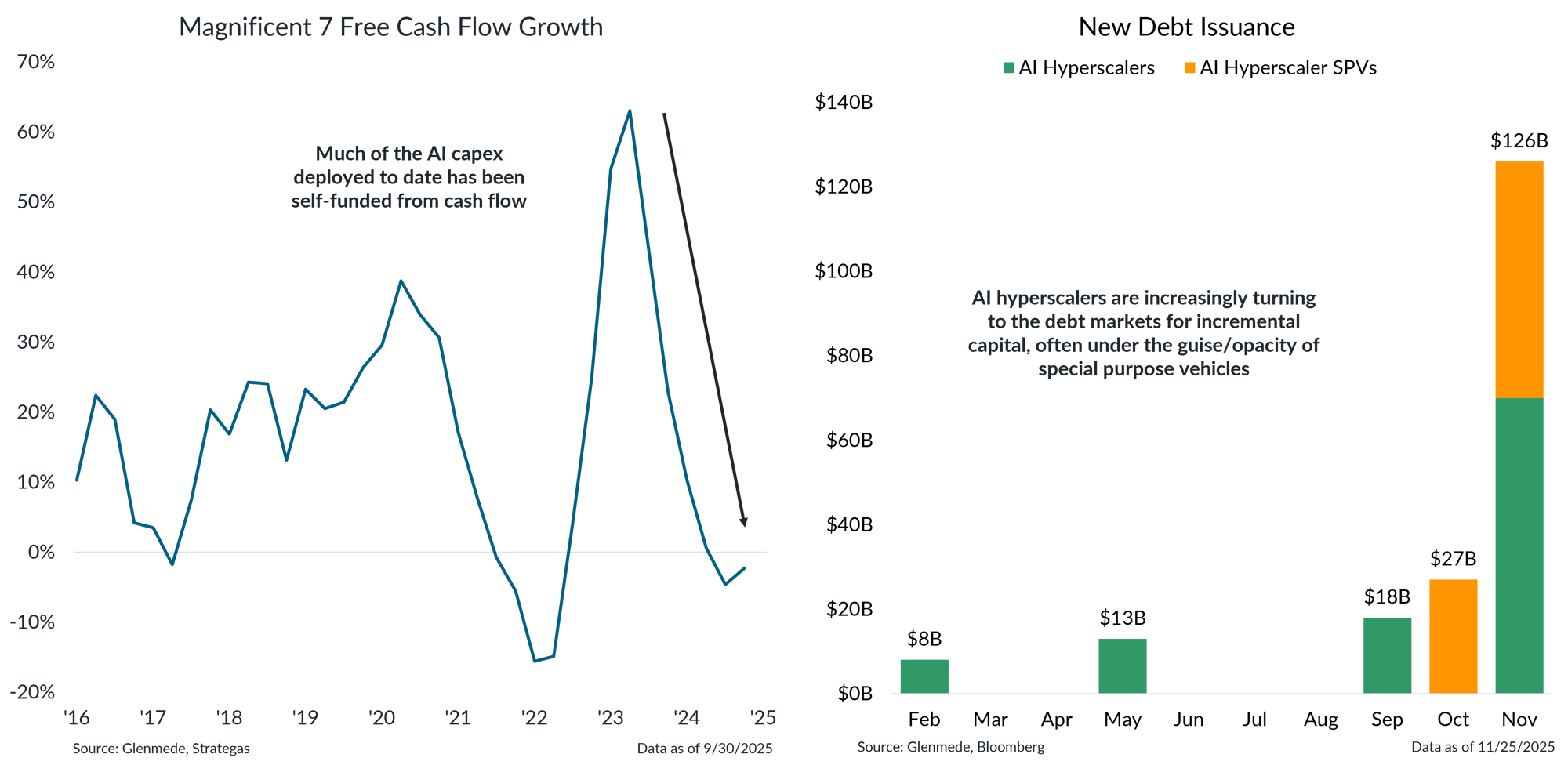
Shown on the left is the year-over-year percentage change in free cash flow for the Magnificent 7 (Apple, Alphabet, Amazon, Meta, Microsoft, Nvidia, Tesla). Shown on the right is the monthly amount of new debt issuance from the AI Hyperscalers (Alphabet, Oracle, Amazon, Meta), in billions of U.S. dollars. Green figures represent direct issuance from the companies themselves and orange figures represent indirect issuance via special purpose vehicles (SPVs), subsidiaries, or partner companies that are raising debt guaranteed by the AI Hyperscalers. November figures include pending loan packages.
- Until relatively recently, much of the capital needed to finance the buildout of AI capex had been largely self-funded. However, hyperscalers are increasingly relying on external financing as free cash flow growth has flatlined.
- The growing use of special purpose vehicles (SPVs) to intermediate this borrowing adds opacity to the true pace of leverage buildup, complicating efforts to assess how much balance sheet risk is accumulating beneath the surface.
Upcoming Webinar:
Strategy for a Year of Opportunity, Risks, and Altered Tax Policy
Thoughtful preparation can help you navigate a year defined by opportunity, growing risks, and meaningful shifts in tax law. Join Jason D. Pride, CFA, Chief of Investment Strategy & Research, and Mark R. Parthemer, JD, AEP, ACTEC Fellow, Chief Wealth Strategist, as they explore the following:
- Economic growth and evolving risks
- The impact of tax law changes
- How to position portfolios and support effective tax planning
Wednesday, January 7, 2026
11:00 AM ET

For more in-depth information on this topic, please reach out to your Glenmede Relationship Manager.

This material is provided solely for informational and/or educational purposes and is not intended as personalized investment advice. When provided to a client, advice is based on the client’s unique circumstances and may differ substantially from any general recommendations, suggestions or other considerations included in this material. Any opinions, recommendations, expectations or projections herein are based on information available at the time of publication and may change thereafter. Information obtained from third-party sources is assumed to be reliable but may not be independently verified, and the accuracy thereof is not guaranteed. Any company, fund or security referenced herein is provided solely for illustrative purposes and should not be construed as a recommendation to buy, hold or sell it. Outcomes (including performance) may differ materially from any expectations and projections noted herein due to various risks and uncertainties. Any reference to risk management or risk control does not imply that risk can be eliminated. All investments have risk. Clients are encouraged to discuss any matter discussed herein with their Glenmede representative.