

Investment Strategy Brief | April 5, 2026
Broadening Market Leadership

Executive Summary
- The equity bull market has lost some steam in the early part of 2026 while leadership has shifted beneath the surface.
- Diversification is having its moment, with mega caps and overrepresented sectors underperforming this year.
- Small caps have begun to outperform after reaching an earnings inflection point.
- Value stocks have rebounded after touching extreme relative undervaluation compared with their growth peers.
- Investors should continue to tilt toward small caps and diversification while avoiding material value/growth tilts.
Leadership has shifted beneath the surface, benefiting value, small cap, and diversified approaches
- The bull market in equities has lost some steam amid geopolitical-driven volatility after a significant rally from last spring’s lows.
- Beneath the surface, equity performance has begun to shift, favoring value over growth, small caps over large caps, and the average stock over the mega cap names that led the market in 2025.
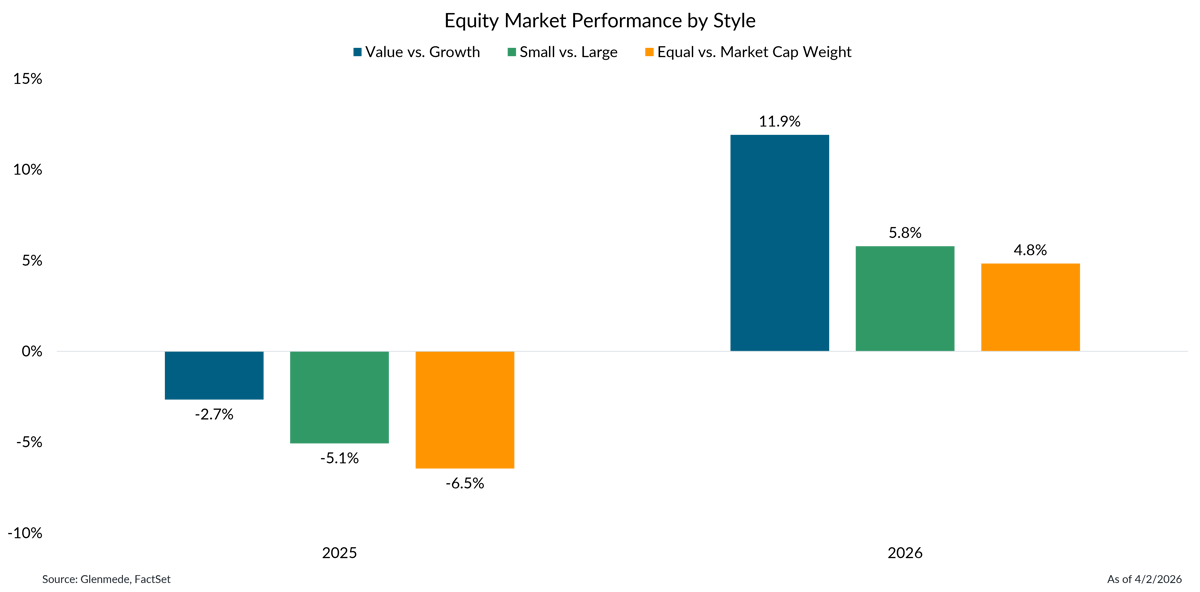
Shown are total return figures for the full year 2025 and 2026 year-to-date, through the latest date shown. Value vs. Growth is represented by the relative performance of the Russell 1000 Value index less the Russell 1000 Growth index. Small vs. Large is represented by the relative performance of the Russell 2000 index less the S&P 500 index. Equal vs. Market Cap Weight is represented by the relative performance of the S&P 500 Equal Weight index less the S&P 500 index. Past performance may not be indicative of future results. One cannot invest directly in an index.
Diversification is having its moment, with mega caps and overrepresented sectors underperforming this year
- A big reason that the standard S&P 500 index has underperformed its equal-weighted variant is the notable underperformance of the largest companies. The Magnificent 7 are down this year, while the rest of the index is roughly flat.
- Sector allocations are also playing a role, as size has been the dividing line between positive and negative returns this year. The sectors with the lowest weight in the S&P 500 have greater representation in the equal-weighted index and have contributed to its outperformance.
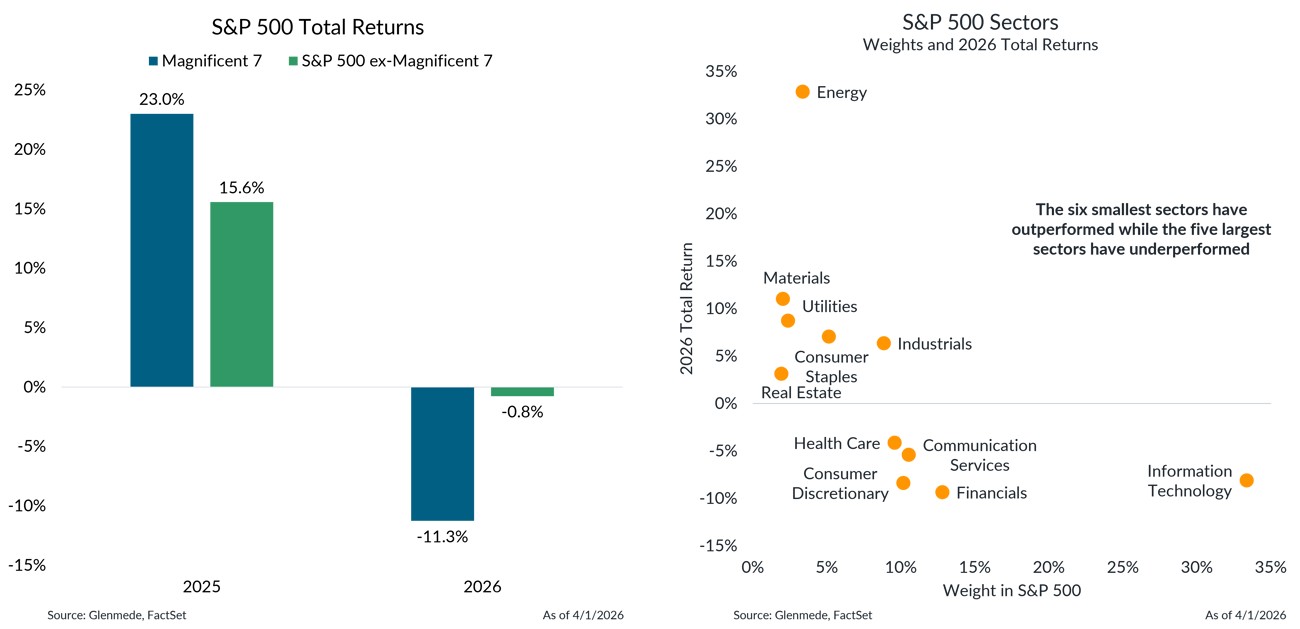
Shown in the left panel are total returns for the Magnificent 7 (Apple, Microsoft, Alphabet, Amazon, Nvidia, Meta, Tesla) on a market capitalization weighted basis in blue and the S&P 500 excluding the Magnificent 7 in green, for calendar year 2025 and year-to-date 2026 as of the latest date shown. Shown in the right panel are the year-to-date 2026 total returns for each constituent sector in the S&P 500 and their average weight in the index. The S&P 500 is a market capitalization weighted index of U.S. large cap stocks. This visual should not be interpreted as a recommendation to buy, hold, or sell any specific securities or sectors. Past performance may not be indicative of future results. One cannot invest directly in an index.
Small caps have begun to outperform after reaching an earnings inflection point
- Small caps have begun to outperform as earnings momentum turns more favorable, marking an inflection point after a weaker stretch over the past few years.
- Following roughly 18% earnings growth in 2025, small cap earnings are expected to accelerate sharply to about 48% in 2026.
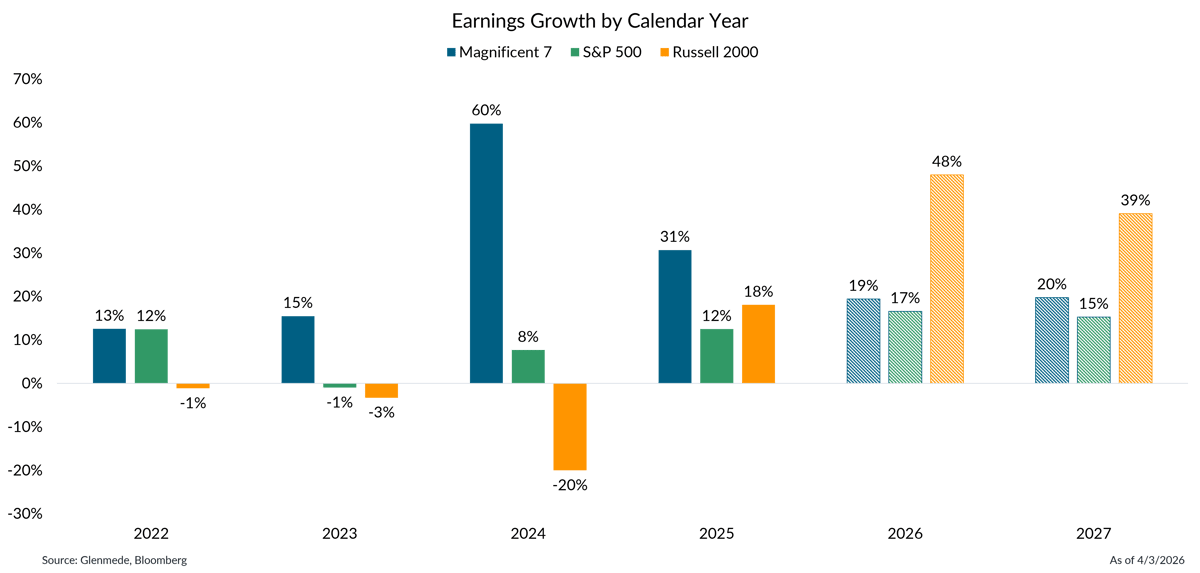
Data shown are the annual calendar year growth rates in earnings for the Magnificent 7 (Apple, Microsoft, Alphabet, Amazon, Nvidia, Meta, Tesla) on an equal-weighted basis, the S&P 500, and the Russell 2000. Solid bars represent actual results, and the hashed bars represent projections based on bottom-up equity analyst estimates. The S&P 500 is a market capitalization weighted index of large cap stocks in the U.S. The Russell 2000 is a market capitalization weighted index of small cap stocks in the U.S. This visual should not be interpreted as a recommendation to buy, hold, or sell any specific securities. Past performance may not be indicative of future results. One cannot invest directly in an index.
Value stocks have rebounded after touching extreme relative undervaluation compared with their growth peers
- Value stocks have rebounded after trading at a significant discount to growth in October of last year, a relative valuation gap that appeared increasingly stretched and susceptible to mean reversion.
- As it stands now, the valuation differentials appear much more reasonable by historical standards.
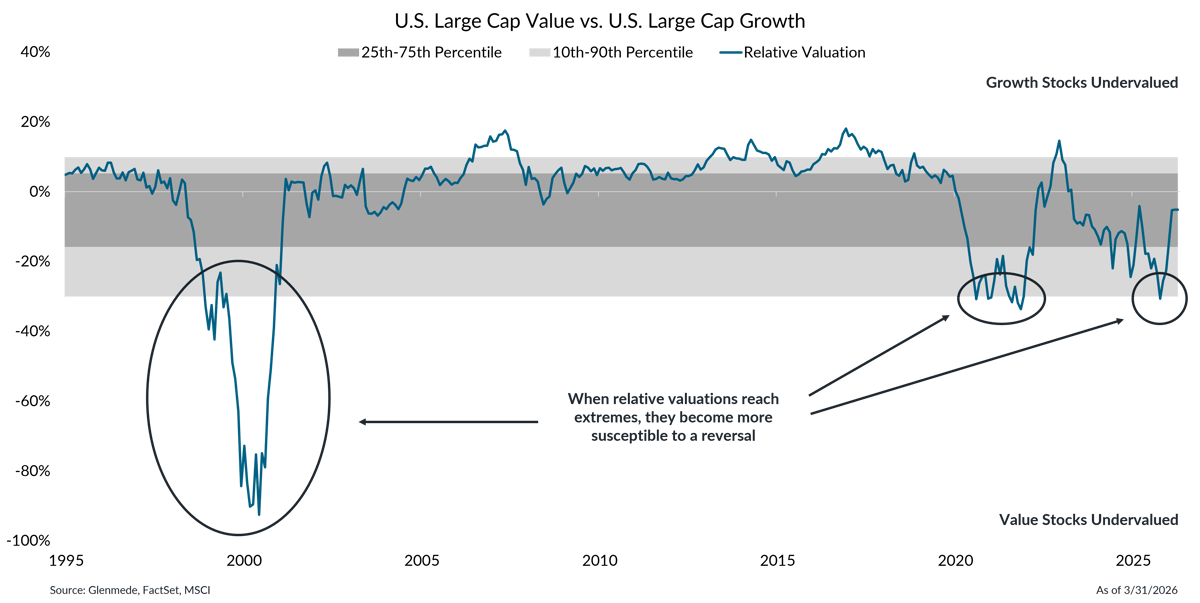
Glenmede’s estimates of long-term fair value for U.S. large cap value and U.S. large cap growth are based on normalized earnings, dividend yield, and book value using MSCI USA Value and MSCI USA Growth indices. The relative valuation line in blue represents the difference in valuation percentiles between the two indices. Past performance may not be indicative of future results. Glenmede’s estimates of fair value are arrived at in good faith, but longer-term targets for valuation may be uncertain. One cannot invest directly in an index.
Investors should continue to tilt toward small caps and diversification while avoiding material value/growth tilts
- Expected returns continue to appear more favorable outside the largest index names, with small caps and more balanced exposure offering a more compelling opportunity set.
- At the same time, the case for a material value or growth tilt looks less enticing, as relative valuations between the two have moved back toward a more normal range.
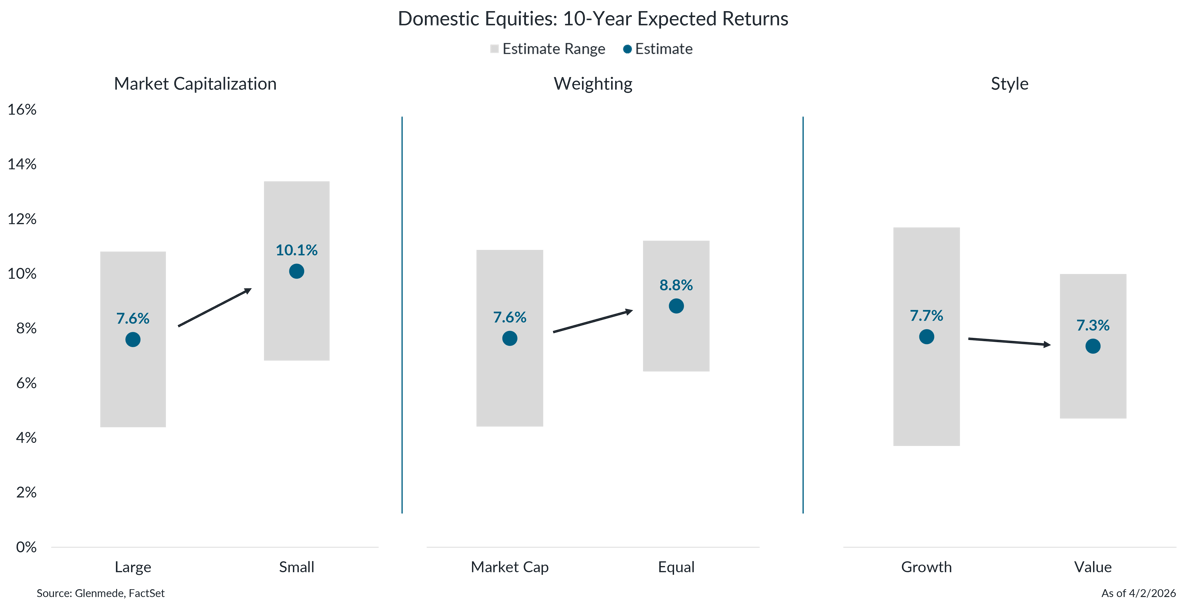
Shown are Glenmede’s proprietary 10-year expected returns, represented by the following indices: Large (MSCI USA), Small (MSCI USA Small Cap), Market Cap (MSCI USA), Equal (MSCI USA Equal Weighted), Growth (MSCI USA Growth), Value (MSCI USA Value). Actual results may differ materially from expectations. One cannot invest directly in an index.
For more in-depth information on this topic, please reach out to your Glenmede Relationship Manager.

This material is provided solely for informational and/or educational purposes and is not intended as personalized investment advice. When provided to a client, advice is based on the client’s unique circumstances and may differ substantially from any general recommendations, suggestions or other considerations included in this material. Any opinions, recommendations, expectations or projections herein are based on information available at the time of publication and may change thereafter. Information obtained from third-party sources is assumed to be reliable but may not be independently verified, and the accuracy thereof is not guaranteed. Any company, fund or security referenced herein is provided solely for illustrative purposes and should not be construed as a recommendation to buy, hold or sell it. Outcomes (including performance) may differ materially from any expectations and projections noted herein due to various risks and uncertainties. Any reference to risk management or risk control does not imply that risk can be eliminated. All investments have risk. Clients are encouraged to discuss any matter discussed herein with their Glenmede representative.