

Investment Strategy Brief
FOMC Preview: A First Vote for a Shifting Fed
January 25, 2026

Executive Summary
- Federal Open Market Committee (FOMC) voters have shifted slightly more hawkish but may still deliver rate cuts later in 2026.
- The Fed faces a delicate balance between a gradually cooling labor market and inflation on the edge of acceptable levels.
- With rates now closer to best estimates of neutral, future rate cut decisions will be data dependent.
- Fed rate cuts are expected to be more gradual in 2026, even under a new Chair.
- A cautious Fed, balancing inflation and labor market trends, is likely to hold rates steady until mid-year 2026.
The composition of the FOMC shifts at the beginning of every year
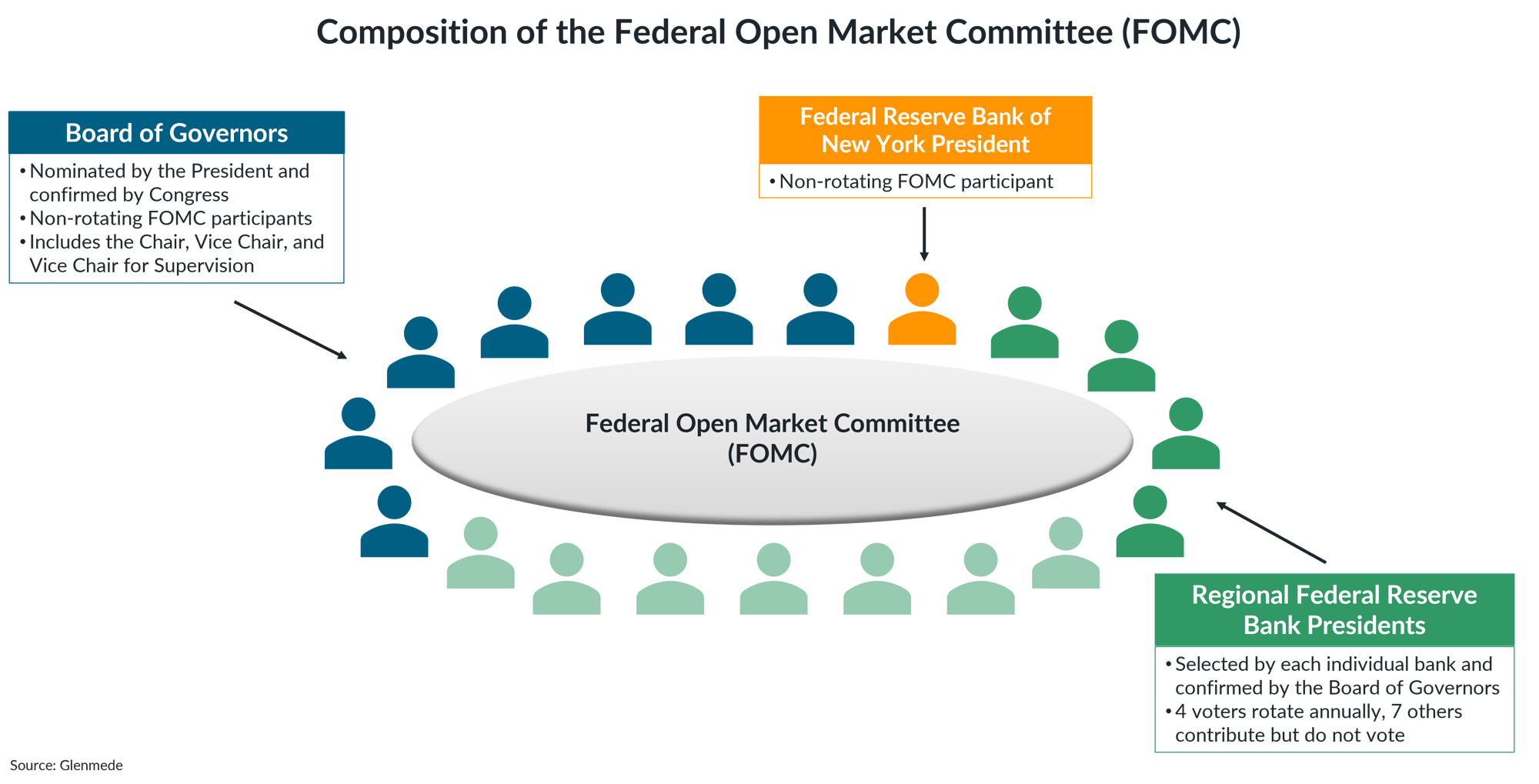
The illustration depicts a general overview of the composition of the FOMC. The visuals shown are for illustrative purposes only.
- The FOMC meets this week for its first session of 2026, with expectations that it will keep rates unchanged.
- This week’s meeting will take place with some new voting members, as four of the regional Presidents rotate in/out.
FOMC voters have shifted slightly more hawkish but may still deliver rate cuts later in 2026
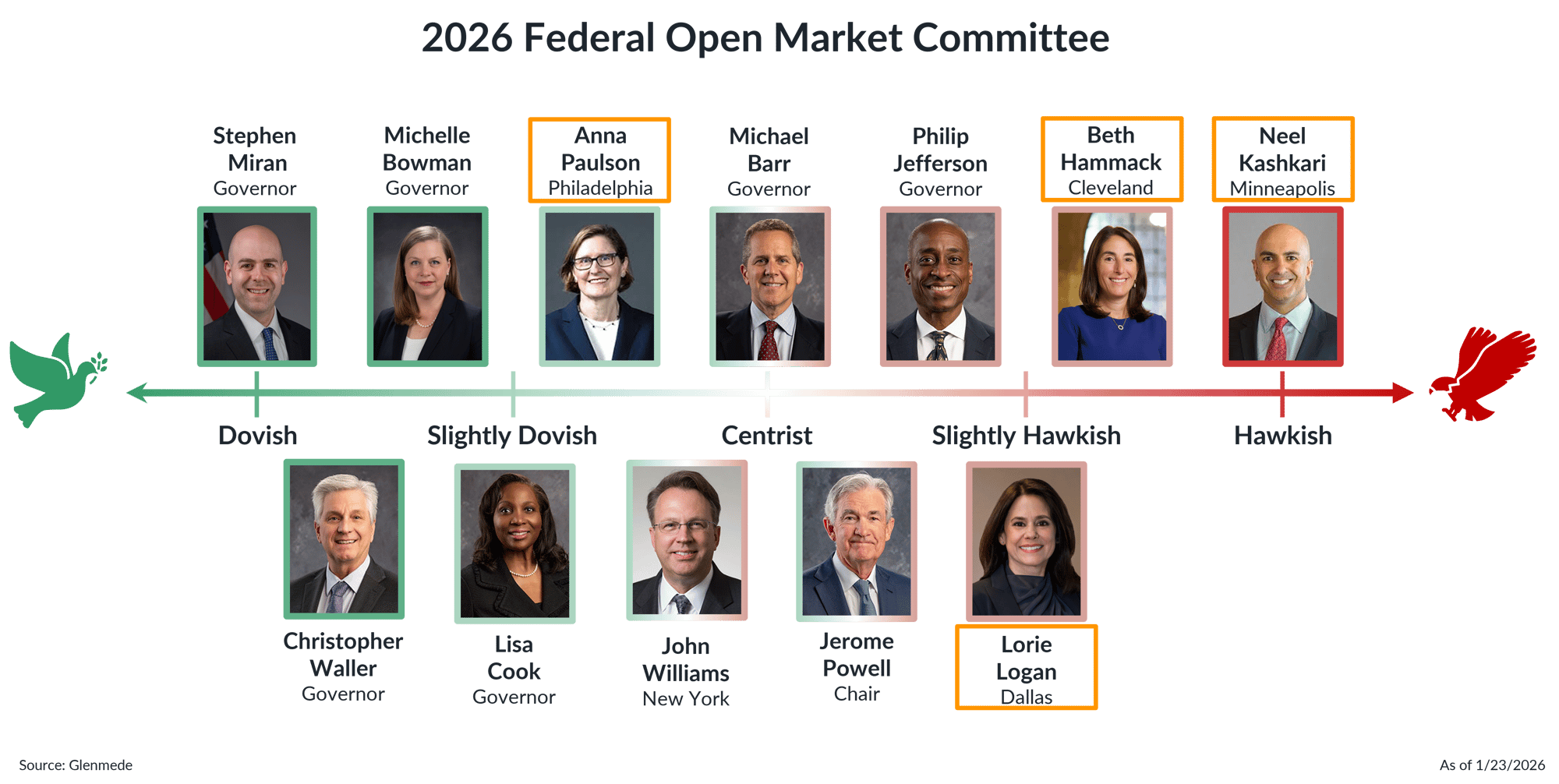
Shown is a general overview of the individuals on the FOMC which includes seven members of the Board of Governors, the President of the New York Federal Reserve Bank and four regional Federal Reserve Bank Presidents on a spectrum of Glenmede’s assessment of their current viewpoints of monetary policy. This visual should not be interpreted as an endorsement of any viewpoint.
- Three of the four new voters on the committee have a stated preference for more hawkish Fed policy, though several of the outgoing voters leaned hawkish as well.
- On net, the composition of the committee may be shifting slightly more hawkish, but rate cuts may still be on the table toward the middle of the year.
- In addition, the Supreme Court heard oral arguments last week in the case involving Lisa Cook, with several justices expressing skepticism toward efforts to remove her from the committee.
The Fed faces a gradually cooling labor market and inflation on the edge of acceptable levels
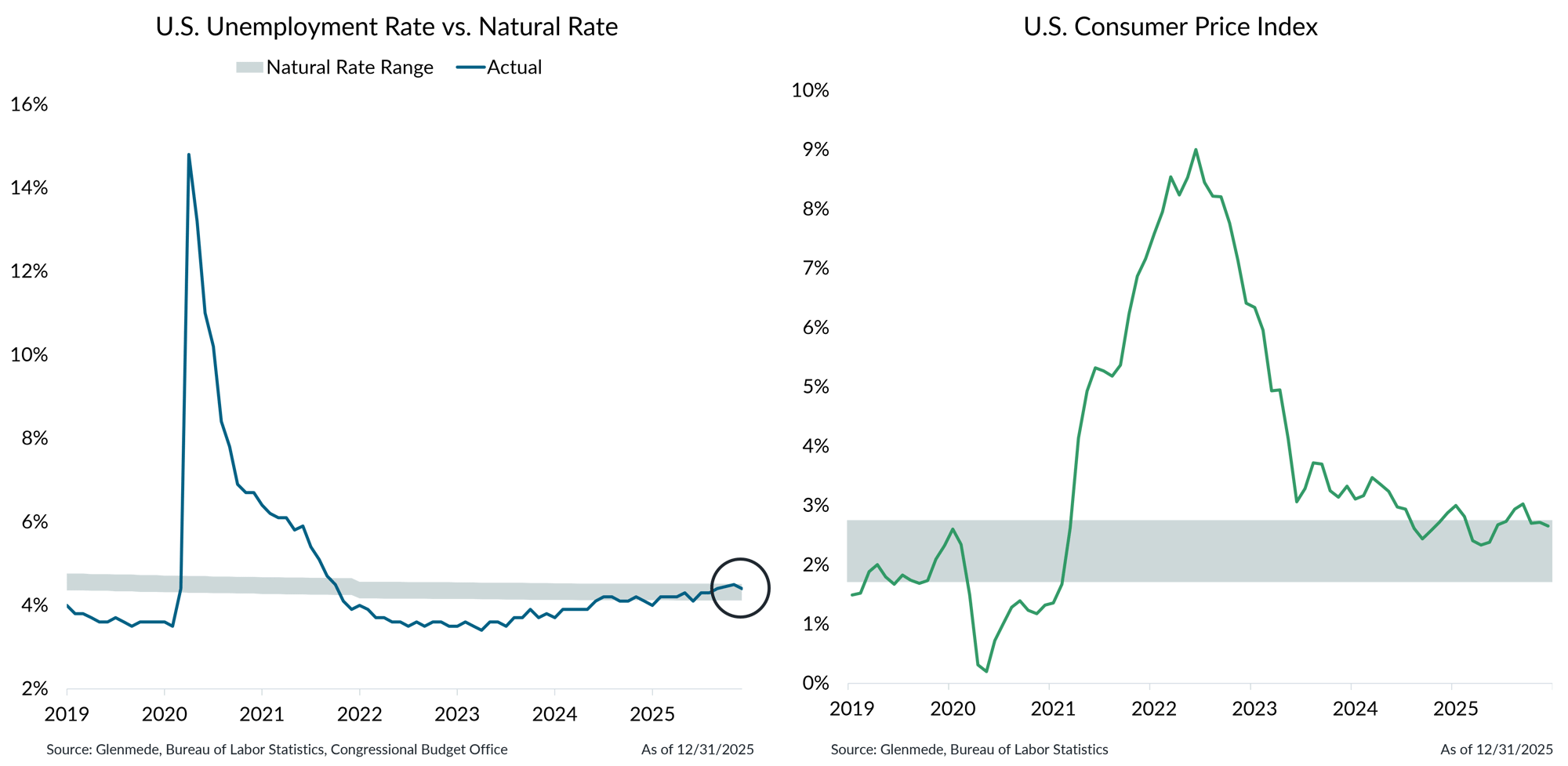
Shown in the left panel is the U.S. unemployment rate for persons aged 16 years and over in blue and a range estimate of the natural rate of unemployment with a Glenmede-defined buffer in gray, which is the baseline level of joblessness that persists in a well-functioning economy due to frictional and structural factors. Shown in the right panel is the year-over-year percent change in the U.S. Consumer Price Index (CPI) in blue and the Fed’s target range consistent with its price stability objective in gray.
- While the unemployment rate has edged higher over the last few years, it still sits firmly within a range consistent with a well-functioning labor market.
- Inflation has moderated from its 2022 peak but sits right on the edge of what the Fed would likely consider to be consistent with its price stability mandate.
- Investors should expect the Fed to be highly attuned to this balance, monitoring incoming data in order to assess which side of its dual mandate requires the greatest attention this year.
Fed rate cuts are expected to be more gradual in 2026, even under a new Chair
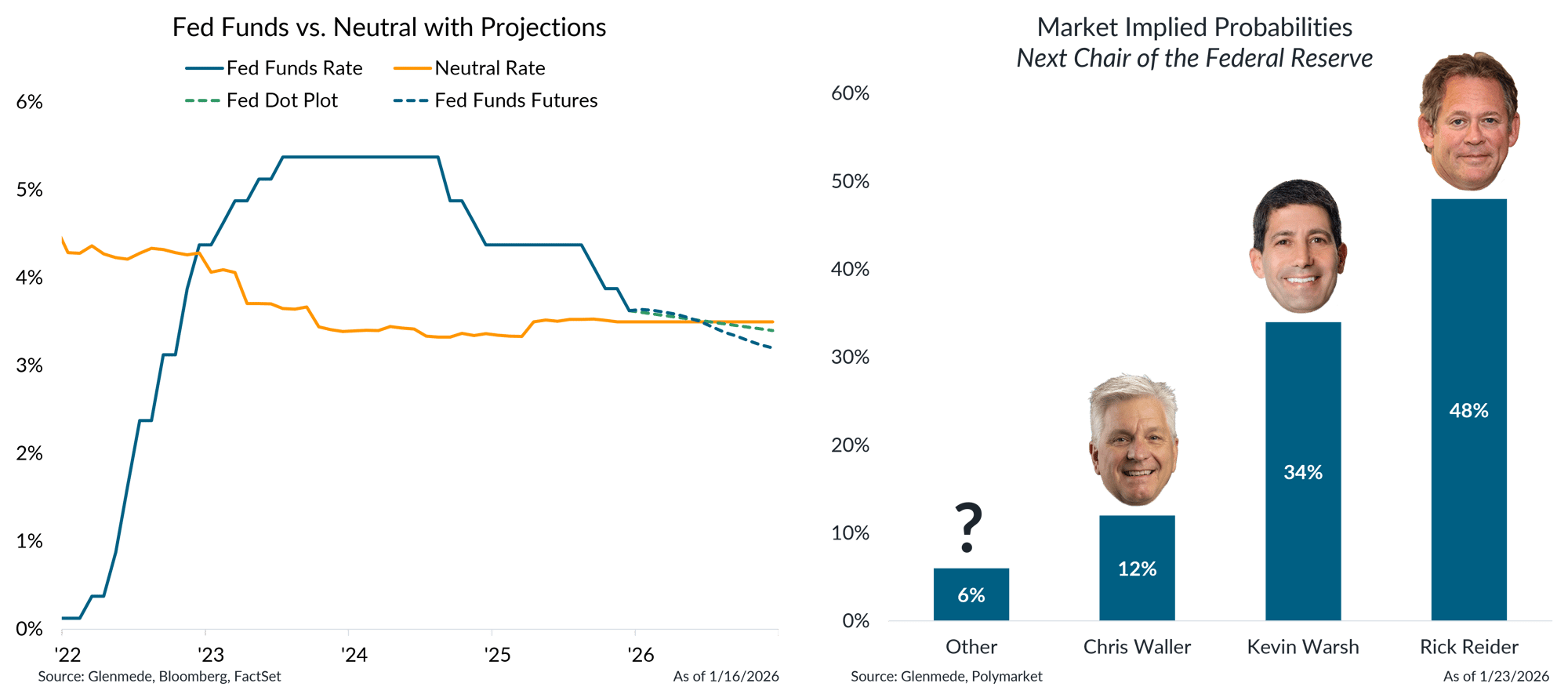
Data shown on the left in orange are Glenmede’s estimates of the neutral federal funds rate over time (i.e., the level of rates that is neither economically stimulative nor restrictive) based on expectations for real interest rates via the Holston-Laubach-Williams model and Glenmede’s inflation expectations. Fed Funds Rate in blue is the target rate midpoint. The dashed blue line represents expectations for the forward path of rates based on fed funds futures pricing. The dashed green line represents expectations for the forward path of rates based on the median respondent in the FOMC’s dot plot projections. Data shown on the right are market-based odds regarding the administration’s nominee for Chair of the Federal Reserve via Polymarket. Polymarket is a prediction market where investors can place bets on various future events. References to Polymarket and use of its data herein in no way should be interpreted as an endorsement or recommendation of Polymarket by Glenmede. Probabilities or likelihoods shown are not the opinions of Glenmede and are shown for illustrative purposes only. Actual results may differ materially from probabilities shown or projections, particularly for prediction markets with low trading volume.
- The Fed is likely to keep rates on hold for the next few meetings as policymakers wait to see how economic conditions evolve before making their next move.
- Further rate cuts would likely occur under a new Fed Chair, with betting markets pointing to Rick Rieder as a leading candidate from a narrowing shortlist.
For more in-depth information on this topic, please reach out to your Glenmede Relationship Manager.

This material is provided solely for informational and/or educational purposes and is not intended as personalized investment advice. When provided to a client, advice is based on the client’s unique circumstances and may differ substantially from any general recommendations, suggestions or other considerations included in this material. Any opinions, recommendations, expectations or projections herein are based on information available at the time of publication and may change thereafter. Information obtained from third-party sources is assumed to be reliable but may not be independently verified, and the accuracy thereof is not guaranteed. Any company, fund or security referenced herein is provided solely for illustrative purposes and should not be construed as a recommendation to buy, hold or sell it. Outcomes (including performance) may differ materially from any expectations and projections noted herein due to various risks and uncertainties. Any reference to risk management or risk control does not imply that risk can be eliminated. All investments have risk. Clients are encouraged to discuss any matter discussed herein with their Glenmede representative.