

Investment Strategy Brief
Gold: When the Insurance Premium is Just Too High
February 8, 2026

Executive Summary
- The price of gold has risen notably over the last two years, followed by considerable volatility this year.
- Gold sits significantly above fair value when measured against both inflation and global money supply.
- Gold has historically experienced significant volatility when its valuation exceeded the 90th percentile.
- Gold is the only asset class projected to potentially deliver negative returns over the next decade.
- Even after the recent pullback in prices, gold is effectively a very expensive insurance premium that is likely not worth the price.
Gold is often regarded as a safe-haven asset
The visual shown is for illustrative purposes only is not an explicit recommendation to buy, hold, or sell any individual asset class or security.
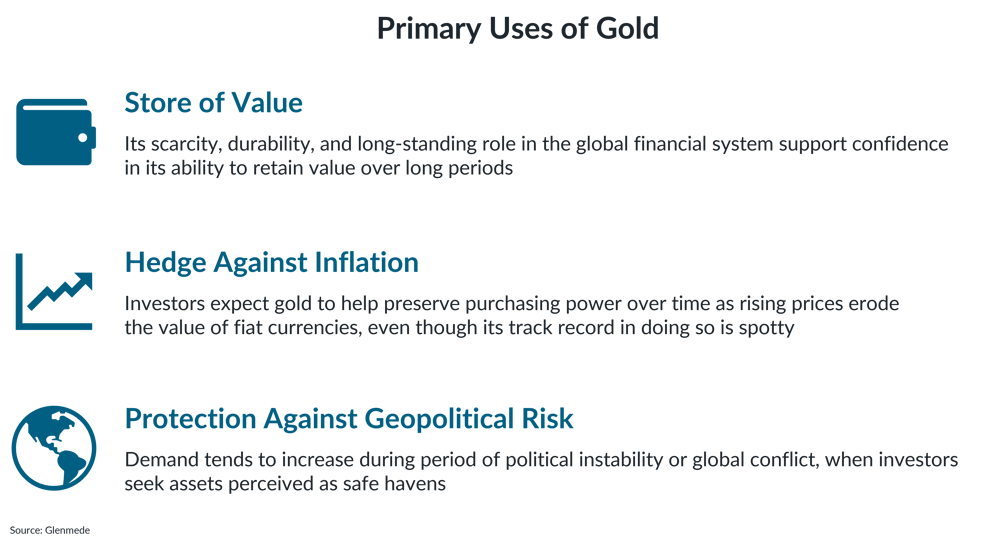
- Investors view gold as a long-term store of value, supported by its scarcity, durability, and established role in the global financial system.
- Gold is also typically viewed as providing portfolio insurance, protecting against both inflation and periods of economic, financial, or geopolitical uncertainty.
The price of gold has risen notably over the last two years, followed by considerable volatility this year
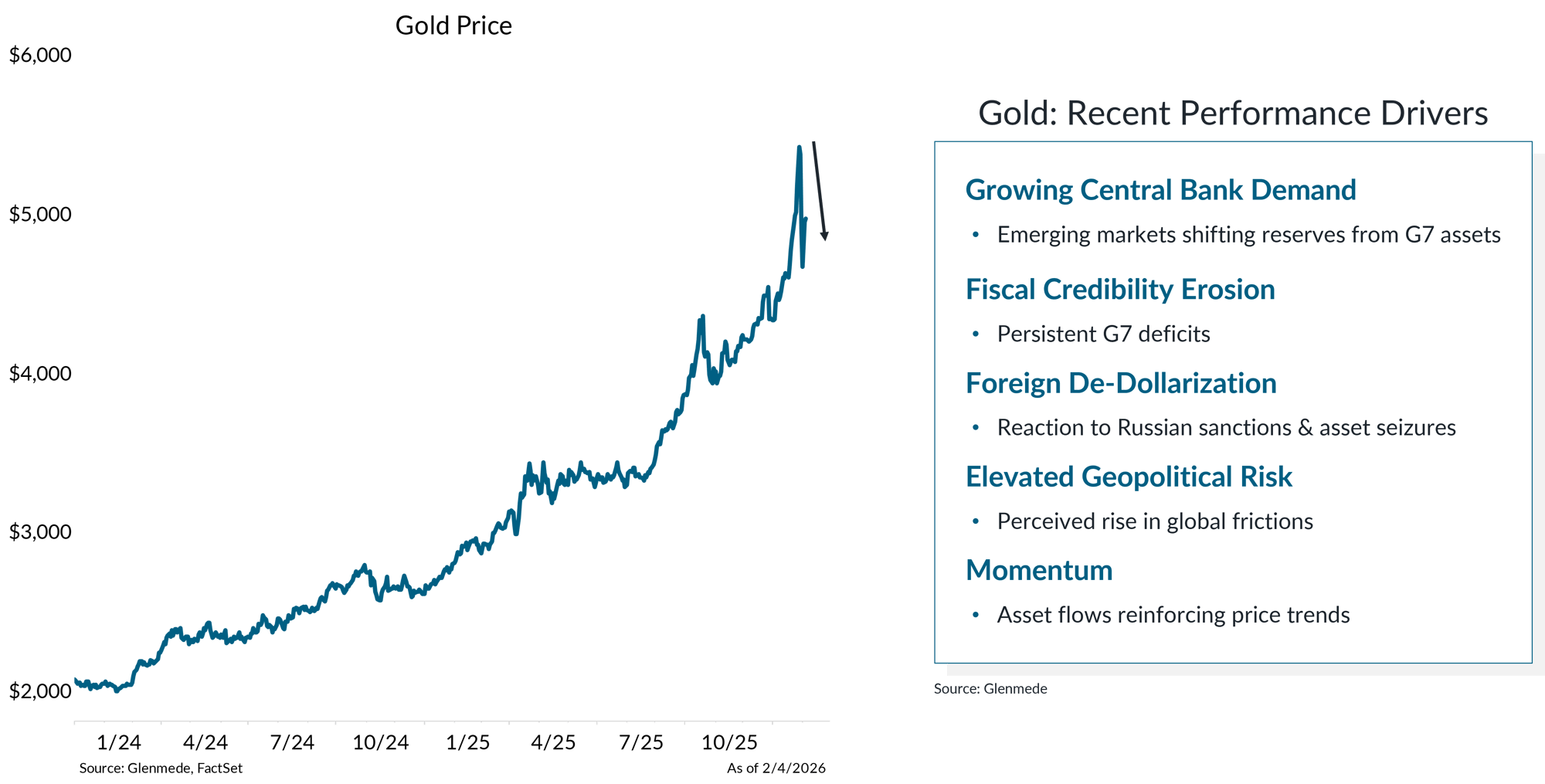
Shown on the left is the spot price of gold, measured in dollars per troy ounce. Past performance may not be indicative of future results.
- Gold has been on a steady upward trajectory over the past two years, reaching a new all-time high last month before experiencing a sharp drawdown.
- Gold’s performance leading up to its peak was driven by growing central bank demand, concerns about persistent fiscal deficits, and foreign de-dollarization.
- Elevated geopolitical risk and momentum driven inflows, supported by expanding access from vehicles like exchange traded funds, have further reinforced investor demand.
Gold sits significantly above fair value when measured against both inflation and the global money supply
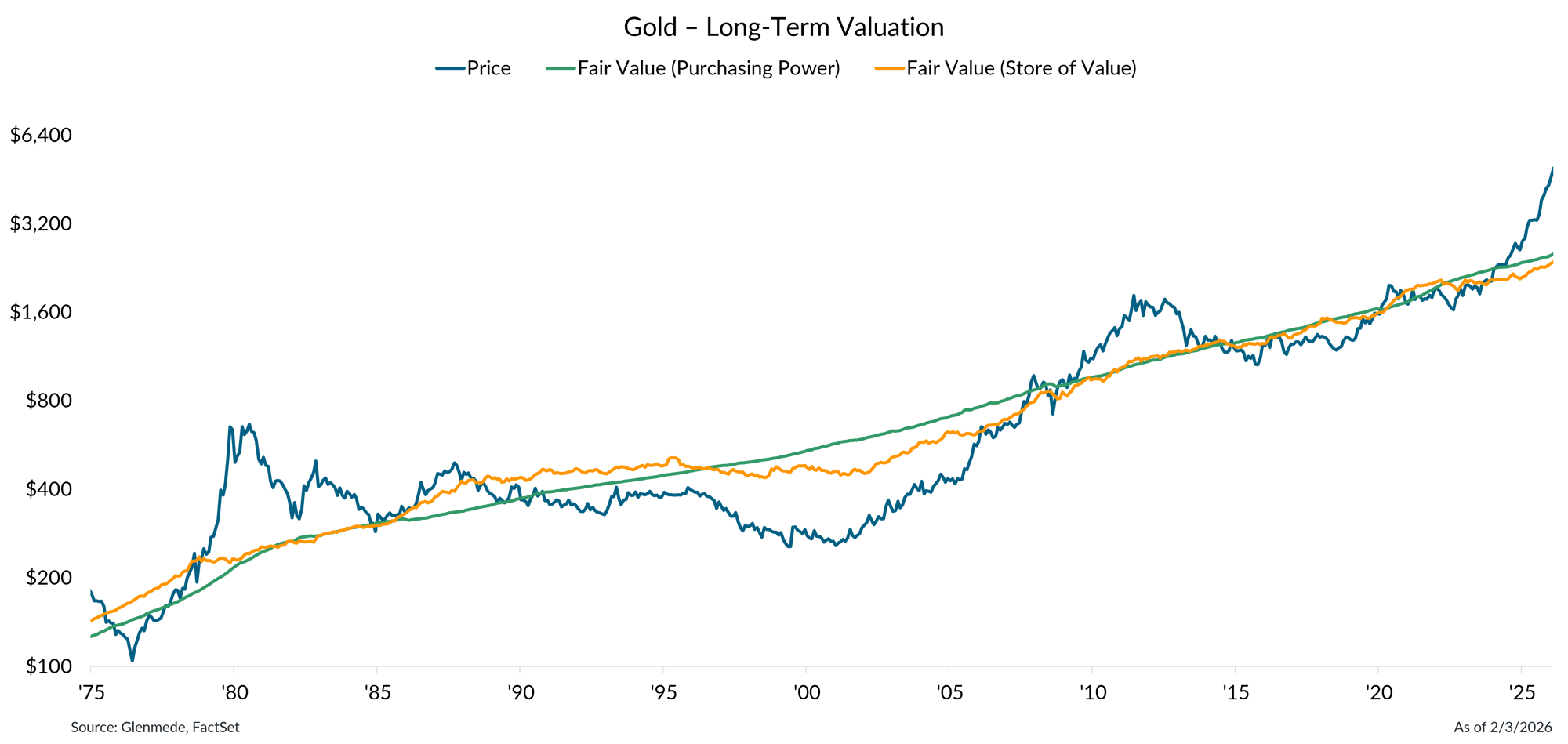
Shown is a comparison between the composite spot price of gold, in blue, measured in dollars per troy ounce, and two estimates of its long-term fair value: 1) the green line reflects gold’s role in preserving purchasing power over time, measured by the relationship between the price of gold and the U.S. Consumer Price Index; 2) the orange line reflects gold’s role as a store of value, measured by the relationship between global monetary supply and the total supply of gold. Fair value estimates are Glenmede’s proprietary estimates consistent with long-term normal returns, which reflect how asset classes are expected to behave over extended periods, absent the influence of short-term valuation fluctuations. Glenmede’s estimates of fair value are arrived at in good faith, but longer-term targets may be uncertain.
- Relative to long-term benchmarks, gold is trading well above estimated fair value when measured against both inflation-adjusted purchasing power and global money supply trends.
- This divergence suggests recent price gains have been driven less by historical valuation anchors and more by elevated demand for gold’s defensive and safe-haven characteristics.
Gold has historically experienced significant volatility when its valuation exceeded the 90th percentile
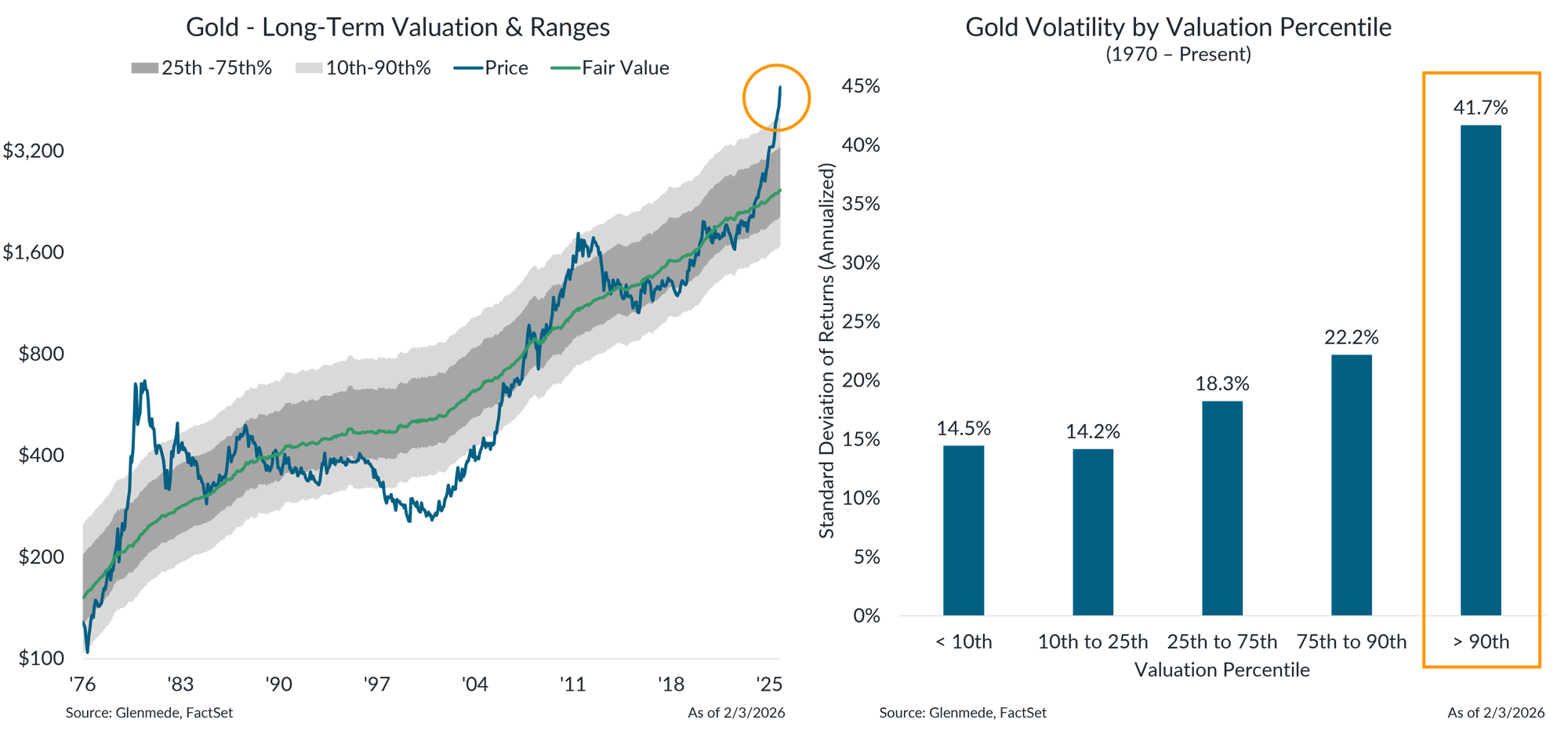
Shown on the left are Glenmede’s estimates of long-term fair value for gold, measured in dollars per troy ounce, which is based on gold’s role in: 1) preserving purchasing power over time, measured by the relationship between the price of gold and the U.S. Consumer Price Index; 2) gold’s role as a store of value, measured by the relationship between global monetary supply and the total supply of gold. Fair value estimates are Glenmede’s proprietary estimates consistent with long-term normal returns, which reflect how asset classes are expected to behave over extended periods, absent the influence of short-term valuation fluctuations. Glenmede’s estimates of fair value are arrived at in good faith, but longer-term targets may be uncertain. Shown on the right are the historical annualized standard deviations of returns for gold, when valuations sit in various valuation percentile ranges. Past performance may not be indicative of future results.
- Glenmede’s proprietary valuation framework, which accounts for both purchasing power and global money supply, suggests that gold now sits at the 98th percentile of longer-term fair value.
- Historically elevated valuations have come hand-in-hand with increased volatility, with gold exhibiting materially higher downside and price instability when trading at or above the 90th percentile of historical valuations.
Gold is the only asset class projected to potentially delivery negative returns over the next decade
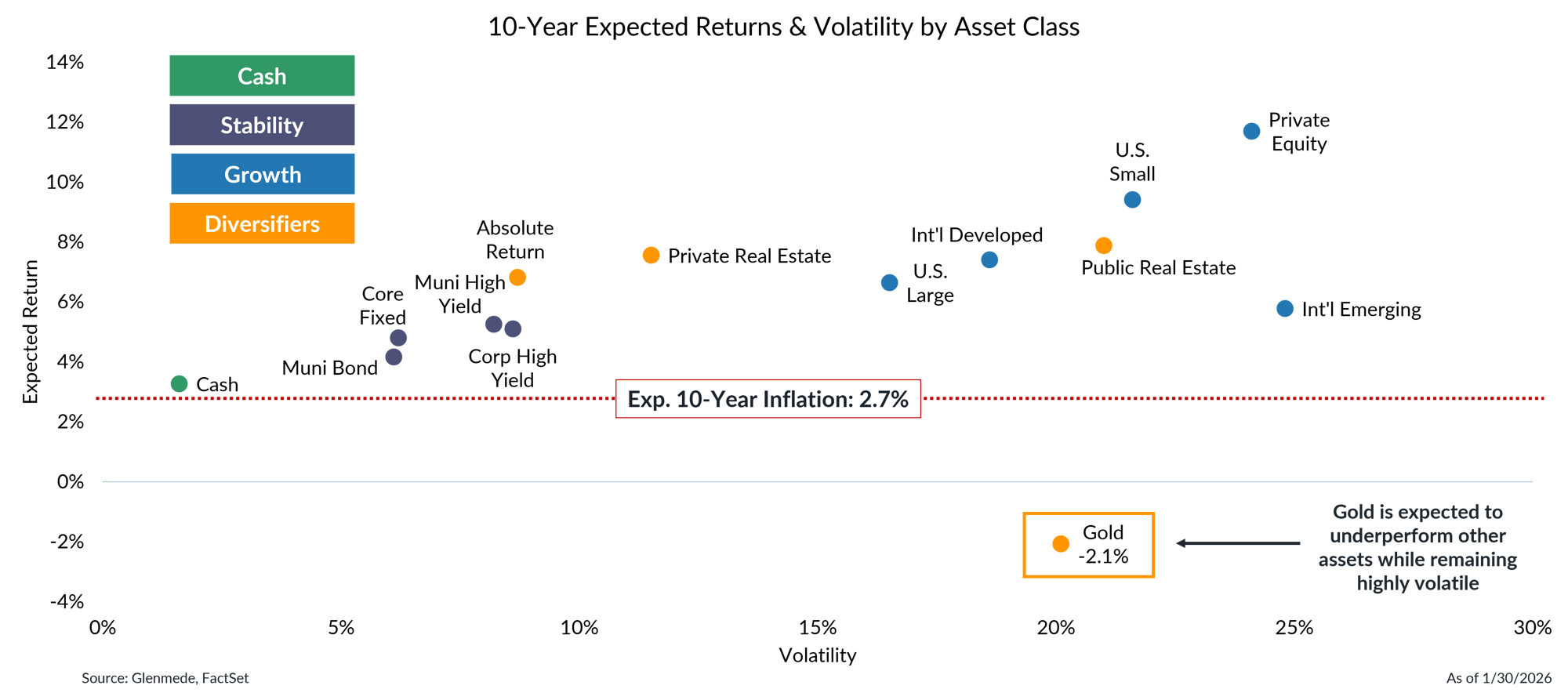
Data shown represent 10-year expected returns and volatility (standard deviation of annual returns) for several asset classes. Proxy indices for each asset class are as follows: Cash (Bloomberg Treasury Bellwethers 3M), Muni Bond (Bloomberg Municipal Bond), Core Fixed (Bloomberg U.S. Aggregate), Muni High Yield (Bloomberg Muni High Yield 2% Issuer Cap), Corp High Yield (Bloomberg U.S. Aggregate Credit Corporate High Yield BB), U.S. Large (MSCI USA), Int'l Developed (MSCI EAFE), U.S. Small (Russell 2000), Int’l Emerging (MSCI EM), Public Real Estate (FTSE/EPRA NAREIT Developed), Private Real Estate (NCREIF Open End Diversified Core Equity), Absolute Return (HFRI Fund of Funds Composite), Gold (Gold Composite Spot ($/ozt)). Expected returns for Private Equity are derived by applying a liquidity premium on top of expected returns for U.S. Small. These figures are projections which, though arrived at in good faith, are not guaranteed. Actual returns may differ materially from projections. One cannot invest directly in an index.
- Over a 10-year horizon, gold is the only major asset class with a negative expected return, despite exhibiting volatility comparable to or higher than many growth-oriented assets.
- This combination of low expected returns and elevated volatility suggests gold is likely to underperform other asset classes over the next decade on a risk-adjusted basis.
- In a more normal environment, gold can play a useful role in portfolios as an insurance premium, but the cost of that protection appears quite elevated at this time.
For more in-depth information on this topic, please reach out to your Glenmede Relationship Manager.

This material is provided solely for informational and/or educational purposes and is not intended as personalized investment advice. When provided to a client, advice is based on the client’s unique circumstances and may differ substantially from any general recommendations, suggestions or other considerations included in this material. Any opinions, recommendations, expectations or projections herein are based on information available at the time of publication and may change thereafter. Information obtained from third-party sources is assumed to be reliable but may not be independently verified, and the accuracy thereof is not guaranteed. Any company, fund or security referenced herein is provided solely for illustrative purposes and should not be construed as a recommendation to buy, hold or sell it. Outcomes (including performance) may differ materially from any expectations and projections noted herein due to various risks and uncertainties. Any reference to risk management or risk control does not imply that risk can be eliminated. All investments have risk. Clients are encouraged to discuss any matter discussed herein with their Glenmede representative.