

Investment Strategy Brief
Growth on the Horizon, Risks on the Radar
December 28, 2025

Executive Summary
- A host of key drivers should, in combination, lead to an acceleration of the U.S. economy in 2026.
- Key risks to monitor include inflation upside, artificial intelligence (AI) capex overextension, and weakening credit discipline in debt markets.
- Equities have recovered, but valuations for most assets remain relatively reasonable.
- Most fixed income yields are higher than recent history and in the vicinity of fair value levels.
- While economic growth should accelerate in 2026, lurking risks and disparate valuations justify active rebalancing and diversification.
A host of key drivers should, in combination, lead to an acceleration of the U.S. economy in 2026
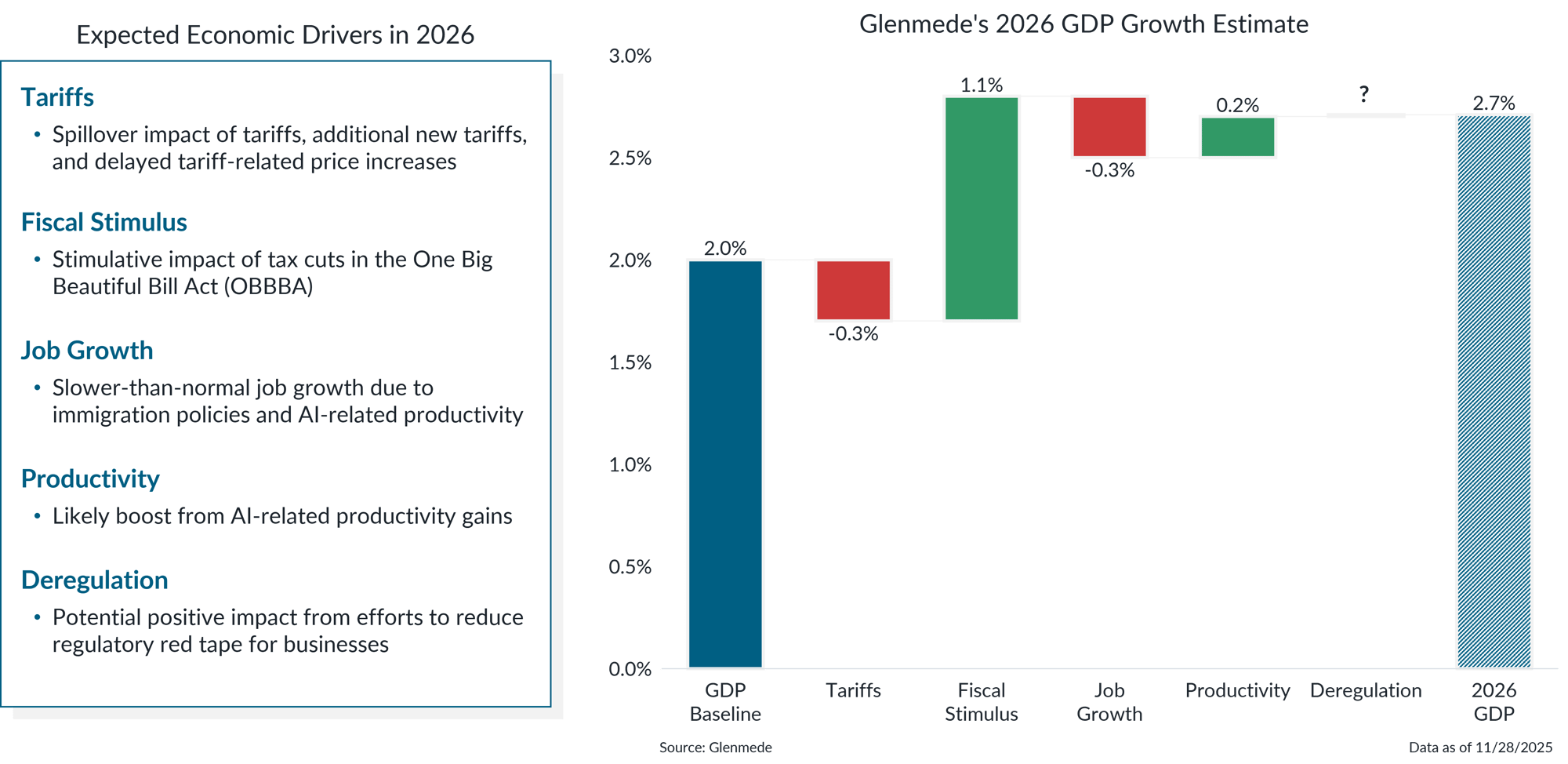
Shown on the left is a brief breakdown of major expected economic drivers in 2026. Shown on the right are the drivers and their estimated impact on U.S. real gross domestic product (GDP) growth. GDP Baseline is an assumed long-term growth rate for the U.S. economy that is consistent with estimates used by both the Congressional Budget Office (CBO) and the Federal Reserve. Though created in good faith, there can be no guarantee that these indicators will be accurate. Actual results may differ materially from projections.
- Government policy will likely remain a key driver in 2026, with tariffs posing a headwind to growth but more than offset by fiscal stimulus from the One Big Beautiful Bill Act (OBBBA).
- Labor markets may continue to soften, while AI-related productivity gains and deregulation could offer incremental tailwinds.
Top Risks to Monitor in 2026
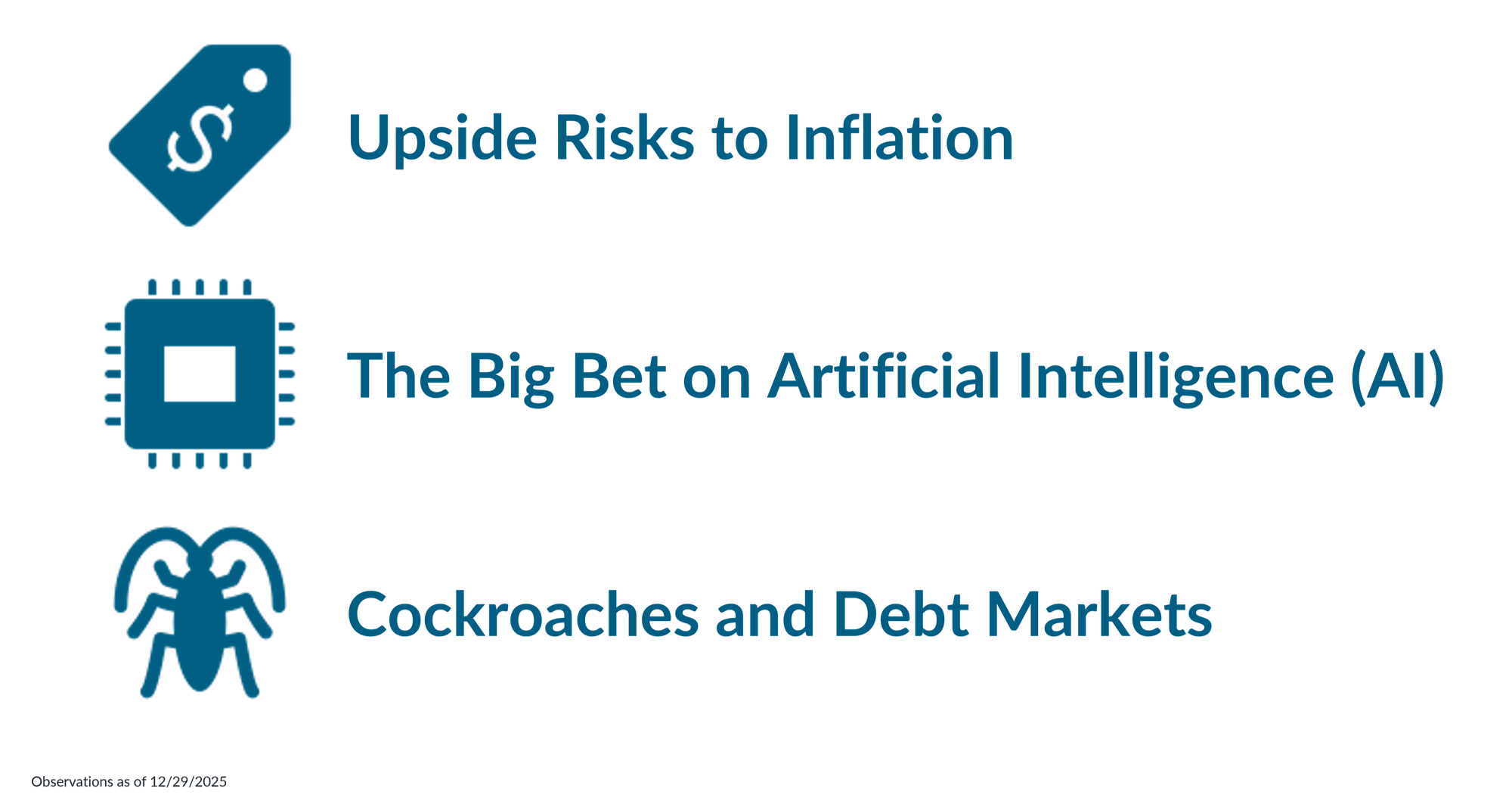
These statements reflect Glenmede’s opinions or projections, which may change after the date of publication. Actual future developments may differ materially from the opinions and projections noted above.
- The interplay between higher tariffs and unprecedented late-cycle fiscal stimulus runs the risk of rekindling inflation.
- Massive investments in datacenters show the hallmarks of prior buildouts that ultimately misjudged demand.
- Stress in auto lending may be the first “cockroach” warranting vigilance, particularly around private credit and special purpose vehicles (SPV)-financing.
Equities have recovered, but valuations for most assets remain relatively reasonable
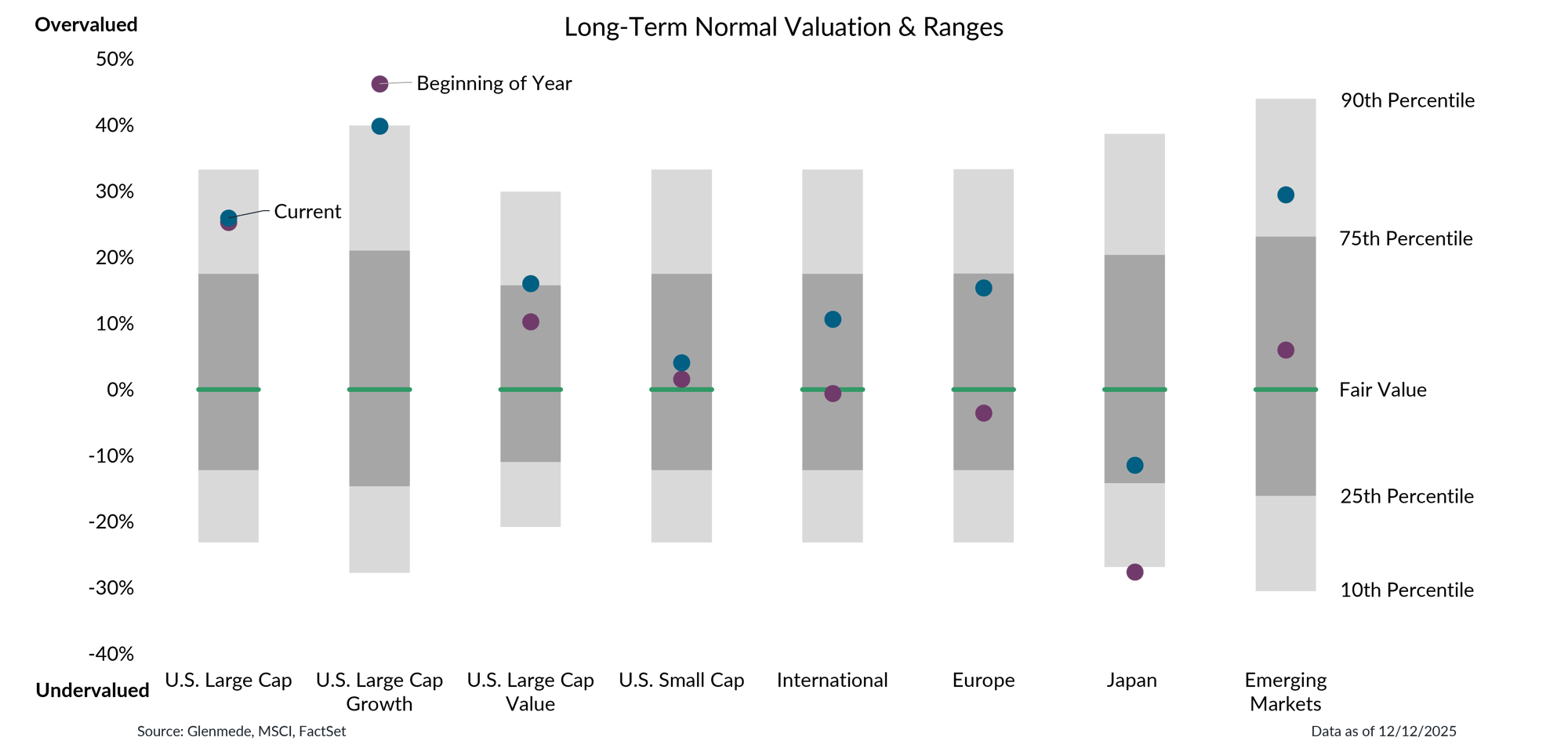
Data shown are Glenmede’s estimates of long-term fair value for U.S. Large Cap (MSCI USA), U.S. Large Cap Growth (MSCI USA Growth), U.S. Large Cap Value (MSCI USA Value), U.S. Small Cap(MSCI USA Small), International (MSCI All Country World ex-U.S.), Europe (MSCI Europe), Japan (MSCI Japan), and Emerging Markets (MSCI EM) based on normalized earnings, normalized cashflows, dividend yield, and book value for each index. Blue dots represent current valuation levels and purple dots represent valuation levels at the beginning of 2025. Glenmede’s estimates of fair value are arrived at in good faith, but longer-term targets for valuation may be uncertain. One cannot invest directly in an index.
- Large cap stocks are trading near the 85th percentile of longer-term fair value. However, those premium valuations are being driven by 90th percentile valuations on growth equities.
- In contrast, small caps are currently priced closer to long-term fair value, offering a more favorable risk-reward profile than their large cap counterparts.
Most fixed income yields are higher than recent history and in the vicinity of fair value levels
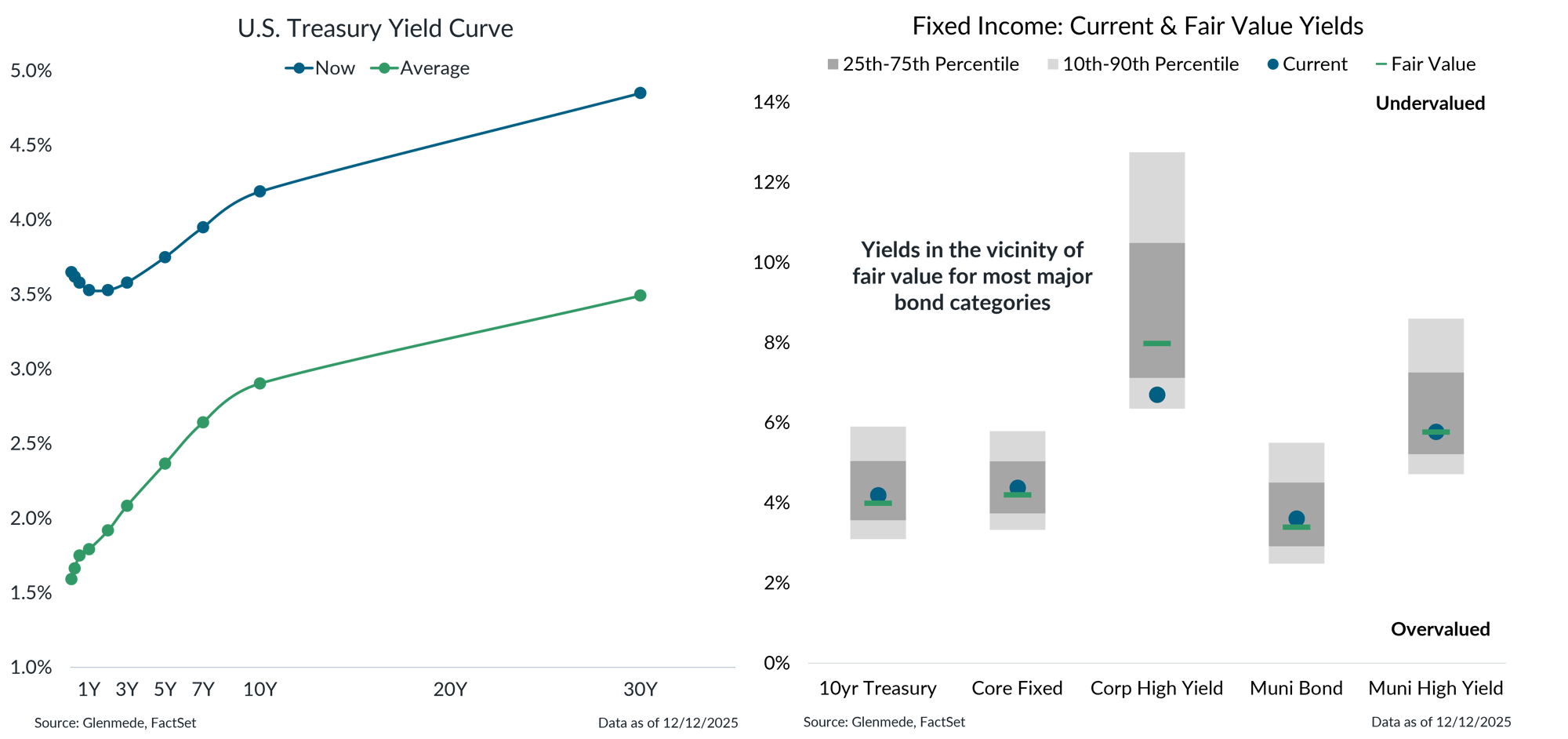
Shown on the left is a snapshot of the U.S. Treasury yield curve in blue and the average of each maturity’s yields over the past 20 years in green. Shown on the right are Glenmede’s estimates of long-term fair value for taxable and tax-exempt debt securities. Proxy indices for each asset class are as follows: Core Fixed (Bloomberg U.S. Aggregate), Corp High Yield (Bloomberg U.S. Aggregate Credit Corporate High Yield BB), Muni Bond (Bloomberg Municipal Bond), Muni High Yield (Bloomberg Municipal High Yield). Glenmede’s estimates of fair value are arrived at in good faith, but longer-term targets for valuation may be uncertain. One cannot invest directly in an index.
- Fixed income yields are generally higher across the board, offering attractive options for investors compared with historical norms.
- Yields across major fixed income categories remain near fair value, though corporate high yield bond spreads remain tight.
A diversified portfolio should continue to reduce risks and enhance potential returns

The chart on the left is provided solely for illustrative purposes to depict a hypothetical portfolio diversified across various asset classes and should not be construed as a recommendation to invest in any particular asset class or combination of asset classes. Investors should consult with their advisor to determine an appropriate asset allocation for their particular circumstances. Data shown on the right reflect Glenmede’s proprietary capital market assumptions for the next 10 years for U.S. Large Cap (represented by the S&P 500) and a Diversified Portfolio (represented by Glenmede’s All Asset+ Growth with Income model portfolio). Expected risk reflects the standard deviation of Glenmede’s expected asset class returns. Actual results may differ materially from expectations.
- A well-diversified portfolio may be well-positioned to outperform the S&P 500 with notably less risk over the next 10 years.
- Heading into 2026, investors should maintain a neutral risk stance while staying alert for opportunities for thoughtful rebalancing and diversification.
Upcoming Webinar:
Strategy for a Year of Opportunity, Risks, and Altered Tax Policy
Thoughtful preparation can help you navigate a year defined by opportunity, growing risks, and meaningful shifts in tax law. Join Jason D. Pride, CFA, Chief of Investment Strategy & Research, and Mark R. Parthemer, JD, AEP, ACTEC Fellow, Chief Wealth Strategist, as they explore the following:
- Economic growth and evolving risks
- The impact of tax law changes
- How to position portfolios and support effective tax planning
Wednesday, January 7, 2026
11:00 AM ET

For more in-depth information on this topic, please reach out to your Glenmede Relationship Manager.

This material is provided solely for informational and/or educational purposes and is not intended as personalized investment advice. When provided to a client, advice is based on the client’s unique circumstances and may differ substantially from any general recommendations, suggestions or other considerations included in this material. Any opinions, recommendations, expectations or projections herein are based on information available at the time of publication and may change thereafter. Information obtained from third-party sources is assumed to be reliable but may not be independently verified, and the accuracy thereof is not guaranteed. Any company, fund or security referenced herein is provided solely for illustrative purposes and should not be construed as a recommendation to buy, hold or sell it. Outcomes (including performance) may differ materially from any expectations and projections noted herein due to various risks and uncertainties. Any reference to risk management or risk control does not imply that risk can be eliminated. All investments have risk. Clients are encouraged to discuss any matter discussed herein with their Glenmede representative.