

Investment Strategy Brief | May 3 , 2026
Land of the (Still) Rising Sun

Executive Summary
-
Corporate governance reforms have driven Japanese equities to new highs after a prolonged period of stagnation.
-
Improved capital efficiency and stronger earnings growth continue to make steady improvement relative to developed market peers.
-
Japan’s earnings have grown at a faster pace than their European counterparts through this period of reform.
-
Valuations still sit below fair value, offering a compelling expected return outlook over the next decade.
-
Ongoing reforms and improving fundamentals position Japanese equities as an attractive relative opportunity within portfolios.
Japanese equities are consistently reaching new highs after a prolonged period of stagnation
-
Japanese equities experienced decades of stagnation following the collapse of the asset price bubble in 1989, weighed down by deflation, suboptimal corporate governance practices, and inefficient capital allocation.
-
A key policy initiative of Prime Minister Shinzo Abe kicked off a wave of corporate governance reforms beginning in 2013, which have progressively shifted from building foundational standards to enforcing measurable outcomes.
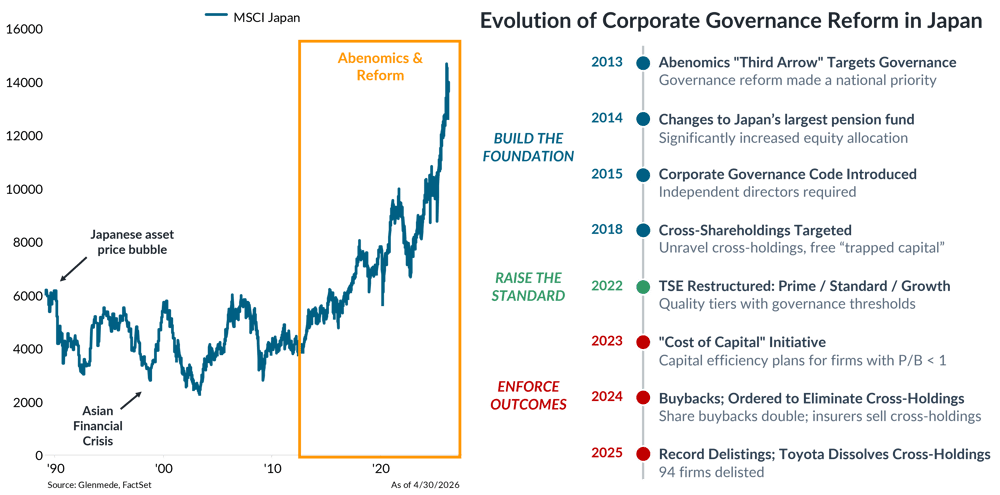
Shown on the left is the MSCI Japan Index, which tracks the total return of large and mid cap equities in Japan, in U.S. dollar terms. Shown on the right is a non-exhaustive summary of the evolution of corporate governance reforms in Japan. TSE stands for Tokyo Stock Exchange. P/B refers to price-to-book ratio. Past performance may not be indicative of future results. One cannot invest directly in an index.
Corporate governance reforms have improved capital efficiency and strengthened board independence
-
Board independence, which is standard practice among U.S. firms, has improved dramatically, with 98% of prime market companies in Japan now meeting a one-third independence threshold, up from just 6% in 2014.
-
Fewer firms have majority independent boards, indicating there is still room for further progress.
- Shareholder distributions have surged, with dividends and buybacks both reaching record highs in 2024, reflecting a growing commitment to returning capital to investors.
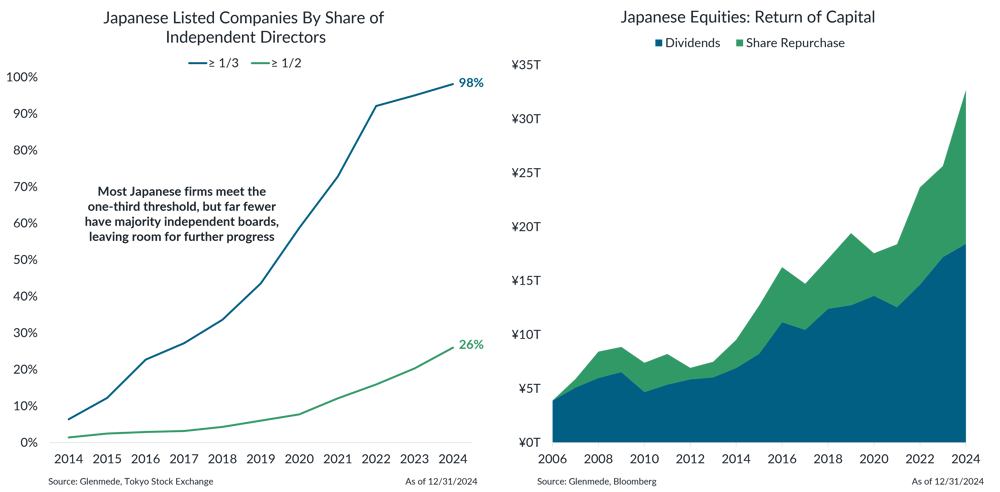
Shown on the left is the percentage of companies in the Prime Market, the Tokyo’s Stock Exchange’s segment for large, liquid firms with higher governance standards, with at least one-third independent directors in blue and a majority of independent directors in green. Shown on the right are dividends and share buybacks for Japanese companies in the TOPIX index, which tracks a broad universe of listed companies on the Tokyo Stock Exchange, measured in Japanese yen. Figures represent total shareholder distributions in Japanese yen.
The improving profitability of Japanese equities is driving a shift away from persistent valuation discounts
-
Japan's return on assets has nearly doubled since 2013, reflecting meaningful profitability gains driven by governance reforms and improved capital allocation.
-
A price-to-book ratio around or below 1 signals that investors think a company is not using its assets effectively or acting in shareholders’ best interests, often reflecting weak governance and poor capital allocation.
- Pre-Abenomics, Japanese equities more consistently sat near (or sometimes below) that key threshold but have since improved materially.
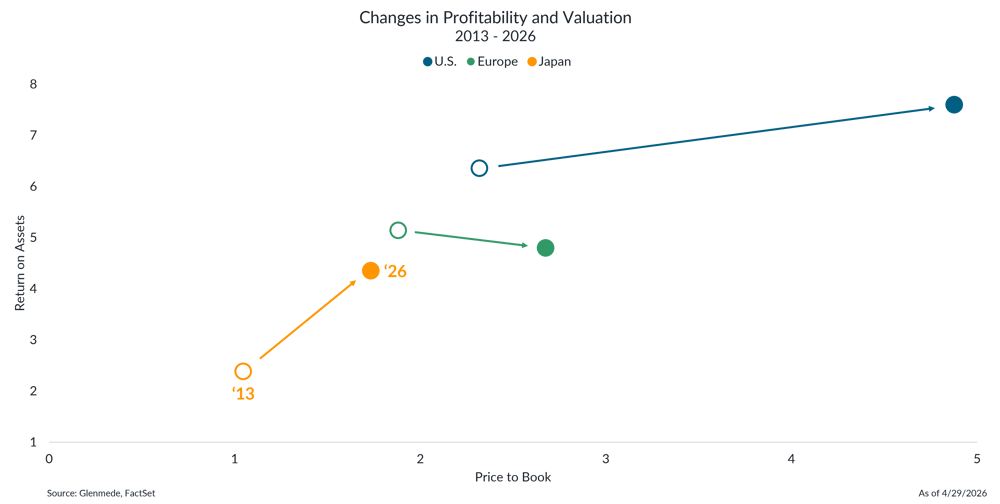
Data shown are profitability and valuation metrics for the MSCI USA, MSCI Japan, and MSCI Europe indices, with equal sector weights (excluding financials and real estate). Hollow dots represent values as of 2013 and solid dots represent values as of the latest date shown. Each dot is graphed along the x-axis according to price-to-book ratio and along the y-axis according to return on assets. Arrows indicate the direction of change from 2013 to 2026. Past performance may not be indicative of future results. One cannot invest directly in an index.
Japan’s earnings have grown at a faster pace than their European counterparts through this period of reform
-
Japan's next twelve months earnings estimates have outpaced Europe throughout this period, supported by both underlying profitability improvements and a narrowing competitiveness gap.
-
Sustained earnings momentum suggests governance-driven improvements are translating into stronger bottom-line results, not just balance sheet cleanup.
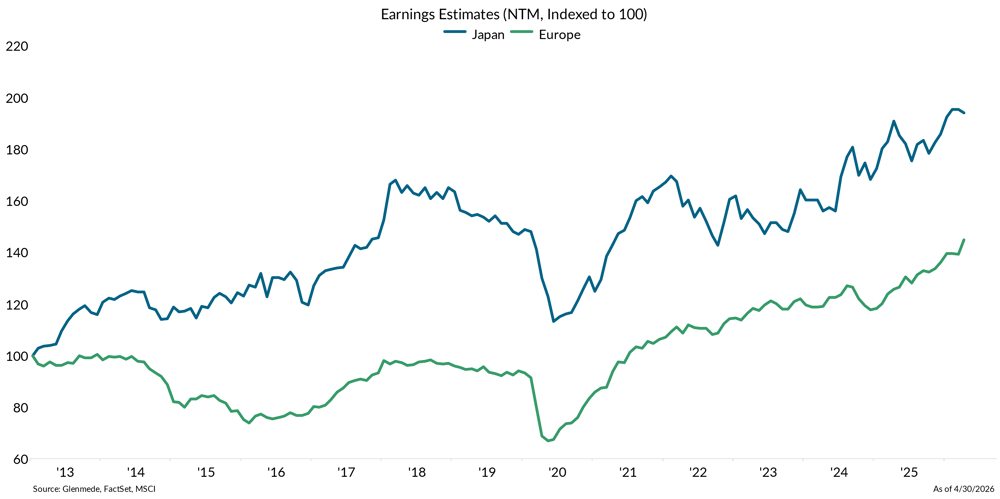
Shown are next twelve months earnings estimates for the MSCI Japan and MSCI Europe indices in U.S. dollar terms. Values are indexed to 100 on the first date shown. Past performance may not be indicative of future results. One cannot invest directly in an index.
Japan offers a compelling expected return outlook over the next decade
-
Japan offers the most compelling expected return outlook supported by strong expected earnings growth and a currency tailwind.
-
Ongoing reforms and improving fundamentals position Japanese equities as an attractive relative opportunity within portfolios.
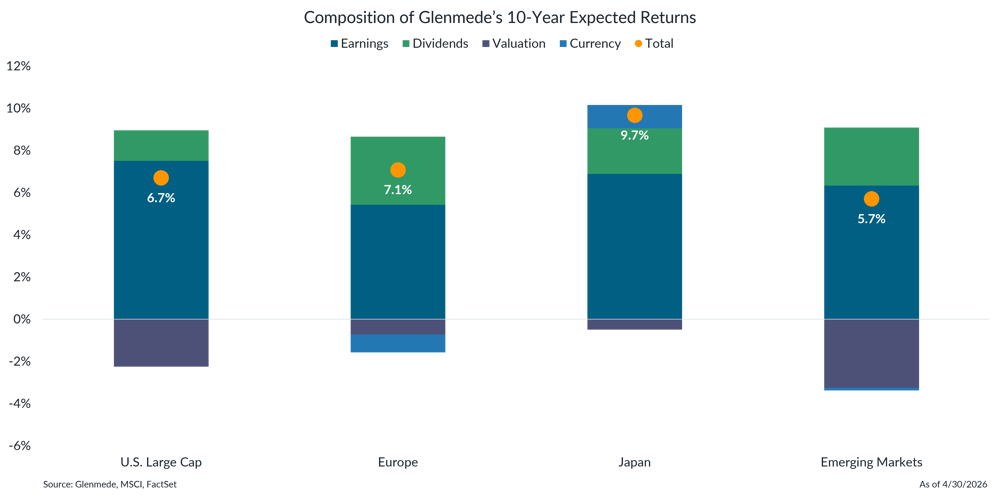
Data shown are Glenmede’s 10-year expected returns and their composition, including earnings, dividends, valuation, currency, and total expected return, for U.S. Large Cap (MSCI USA), Europe (MSCI Europe), Japan (MSCI Japan), and Emerging Markets (MSCI EM). Glenmede’s estimates for expected returns are arrived at in good faith, but longer-term returns may be uncertain. Actual results may differ materially from expectations. One cannot invest directly in an index.
For more in-depth information on this topic, please reach out to your Glenmede Relationship Manager.

This material is provided solely for informational and/or educational purposes and is not intended as personalized investment advice. When provided to a client, advice is based on the client’s unique circumstances and may differ substantially from any general recommendations, suggestions or other considerations included in this material. Any opinions, recommendations, expectations or projections herein are based on information available at the time of publication and may change thereafter. Information obtained from third-party sources is assumed to be reliable but may not be independently verified, and the accuracy thereof is not guaranteed. Any company, fund or security referenced herein is provided solely for illustrative purposes and should not be construed as a recommendation to buy, hold or sell it. Outcomes (including performance) may differ materially from any expectations and projections noted herein due to various risks and uncertainties. Any reference to risk management or risk control does not imply that risk can be eliminated. All investments have risk. Clients are encouraged to discuss any matter discussed herein with their Glenmede representative.