

Investment Strategy Brief | March 15, 2026
Mapping Risks from Middle East Tensions

Executive Summary
- Prediction markets are pricing an uncertain timeline to the end of the conflict in Iran.
- Shipping disruptions appear to be mostly contained to the Strait of Hormuz and its energy-heavy traffic.
- Oil market volatility has pushed inflation expectations higher, though the ultimate impact remains uncertain.
- Energy prices are likely to remain volatile but are currently at levels that are unlikely to lead to recession.
- Investors should not expect a lasting market impact but continue to monitor conditions that could lead to more material economic effects.
Predictions markets are pricing an uncertain timeline to the end of the conflict in Iran
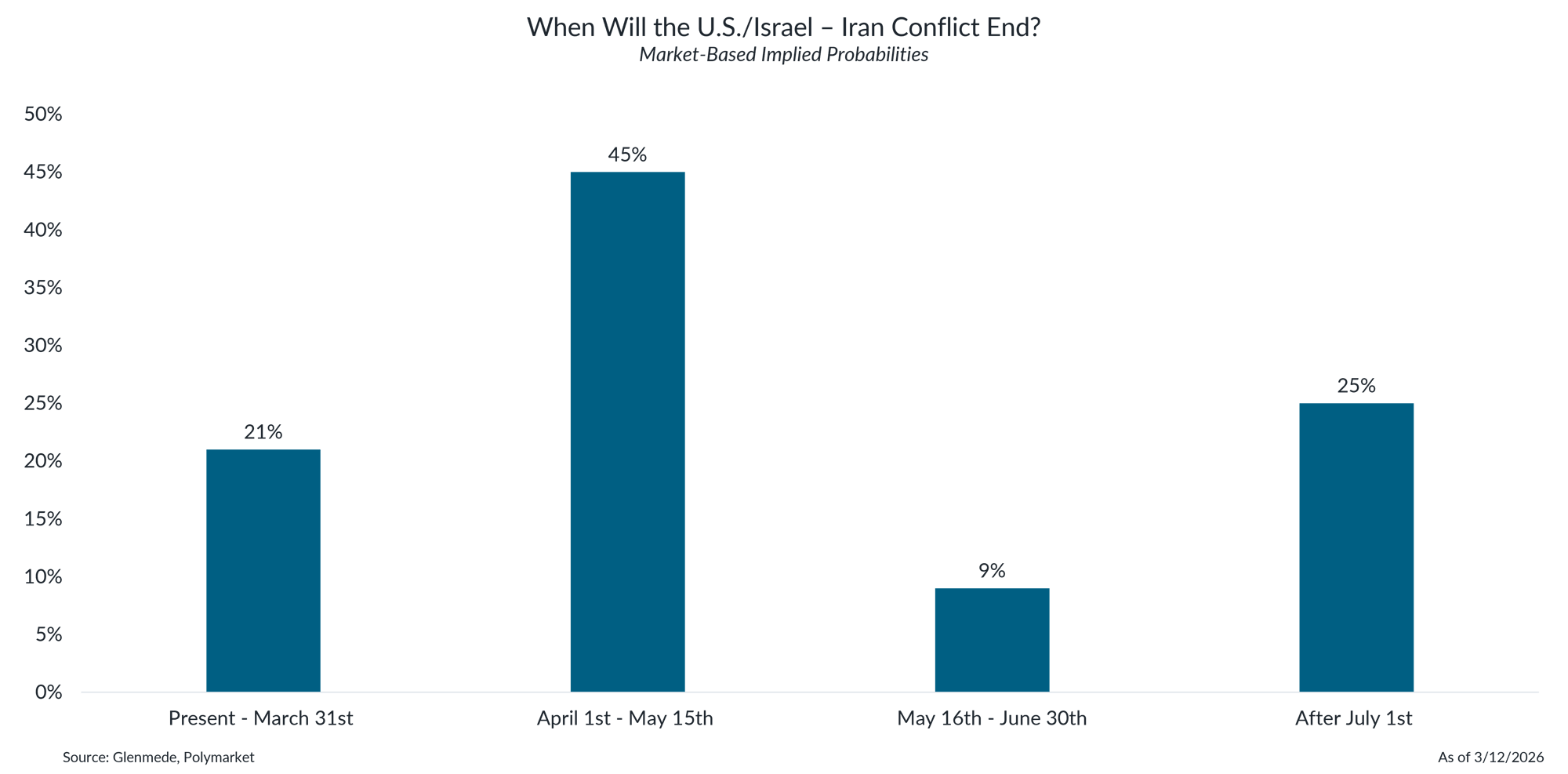
Shown are market-based odds of when the U.S./Israel and Iran conflict will end via Polymarket. Polymarket is a prediction market where investors can place bets on various future events. References to Polymarket and use of its data herein should in no way be interpreted as an endorsement or recommendation of Polymarket by Glenmede. Probabilities or likelihoods shown are not the opinions of Glenmede and are shown for illustrative purposes only. Actual results my differ materially from probabilities shown, particularly for prediction markets with low trading volume.
- Two weeks into the conflict in Iran, markets continue to exhibit notable sensitivity to the economic impacts from volatile energy markets and supply chain disruptions.
- Market-implied probabilities suggest considerable uncertainty regarding when the U.S./Israel - Iran conflict will end, but a tenuous consensus appears to point to a mid-May resolution.
Shipping disruptions appear to be mostly contained to the Strait of Hormuz and its energy-heavy traffic
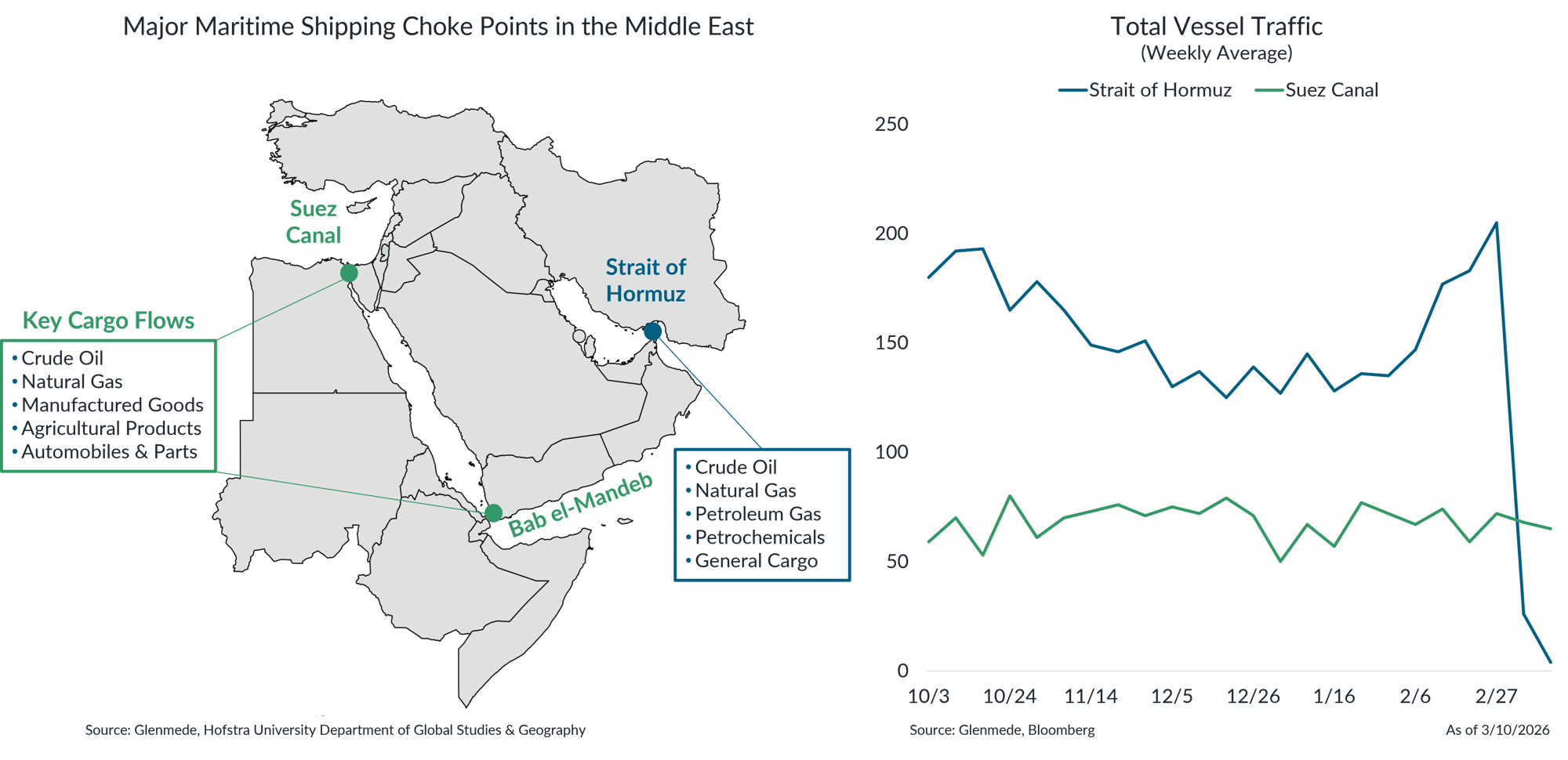
Shown on the left is a map of the Middle East and parts of Africa with blue dot representing major maritime shipping choke points in the region. Manufactured goods includes items like electronics, textiles, appliances, and other similar goods. Data on the right represent the daily average flow of vessel traffic per week across the Strait of Hormuz (West to East) in blue and the Suez Canal (South to North) in green, including bulk carriers, dry cargo/passenger vessels, and crude oil tankers.
- Total vessel traffic through the Strait of Hormuz has declined sharply in recent months, while traffic through the Suez Canal has remained relatively stable, highlighting diverging trends across key Middle East maritime choke points.
- The sharper decline of traffic at the Strait of Hormuz reflects its direct proximity to the conflict, highlighting that market concerns are so far concentrated around this specific, energy-intensive route rather than on broader global supply chain conditions.
Bond markets have already begun pricing the rise in oil prices into inflation expectations
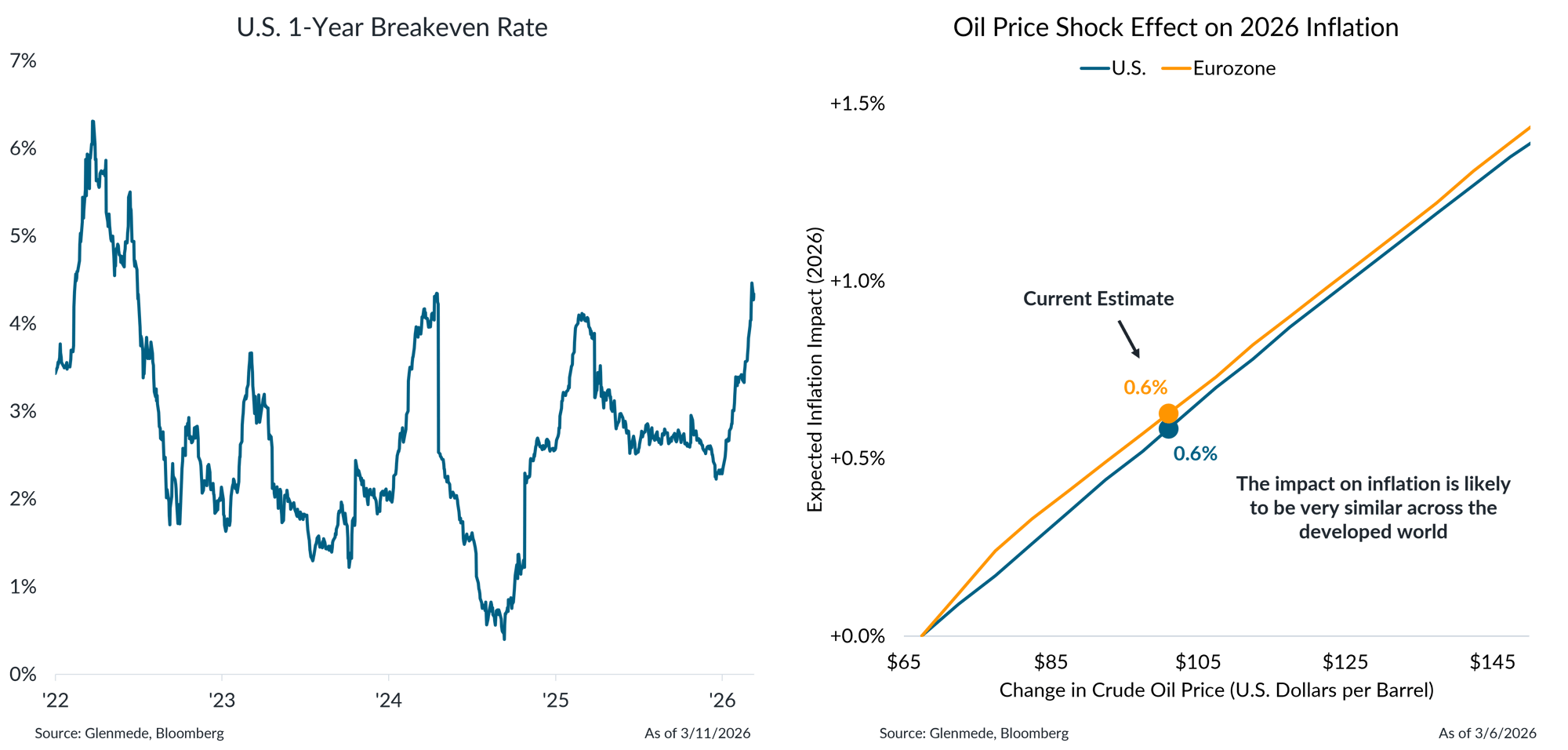
Shown on the left are U.S. 1-year breakeven inflation rates, implied via pricing in 1-year nominal U.S. Treasury securities vs. 1-year Treasury Inflation Protected Securities (TIPS). Shown on the right are Glenmede’s estimates for the impact of a one-time shock in the price of crude oil on the year-over-year growth for the Consumer Price Index in 2026 for the U.S. (blue) and the Harmonized Index of Consumer Prices for the Eurozone (orange). The lines represent a spectrum of sensitivities for a range of changes in crude oil prices from no change to an increase of $100 per barrel. The dots represent current estimates based on the latest pricing of Brent crude oil spot prices. Actual results may differ materially from projections.
- Rising oil market uncertainty has helped push U.S. inflation expectations to their highest level since early 2024, with 1‑year breakeven rates climbing alongside recent geopolitical developments.
- The current level of crude oil prices implies a roughly 0.6% boost to inflation this year in both the U.S. and the Eurozone as higher energy costs have the potential to feed quickly to consumer prices and broader production costs.
- Because oil is a global commodity, it is likely to have a similar effect on inflation for developed market economies. However, Europe may see a slightly higher impact, since energy expenses are a larger share of household consumption.
Lower energy spending and rising domestic production have reduced the U.S. economy's exposure to oil shocks
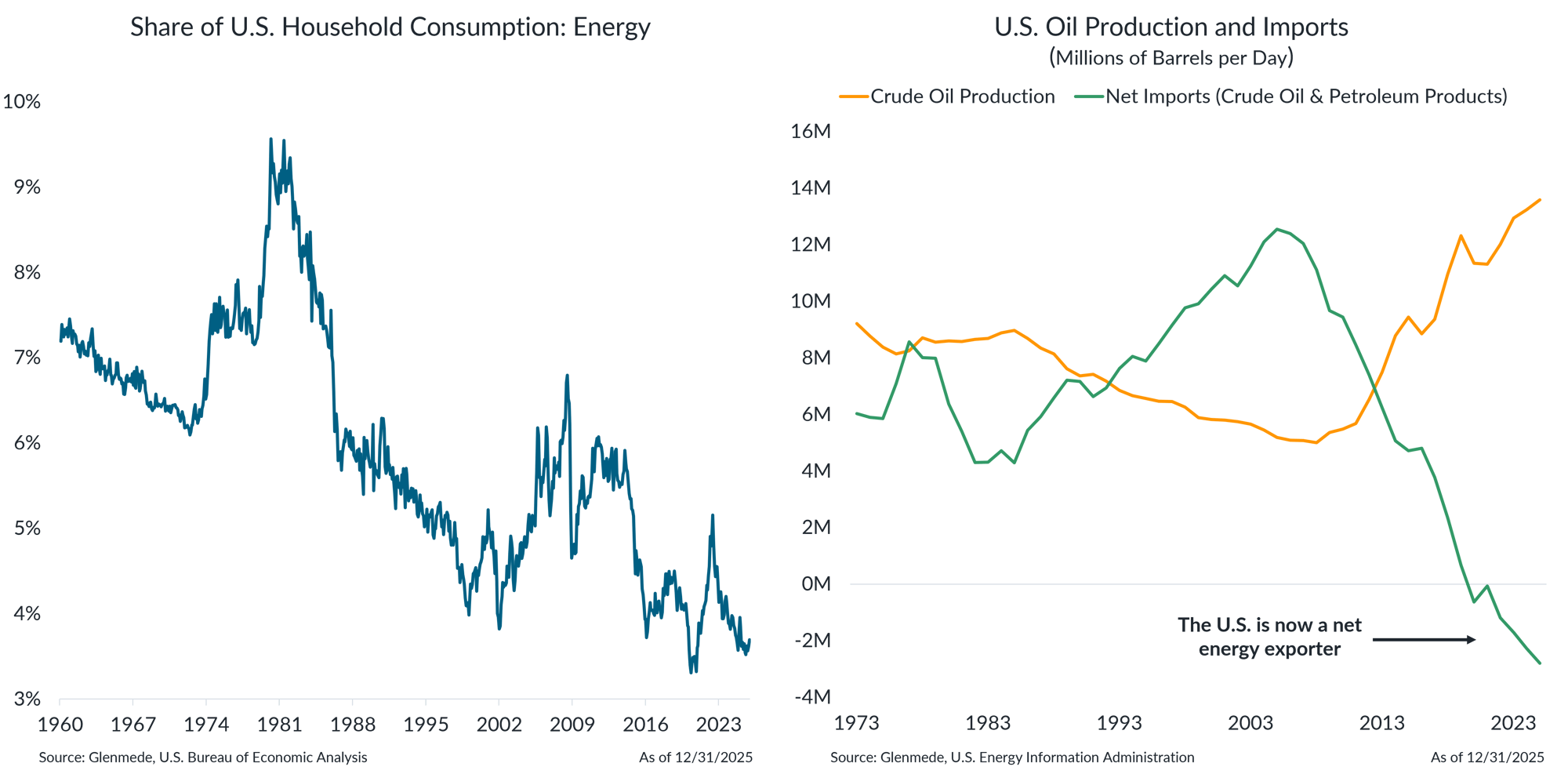
Shown on the left is the share of personal consumption expenditures spent on energy goods and services, expressed as a percentage of total personal consumption expenditures, with all values measured in current U.S. dollars. Energy goods and services include gasoline and other motor fuels, lubricants and fluids, household fuels, electricity, and natural gas. Shown on the right in orange is U.S. crude oil production and U.S. net imports of crude oil and petroleum in green, both in millions of barrels per day.
- Before the conflict, energy accounted for a much smaller share of U.S. household consumption than in prior decades, which should help reduce the direct impact of higher oil prices on consumer spending and inflation.
- Energy’s share of consumption could rise in the months ahead, as U.S. consumers have historically reallocated their budgets to spend less on other goods and services when energy costs have increased.
- It is unlikely that U.S. economic growth will be as sensitive to an oil shock as it has in prior decades because the U.S. is now a significant net exporter of energy products. Higher exports and perhaps additional investment from energy producers could help offset an expected drag from household spending.
Energy prices are likely to remain volatile, but are currently at levels that are unlikely to lead to recession
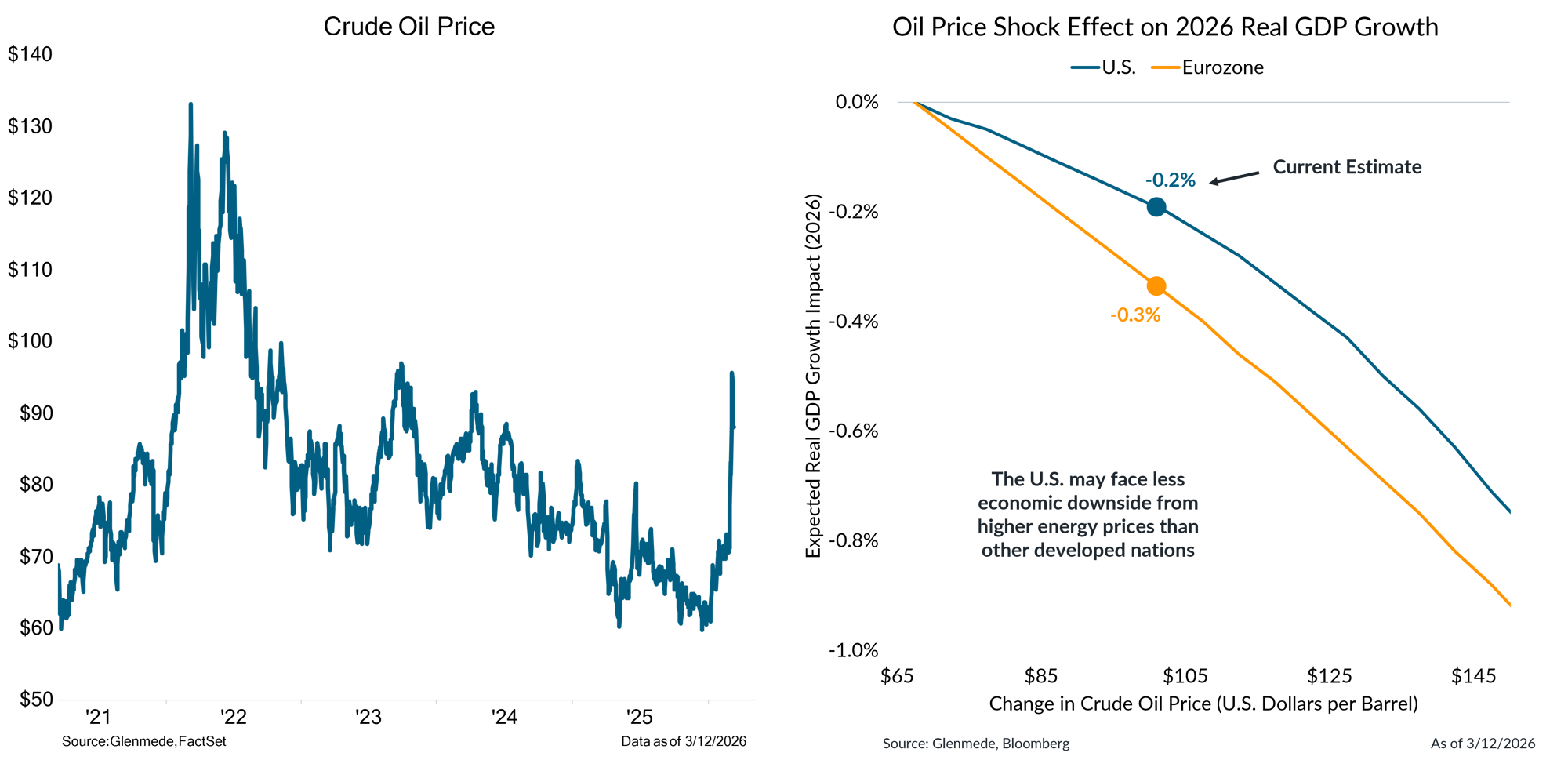
Shown on the left are the spot prices of Brent crude oil over time, measured in U.S. dollars per barrel. Shown on the right are Glenmede’s estimates for the impact of a one-time shock in the price of crude oil on 2026 real gross domestic product growth for the U.S. (blue) and Eurozone (orange). The lines represent a spectrum of sensitivities for a range of changes in crude oil prices from no change to an increase of $100 per barrel. The dots represent current estimates based on the latest pricing of Brent crude oil spot prices. Actual results may differ materially from projections.
- Crude oil prices remain volatile as each new headline reshapes expectations for supply risks, shipping disruptions, and the likely duration of the conflict.
- A range of possible outcomes for the impact on economic growth remains likely, though current crude oil prices are unlikely to be high enough to induce recession. However, the European economy may be more sensitive, as they are large net importers of energy products.
- Investors should not expect a lasting market impact but continue to monitor conditions that could lead to more material economic effects.
For more in-depth information on this topic, please reach out to your Glenmede Relationship Manager.

This material is provided solely for informational and/or educational purposes and is not intended as personalized investment advice. When provided to a client, advice is based on the client’s unique circumstances and may differ substantially from any general recommendations, suggestions or other considerations included in this material. Any opinions, recommendations, expectations or projections herein are based on information available at the time of publication and may change thereafter. Information obtained from third-party sources is assumed to be reliable but may not be independently verified, and the accuracy thereof is not guaranteed. Any company, fund or security referenced herein is provided solely for illustrative purposes and should not be construed as a recommendation to buy, hold or sell it. Outcomes (including performance) may differ materially from any expectations and projections noted herein due to various risks and uncertainties. Any reference to risk management or risk control does not imply that risk can be eliminated. All investments have risk. Clients are encouraged to discuss any matter discussed herein with their Glenmede representative.