

Investment Strategy Brief | March 22, 2026
Private Credit Under the Microscope

Executive Summary
-
- Private credit has rapidly grown to become a notable part of the debt ecosystem in the U.S. and has recently drawn increased scrutiny.
- Private credit losses have so far remained subdued, but there are signs of looser safeguards and increased use of payment-in-kind.
- Software is a significant share of private credit and faces increased pressure from Artificial Intelligence (AI) disruption.
- Private credit investors are largely long-term investors, although banks do provide lending to private investment funds.
- Private credit issues are unlikely to lead to a systemic event that puts the the economic expansion at risk but deserve ongoing monitoring.
Private credit has rapidly grown to become a notable part of the debt ecosystem in the U.S.
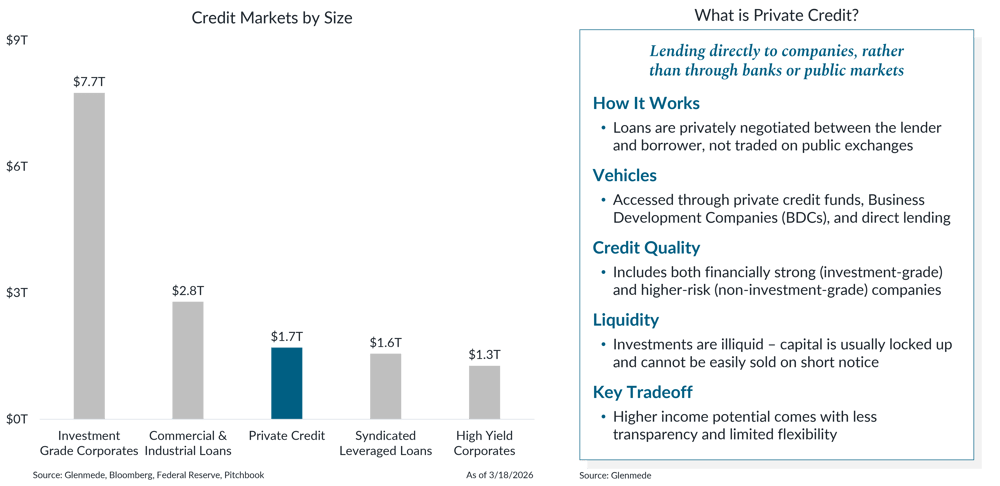
Shown on the left are the outstanding debt obligations across select credit markets, in trillions of U.S. dollars. Investment grade corporates are represented by the Bloomberg U.S. Aggregate Corporate Index; commercial and industrial loans outstanding are sourced from the Federal Reserve; high yield corporates are represented by Bloomberg High Yield Index; and syndicated leverage loans are represented by Morningstar LSTA Leveraged Loan Index. Private credit is represented by loans owned by private investment funds, collateralized loan obligation (CLO) pools, and business development companies, but excludes direct lending by other investors, according to data from Pitchbook. One cannot invest directly in an index.
- The size of the private credit market has grown roughly fivefold over the past 15 years, fueled by the rise of direct lending, looser underwriting standards, and growing demand for non-bank financing.
- More recently, a series of credit events, including bankruptcies at Thrasio, Tricolor, and First Brands, has increased scrutiny of leverage and underwriting practices across the asset class.
- This year, slower growth in the space has been accompanied by concerns around software-heavy exposures, while redemption restrictions at some vehicles and loan markdowns have reinforced questions around liquidity, valuation, and the ability to absorb stress.
Private credit markets exhibit some signs of weakened safeguards and increased the use of payment-in-kind
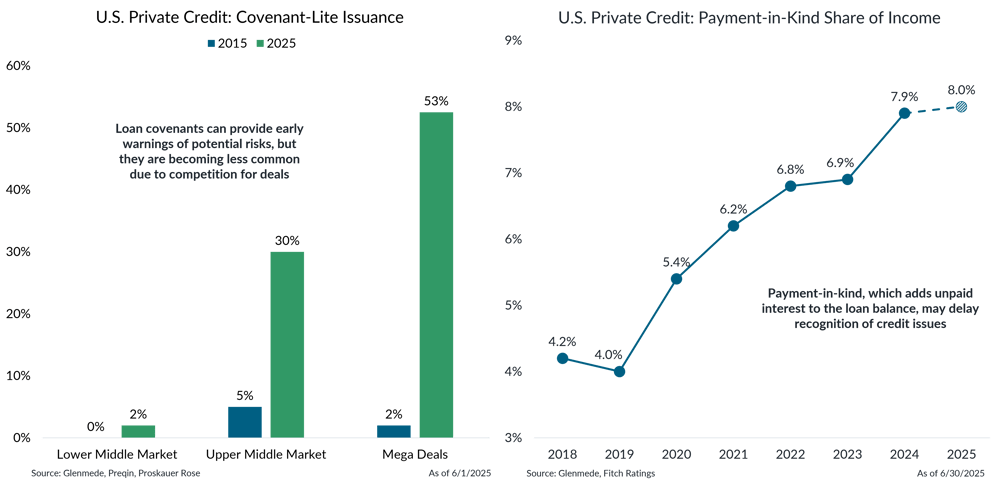
Shown on the left are the shares of new private credit issuance classified as covenant-lite, defined by those that lack one clear financial maintenance covenant such as leverage or interest coverage ratios. Each group is defined by the following: Lower Middle Market (less than $25 million in borrower EBITDA), Upper Middle Market (greater than $50 million in borrower EBITDA), and Mega Deals (greater than $500 million in borrower total debt). EBITDA refers to earnings before interest, taxes, depreciation, and amortization. Shown on the right is payment-in-kind income as a percentage of interest and dividend income for business development companies rated by Fitch.
- As private credit has scaled rapidly, deal protections have weakened, with covenant‑lite structures now dominating issuance, particularly in larger transactions.
- The share of income paid in-kind has risen steadily since 2019, reaching roughly 8% of income, indicating greater use of non‑cash interest features and making it more difficult to spot emerging credit issues.
Credit losses have remained subdued, but payment-in-kind provisions may be masking underlying issues
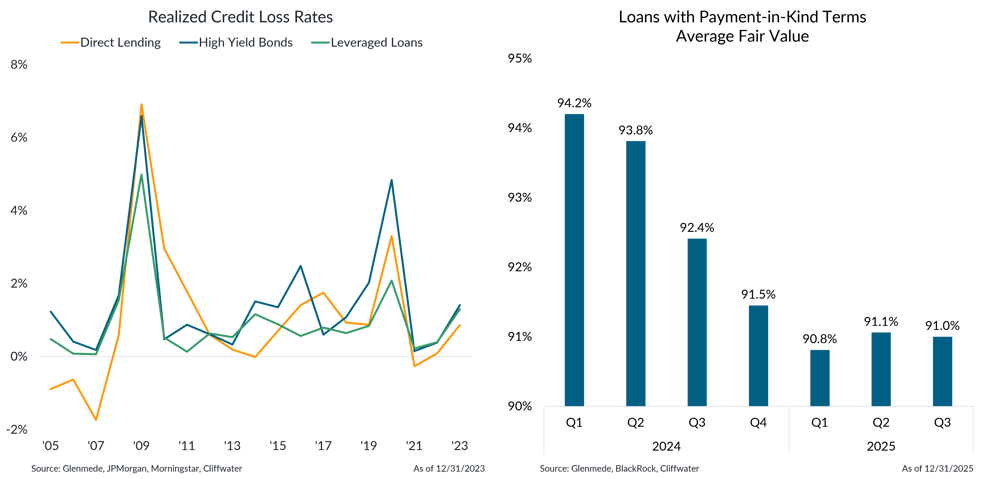
Shown on the left are annual realized credit loss rates (i.e., default rate x (1 – recovery rate)) for Direct Lending (Cliffwater Direct Lending Index), High Yield Bonds (Bloomberg U.S. High Yield Index), and Leveraged Loans (Morningstar LSTA U.S. Leveraged Loan Index). Negative credit losses may reflect mark-to-market improvements, restructurings outperforming expectations, or other events. Shown on the right is the average fair value of loans in the Cliffwater Direct Lending Index with payment-in-kind terms, as a percentage of par value. Past performance may not be indicative of future results. One cannot invest directly in an index.
- Realized credit loss rates across direct lending, leveraged loans, and high‑yield bonds have remained subdued, with recent levels well below prior cycle peaks.
- In contrast, average fair values on loans with payment-in-kind terms have declined steadily since 2024, pointing to growing valuation pressure within this segment.
- The divergence between stable realized losses and falling payment-in-kind loan valuations suggests stress may be emerging through marks and deal structures rather than realized defaults.
Software is a significant share of private credit and faces increased pressure from AI disruption
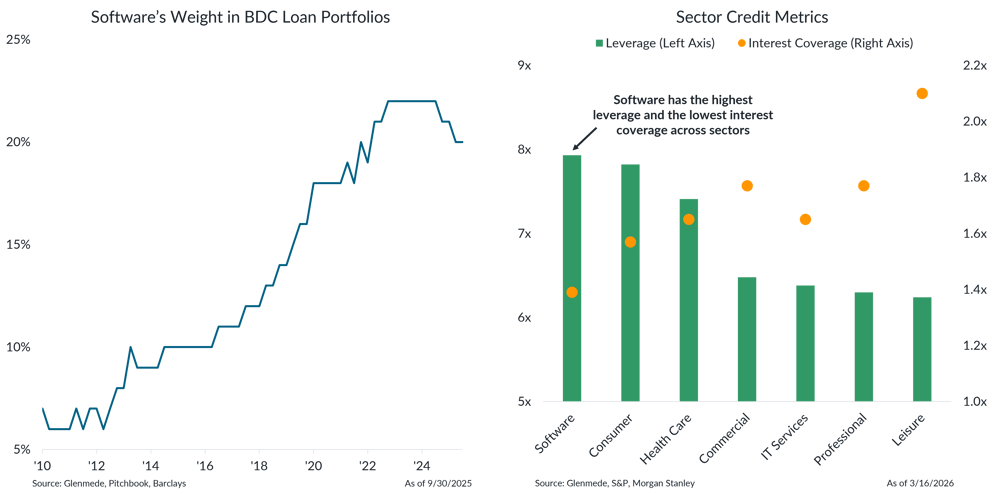
Shown on the left is the fair value weight of the software sector in business development company (BDC) loan portfolios over time. Shown on the right are sector-level credit metrics, including median leverage in green (left axis) and interest coverage in orange (right axis), based on 2025 estimates for the S&P Leveraged Credit Estimated Universe. Leisure includes hotels and restaurants. Consumer, commercial, and professional all refer to services within each sector.
- Software has become a significant share of BDC portfolios, with its weight rising steadily over the past decade and remaining near historical highs.
- Relative to other sectors, software exhibits the highest leverage levels and the lowest interest coverage, indicating weaker credit metrics despite its large portfolio presence.
- This combination of high concentration and thinner cash-flow buffers increases sensitivity to competitive pressures, concurrent with potential disruption from AI-driven changes in the software landscape.
Private credit strains may show up in a number of different channels
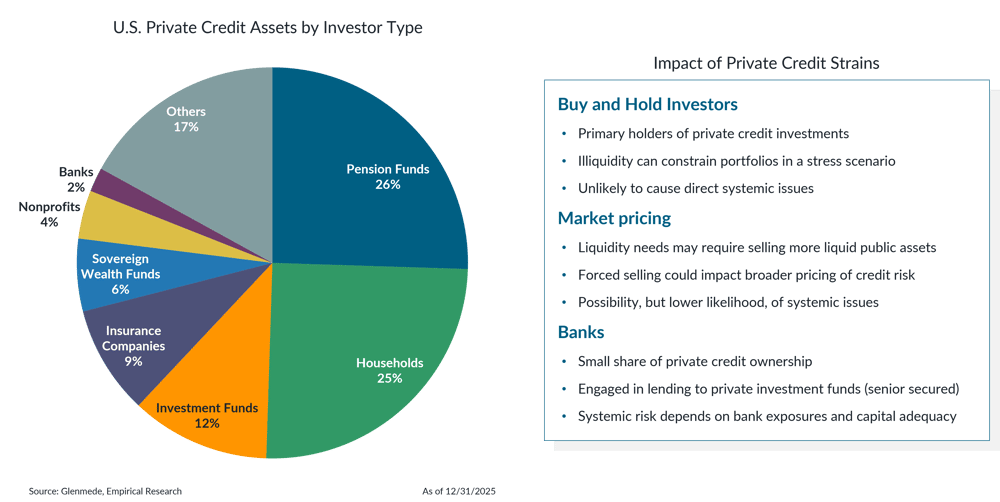
Shown on the left are the share of assets in U.S. private credit funds and business development companies (BDCs) held by various investor types. Shown on the right is additional context, including a non-exhaustive list of potential events that could unfold during a stress scenario.
- Private credit exposure sits mainly with long-horizon investors, including pensions, insurers, and other institutional pools that not only supply capital but, in some cases, are also taking on a larger lending role themselves.
- During periods of stress, limited liquidity and delayed valuations can hinder portfolio rebalancing, potentially prompting investors to sell more liquid public assets and allowing pressure from private credit to spill into public markets. The possibility of broader systemic issues resulting from this is low, but warrants ongoing monitoring.
- In comparison, some banks have extended lines of credit to private credit vehicles, opening up a channel of exposure to traditional lenders should the loans continue to deteriorate.
Stress in private credit is unlikely to lead to a systemic event via traditional lending channels
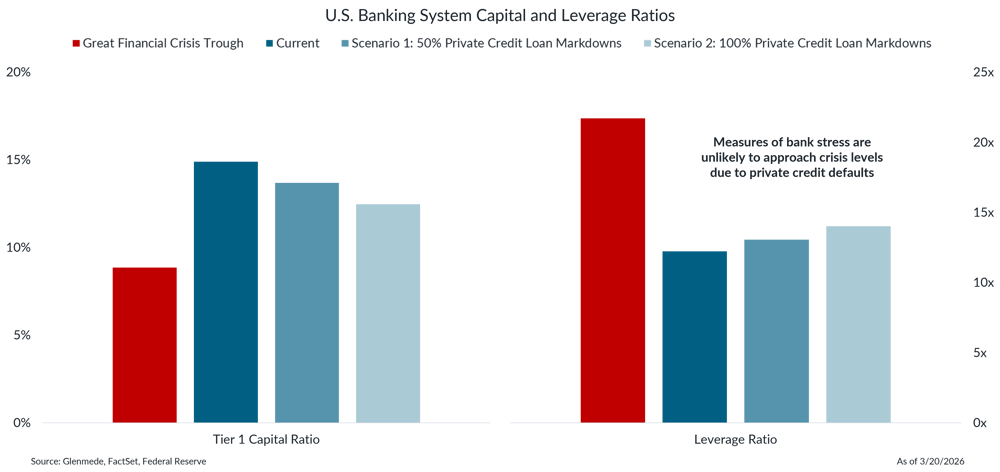
The information shown are average Tier 1 Capital Ratios (Tier 1 Capital/Risk-Weighted Assets) and Leverage Ratios (Total Assets/Total Equity) for two baskets of U.S. banks. The red bars represent data for the following banks at their 2008 troughs: JPMorgan, Citigroup, Bank of America, Wells Fargo, Goldman Sachs, Morgan Stanley, Lehman Brothers, Bear Stearns, Merrill Lynch, Wachovia, Washington Mutual. The blue bars represent data for the following banks as of the latest date shown: JPMorgan, Bank of America, Citigroup, Wells Fargo, Goldman Sachs, Morgan Stanley. The shaded blue bars represents stress tests to the ratios, assuming existing loans to private credit funds face 50% markdowns (Scenario 1) and 100% markdowns (Scenario 2). Past performance may not be indicative of future results. The visual shown should not be interpreted as a recommendation to buy, hold, or sell any individual securities.
- Even under severe stress assumptions, including partial and full markdowns of private credit losses, U.S. banks’ Tier 1 capital ratios remain far better capitalized than during the Global Financial Crisis.
- Leverage ratios also stay far below crisis levels in stress test scenarios, suggesting that private-credit-related losses are unlikely to translate into a systemic banking event through traditional lending channels.
- While private credit issues are unlikely to present material risks to the economic expansion, the situation warrants ongoing monitoring for any notable changes in circumstances.
For more in-depth information on this topic, please reach out to your Glenmede Relationship Manager.

This material is provided solely for informational and/or educational purposes and is not intended as personalized investment advice. When provided to a client, advice is based on the client’s unique circumstances and may differ substantially from any general recommendations, suggestions or other considerations included in this material. Any opinions, recommendations, expectations or projections herein are based on information available at the time of publication and may change thereafter. Information obtained from third-party sources is assumed to be reliable but may not be independently verified, and the accuracy thereof is not guaranteed. Any company, fund or security referenced herein is provided solely for illustrative purposes and should not be construed as a recommendation to buy, hold or sell it. Outcomes (including performance) may differ materially from any expectations and projections noted herein due to various risks and uncertainties. Any reference to risk management or risk control does not imply that risk can be eliminated. All investments have risk. Clients are encouraged to discuss any matter discussed herein with their Glenmede representative.