

Investment Strategy Brief | March 29, 2026
Q1 2026 Market Review

Executive Summary
- After posting strong returns in 2025, equity and bond markets experienced notable volatility to start 2026.
- Policy uncertainty stayed elevated amid renewed tariff actions and an anticipated Federal Reserve leadership transition in Q2.
- Middle East tensions kept oil markets on edge in Q1 and remain an important risk to monitor.
- Software companies, AI-driven disruption, and potential spillovers for private credit will remain in focus in the coming quarter.
- Recession risks are increasing but remain contained, with focus shifting to several key events in Q2.
Both equity and bond markets experienced notable volatility in Q1
- After several strong quarters in a row, equity markets experienced geopolitical-driven volatility to start 2026, which also put some upward pressure on bond yields due to rising inflation expectations.
- Beneath the headline indices, market leadership shifted beneath the surface, benefiting value stocks over growth, small caps over large, and the average stock over mega caps.
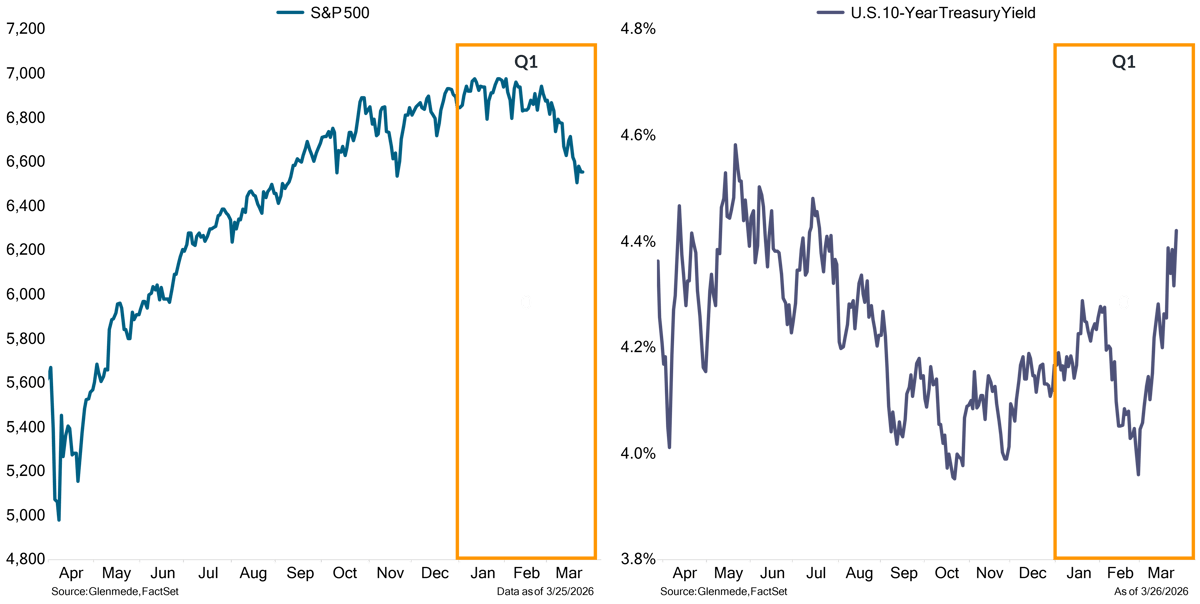
Shown on the left is the S&P 500 which is a market capitalization weighted index of U.S. large cap stocks. Shown on the right is the yield on 10-year U.S. Treasury bonds. Past performance may not be indicative of future results. One cannot invest directly in an index.
Emergency tariffs were ruled illegal by the Supreme Court, but are being reinstated through other means
- The Supreme Court ruled that tariffs imposed under the International Emergency Economic Powers Act (IEEPA) were illegal, removing the legal basis for more than half of the duties collected since early 2025.
- However, the administration has already begun using alternative tools—including Sections 232, 122, 301, and 338—which provide different statutory bases, timelines, and duty caps to reimpose tariffs in roughly the same shape and form as they existed prior to the ruling.
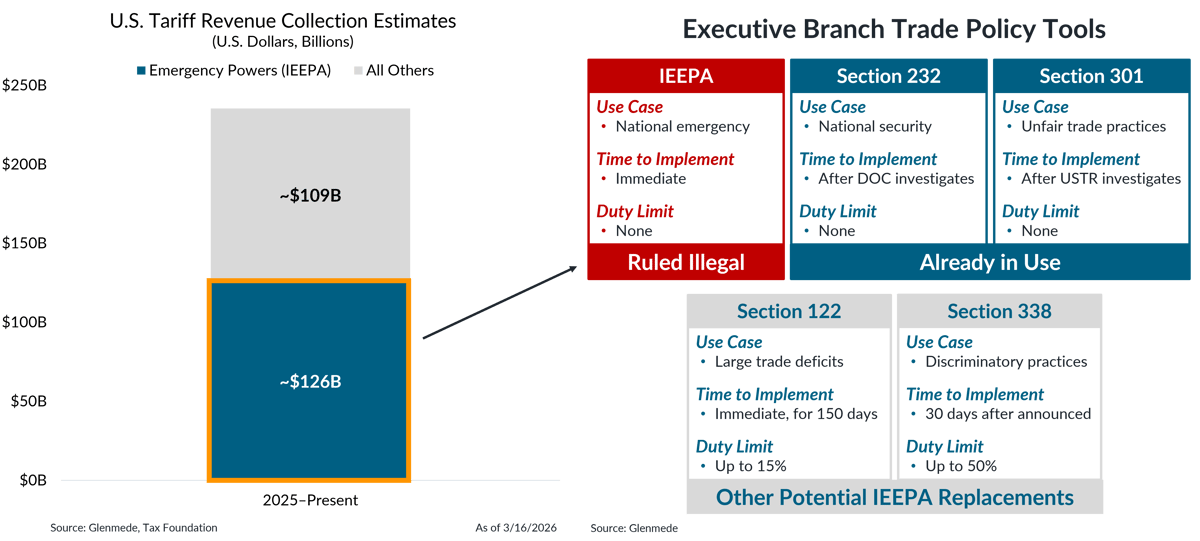
Shown on the left are the monthly customs duties collected by the U.S. Treasury, in billions of U.S. dollars. The information shown on the right outlines legal provisions that grant the President and Congress authority to manage trade policy. The International Emergency Economic Powers Act of 1977 (IEEPA) authorizes the President to regulate international commerce after declaration of a national emergency or in response to threats to the U.S. The Trade Expansion Act of 1962: Section 232 delegates congressional authority to the President to impose import restrictions that threaten national security. The Trade Act of 1930: Section 338 grants the President the authority to impose tariffs of up to 50% on imports from countries that discriminate against the U.S. The Trade Act of 1974: Section 122 authorizes the President to address a balance of payments deficit or to prevent an imminent and significant depreciation in the dollar. The Trade Act of 1974: Section 301 authorizes the President to take appropriate action in response to unreasonable or discriminatory burdens to U.S. commerce. DOC refers to the U.S. Department of Commerce. USTR refers to the Office of the United States Trade Representative. The options shown are not exhaustive and actual trade actions taken may differ materially from those described.
Kevin Warsh was nominated for chairman of the Federal Reserve and is in line for a Q2 confirmation process
- In early March, President Trump officially submitted Kevin Warsh’s nomination for Federal Reserve Chair to the Senate, with the confirmation process expected to advance in Q2 through a Senate Banking Committee hearing and vote followed by a full Senate vote.
- However, some senators have signaled they may delay any Fed nomination until the investigation into its spending is fully resolved.
- If the confirmation is not completed by the end of Powell’s term in the middle of May, he could remain as Chair or the position could stay vacant until confirmation.
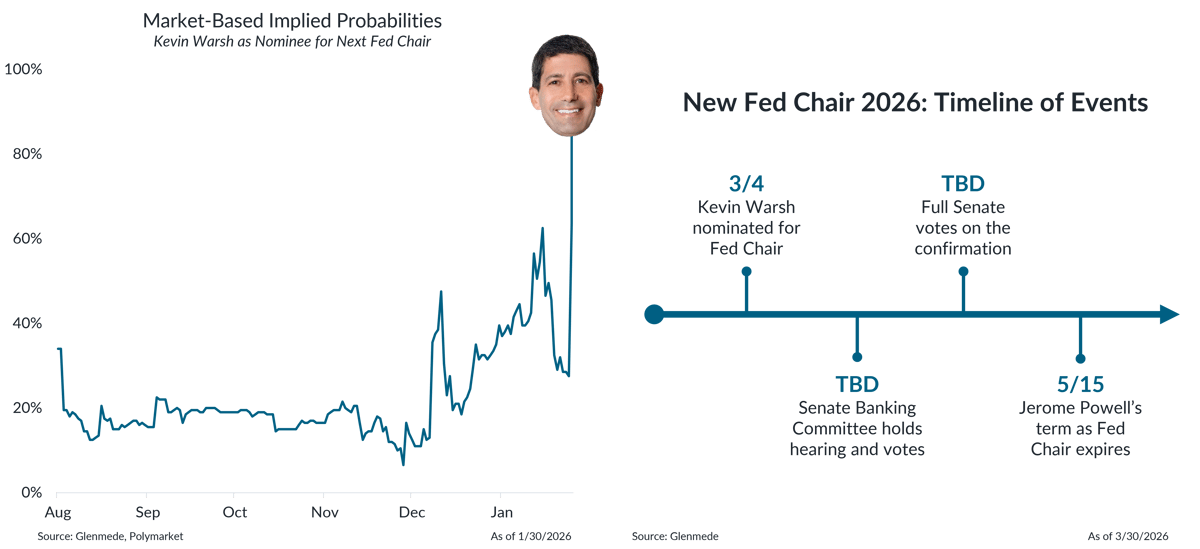
Shown on the left are market-based odds of Kevin Warsh being announced as the administration’s nominee for Chair of the Federal Reserve via Polymarket. Polymarket is a prediction market where investors can place bets on various future events. References to Polymarket and use of its data herein in no way should be interpreted as an endorsement or recommendation of Polymarket by Glenmede. Probabilities or likelihoods shown are not the opinions of Glenmede and are shown for illustrative purposes only. Actual results may differ materially from probabilities shown or projections, particularly for prediction markets with low trading volume. Shown on the right is an illustrative timeline of events related to the next Chair. Federal Reserve Chair appointments require Senate confirmation and timing may vary based on procedural, legal, or scheduling factors. If confirmation is delayed, the incumbent may continue serving or the position may remain vacant. Board composition and individual service decisions may also influence the transition timeline. This visual was created for informational purposes only and is subject to change after the date of publication.
Middle East tensions kept oil markets on edge in Q1 and remain an important risk to monitor
- Middle East tensions were a major driver of volatility in Q1, as escalating conflict disrupted energy infrastructure and shipping flows, most notably through a sharp drop in energy-heavy traffic through the Strait of Hormuz.
- Geopolitics remain an important risk to monitor heading into Q2, as each new headline can quickly shift expectations around supply risks, shipping disruptions, and the potential duration of the conflict.
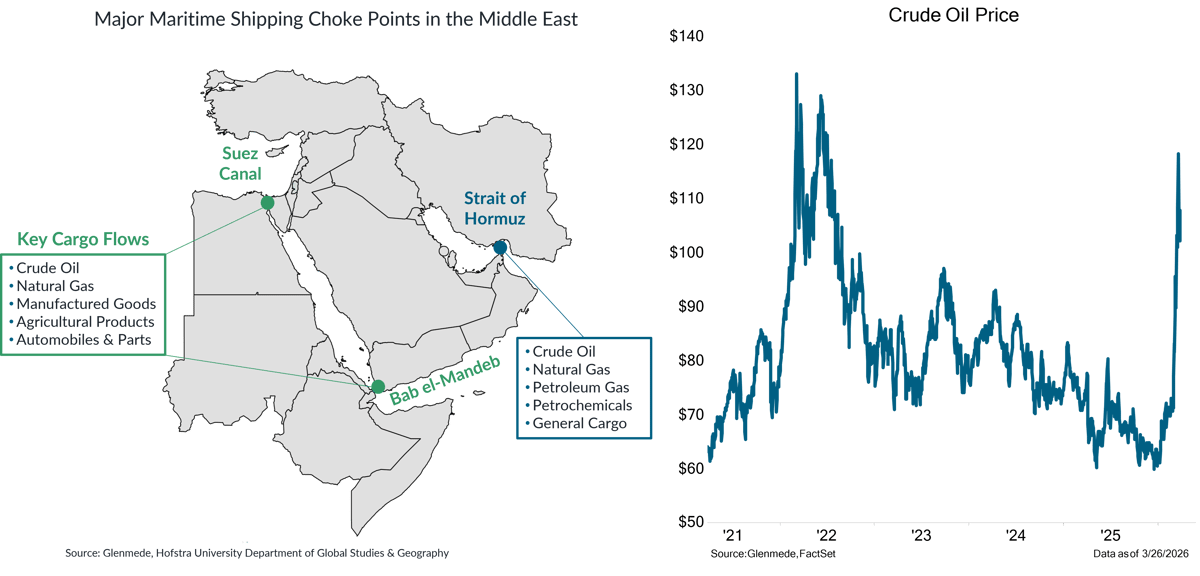
Shown on the left is a map of the Middle East and parts of Africa with dots representing major maritime shipping chokepoints in the region. Manufactured goods includes items like electronics, textiles, appliances, and other similar goods. Shown on the right are the spot prices of Brent crude oil over time, measured in U.S. dollars per barrel.
Software companies were in focus due to AI-driven disruption and potential spillovers for private credit
- Software equities sold off sharply in Q1, reflecting growing concerns that AI-driven disruption could pressure earnings and undermine business models across the sector.
- Relative to other sectors, software exhibits the highest leverage and lowest interest coverage, making it a focus of concern for private credit lenders.
- This combination of high concentration and thinner cash-flow buffers increases sensitivity to competitive pressures and increases downside risk for private credit exposures in Q2.
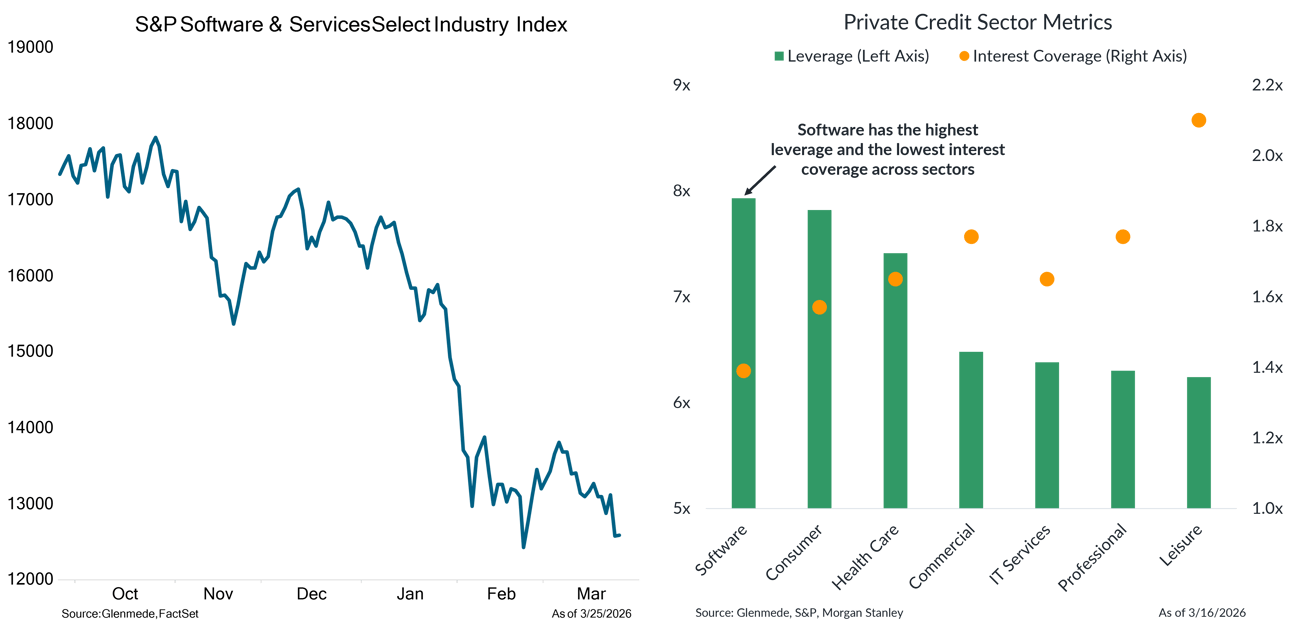
Shown on the left is the S&P Software & Services Select Industry Index price level, which is comprised of U.S. stocks in the S&P Total Market Index that are classified in the GICS application software, interactive home entertainment, IT consulting & other services, and systems software sub-industries. Shown on the right are sector-level credit metrics, including median leverage in green (left axis) and interest coverage in orange (right axis), based on 2025 estimates for the S&P Leveraged Credit Estimated Universe. Leisure includes hotels and restaurants. Consumer, commercial, and professional all refer to services within each sector. Past performance may not be indicative of future results. One cannot invest directly in an index.
Recession risks are increasing but remain contained, with focus shifting to several key events in Q2
- Recession risk remains relatively low. However, if crude oil prices were to remain elevated at ~$100 per barrel, recession risk would increase to about 15%, and if prices reach $150 per barrel, the probability would rise more sharply to about 30%.
- While the conflict may modestly lift inflation and weigh on growth, the U.S. economy enters this period from a position of strength, and these factors alone are unlikely to push it into recession.
- Investors should watch several Q2 developments, including geopolitics, policy decisions, and financial conditions, as key indicators of whether recession risks begin to rise further or start to stabilize.
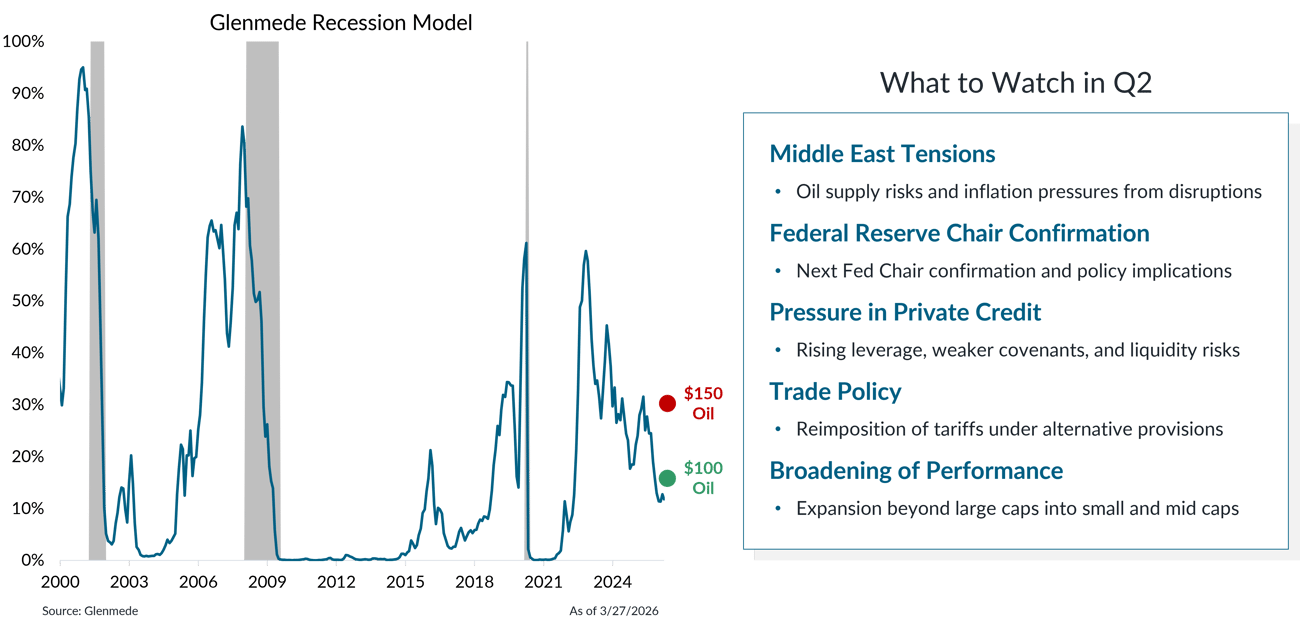
Shown on the left is Glenmede’s Recession Model, a tool developed by Glenmede to estimate the probability of a recession in the U.S. occurring within the next 12 months. The model is a balanced mix of (1) long-term excess indicators covering manufacturing, employment, and debt balances and (2) near-term leading indicators covering monetary policy, credit markets, business sentiment, and other economic trends. Shaded areas represent recession periods of the U.S. economy. Though created in good faith, there can be no guarantee that these indicators will be accurate. The model was established in 2015. The data shown for prior periods represent backtested results. The dots represent a shock overlay to account for the price of crude oil rising to $100 per barrel (green) and $150 per barrel (red). Actual results may differ materially from projections.
For more in-depth information on this topic, please reach out to your Glenmede Relationship Manager.

This material is provided solely for informational and/or educational purposes and is not intended as personalized investment advice. When provided to a client, advice is based on the client’s unique circumstances and may differ substantially from any general recommendations, suggestions or other considerations included in this material. Any opinions, recommendations, expectations or projections herein are based on information available at the time of publication and may change thereafter. Information obtained from third-party sources is assumed to be reliable but may not be independently verified, and the accuracy thereof is not guaranteed. Any company, fund or security referenced herein is provided solely for illustrative purposes and should not be construed as a recommendation to buy, hold or sell it. Outcomes (including performance) may differ materially from any expectations and projections noted herein due to various risks and uncertainties. Any reference to risk management or risk control does not imply that risk can be eliminated. All investments have risk. Clients are encouraged to discuss any matter discussed herein with their Glenmede representative.