

Investment Strategy Brief | October 18, 2026
Q3 Earnings: More Than Meets the Eye

Executive Summary
-
As third-quarter earnings season gets underway, earnings growth expectations remain strong.
-
Earnings growth is expected to be led by technology, the Magnificent 7, and energy.
-
Artificial intelligence (AI) investment accounting remains a near-term earnings tailwind for large cap companies but could become a headwind by 2028.
-
Beyond AI-related accounting effects, earnings growth is broadening across the capitalization spectrum.
-
Robust, broadening profit growth continues to provide a supportive backdrop for equity markets.
As third-quarter earnings season gets underway, earnings growth expectations remain strong
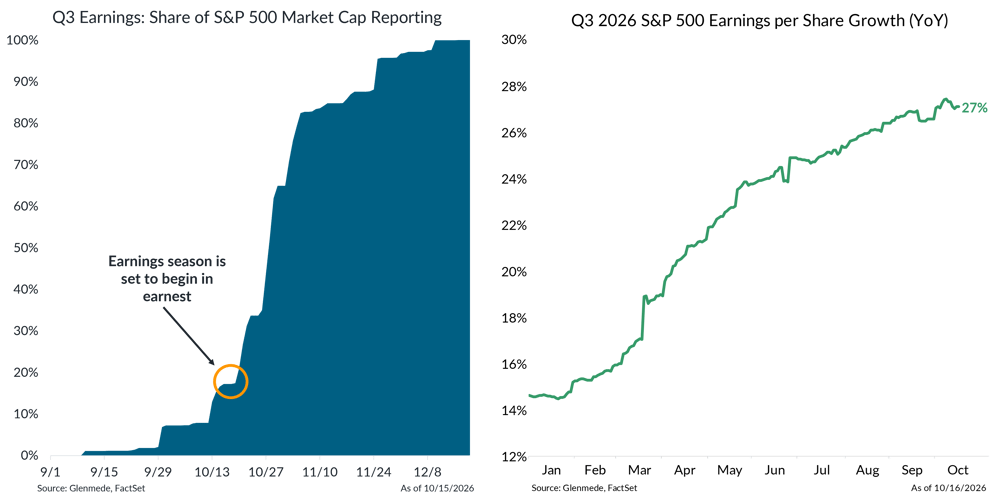
Shown on the left is a timeline of the cumulative share of the S&P 500’s market capitalization that has reported or will report Q3 2026 earnings results. Shown on the right is the progression of estimates for year-over-year growth in S&P 500 earnings per share for Q3 2026. Estimates are based on consensus analyst expectations and are subject to change. Actual results may differ materially from expectations. One cannot invest directly in an index.
-
Q3 earnings season is just getting underway, with less than 20% of S&P 500 market capitalization having reported results.
-
Consensus forecasts for S&P 500 earnings growth have risen from roughly 14% to 27% year-over-year since the start of 2026, which would be an exceptionally robust result.
Earnings growth is expected to be led by technology, the Magnificent 7, and energy
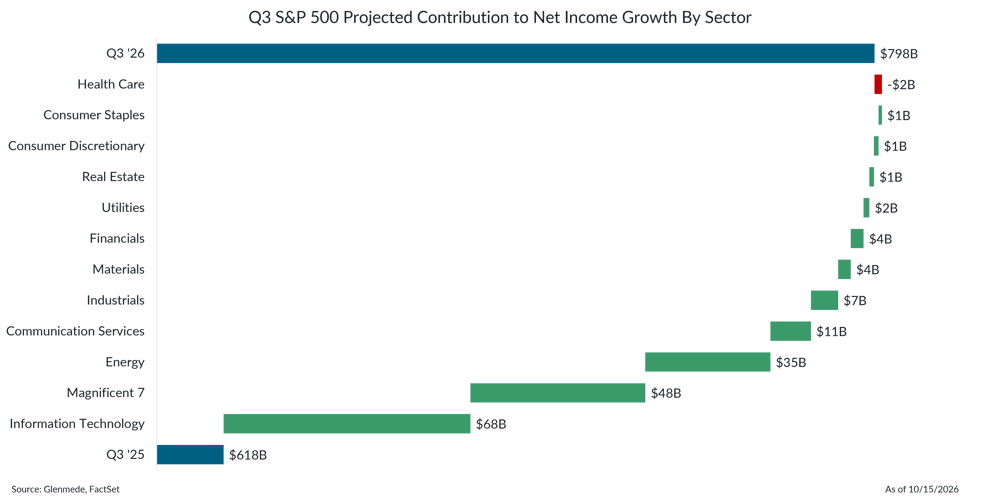
Shown is the projected contribution to year-over-year S&P 500 net income growth in Q3 2026 by sector. The Magnificent 7 (Apple, Microsoft, Alphabet, Amazon, Nvidia, Meta, and Tesla) are presented as a separate category and excluded from their respective sectors. Estimates are based on consensus expectations and are subject to change. Actual results may differ materially from expectations. References to individual stocks should not be construed as a recommendation to buy, hold, or sell. One cannot invest directly in an index.
-
Technology and energy are expected to contribute more than half of Q3 net income growth, excluding the Magnificent 7.
-
The Magnificent 7 remains a powerful earnings driver, accounting for another quarter of projected net income growth this quarter.
AI infrastructure spending is temporarily lifting reported earnings
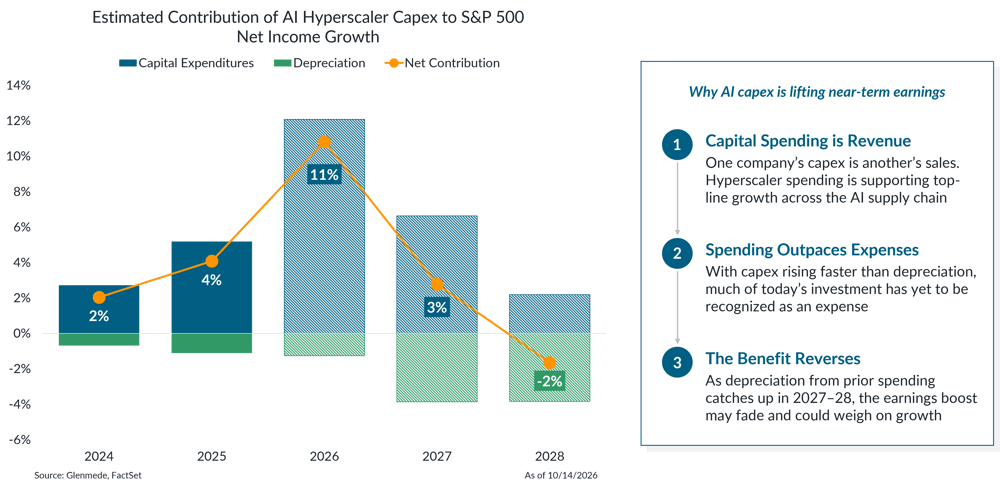
Shown is the estimated contribution of AI Hyperscaler (Amazon, Alphabet, Meta, Microsoft, and Oracle) capital spending to S&P 500 net income growth. Blue bars represent the estimated earnings benefit from capital expenditures, green bars represent the impact of depreciation and amortization, and the orange line shows the net contribution. Estimates are based on consensus expectations and Glenmede assumptions and are subject to change. Solid bars are estimates based on reported results and hashed bars are projections. These figures are projections which, though arrived at in good faith, are not guaranteed. Actual results may differ materially from projections. One cannot invest directly in an index. References to individual stocks should not be construed as a recommendation to buy, hold, or sell.
-
One company’s investment in data centers, chips, and other AI infrastructure is another company’s sales. As a result, heavy spending by large technology companies is supporting revenues and earnings across the AI supply chain today.
-
At the same time, the companies making those investments generally spread the cost over several years (i.e., depreciation), providing an additional near-term benefit to earnings rather than recognizing those costs up front.
-
Over time, those costs catch up as depreciation builds, reducing that earnings benefit over time and potentially becoming a modest headwind by 2028.
Fully expensing AI capex up front would temper near-term earnings growth
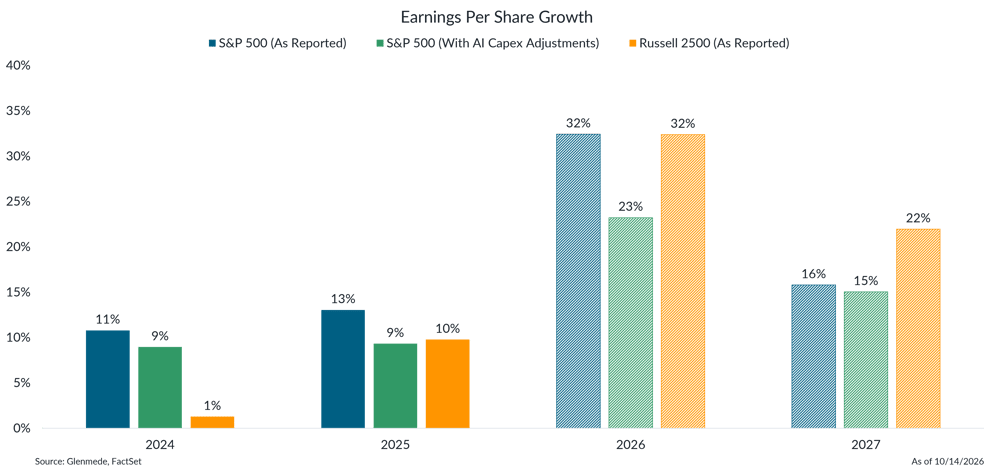
Shown is consensus earnings per share (EPS) growth on a year-over-year basis. Blue bars are as reported results for the S&P 500. Green bars are an estimate of EPS growth if AI Hyperscalers (Amazon, Alphabet, Meta, Microsoft, and Oracle) expensed their capital spending in the year incurred instead of depreciating it over time. Orange bars are as reported results for the Russell 2500. The full-expensing estimate reduces consensus EPS by the Hyperscalers' after-tax gap between capex and depreciation and amortization as a share of S&P 500 net income, holding all other S&P 500 companies unchanged. Solid bars are estimates based on reported results and hashed bars are projections. These figures are projections which, though arrived at in good faith, are not guaranteed. Actual results may differ materially from projections. One cannot invest directly in an index. References to individual stocks should not be construed as a recommendation to buy, hold, or sell.
-
Reported S&P 500 earnings growth may overstate underlying profit trends, as robust AI-related capital spending currently provides a temporary accounting benefit.
-
Adjusting for the timing mismatch between capital expenditures and depreciation lowers projected S&P 500 earnings growth from 32% to 23% in 2026.
-
Even after this adjustment, earnings growth remains comparable across the capitalization spectrum, with Russell 2500 companies expected to keep pace with large cap peers.
For more in-depth information on this topic, please reach out to your Glenmede Relationship Manager.

This material is provided solely for informational or educational purposes and is not intended as personalized investment advice. When provided to a client, advice is based on the client’s unique circumstances and may differ substantially from any general recommendations, suggestions, or other considerations included in this material. Any opinions, recommendations, expectations, or projections included herein are subject to change, and any potential outcome discussed, including but not limited to performance, legislation, or tax consequence, ultimately may not occur. Information obtained from third-party sources is assumed to be reliable but may not be independently verified, and the accuracy thereof is not guaranteed. Any company, fund, or security referenced herein is provided solely for illustrative purposes and is not a recommendation to buy, hold, or sell it. Any reference to risk management or risk control does not imply that risk can be eliminated. All investments have risk. Readers should contact Glenmede or consult with a financial, investment, tax, legal, or other advisor if they have any questions about this material or want advice or more information.