

Investment Strategy Brief | March 8, 2026
Rising Tensions in the
Middle East

Executive Summary
- Escalating conflict in Iran is most likely to appear in energy prices, which have recently been a driver behind falling inflation.
- The Middle East is home to three major maritime shipping choke points and a notable portion of the world’s oil production.
- OPEC spare capacity could help fill a gap if Iran’s oil production faces disruptions, but further shocks would be much harder to offset.
- Markets have historically reacted to major conflicts, but lasting effects typically occur only when they coincide with recessions.
- Rising oil prices and Middle East uncertainty are unlikely by themselves to push the U.S. into recession.
Escalating conflict may appear in energy prices, which have recently been a driver behind falling inflation
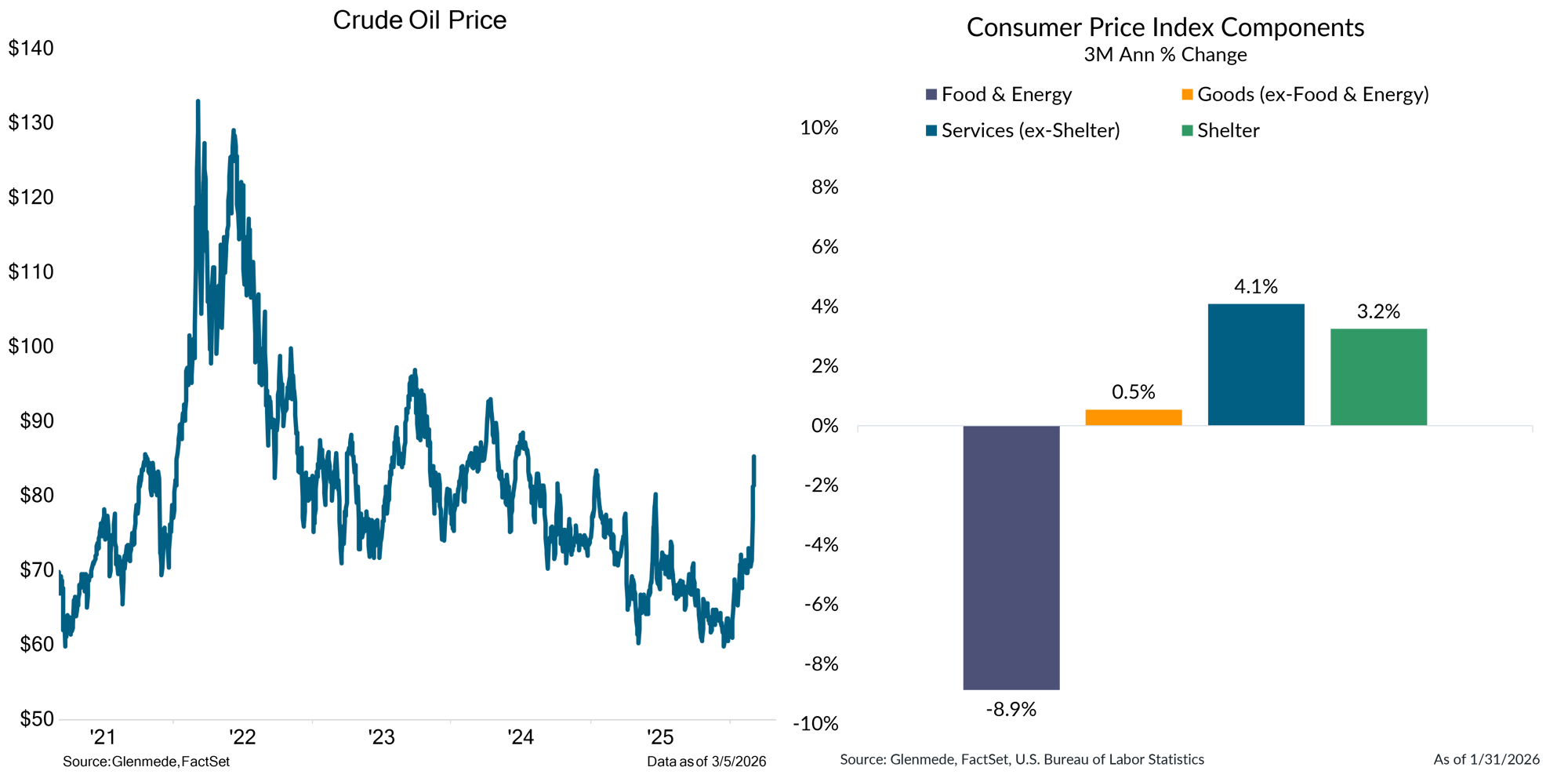
Shown on the left are the spot prices of Brent crude oil over time, measured in U.S. dollars per barrel. Shown on the right are the 3-month annualized percent changes in the U.S. CPI components. Food & Energy is represented by the food & energy subcomponents. Services (ex. Shelter) is represented by Services Less Rent of Shelter. Shelter is represented by Rent of Shelter. Goods (ex-Food & Energy) is represented by the commodities component (excluding food & energy). CPI measures the price of a basket of goods & services consumed by U.S. households.
- The U.S. and Israeli strikes on Iran last week have renewed focus on geopolitical risk in energy markets, with crude oil prices accelerating meaningfully after plotting new multi-year lows to end 2025.
- Energy has recently been an important driver of disinflation, but a geopolitical-driven rebound in oil prices could reverse that support and place upward pressure on inflation.
Maritime choke points play an outsized role in global energy flows and shipping costs
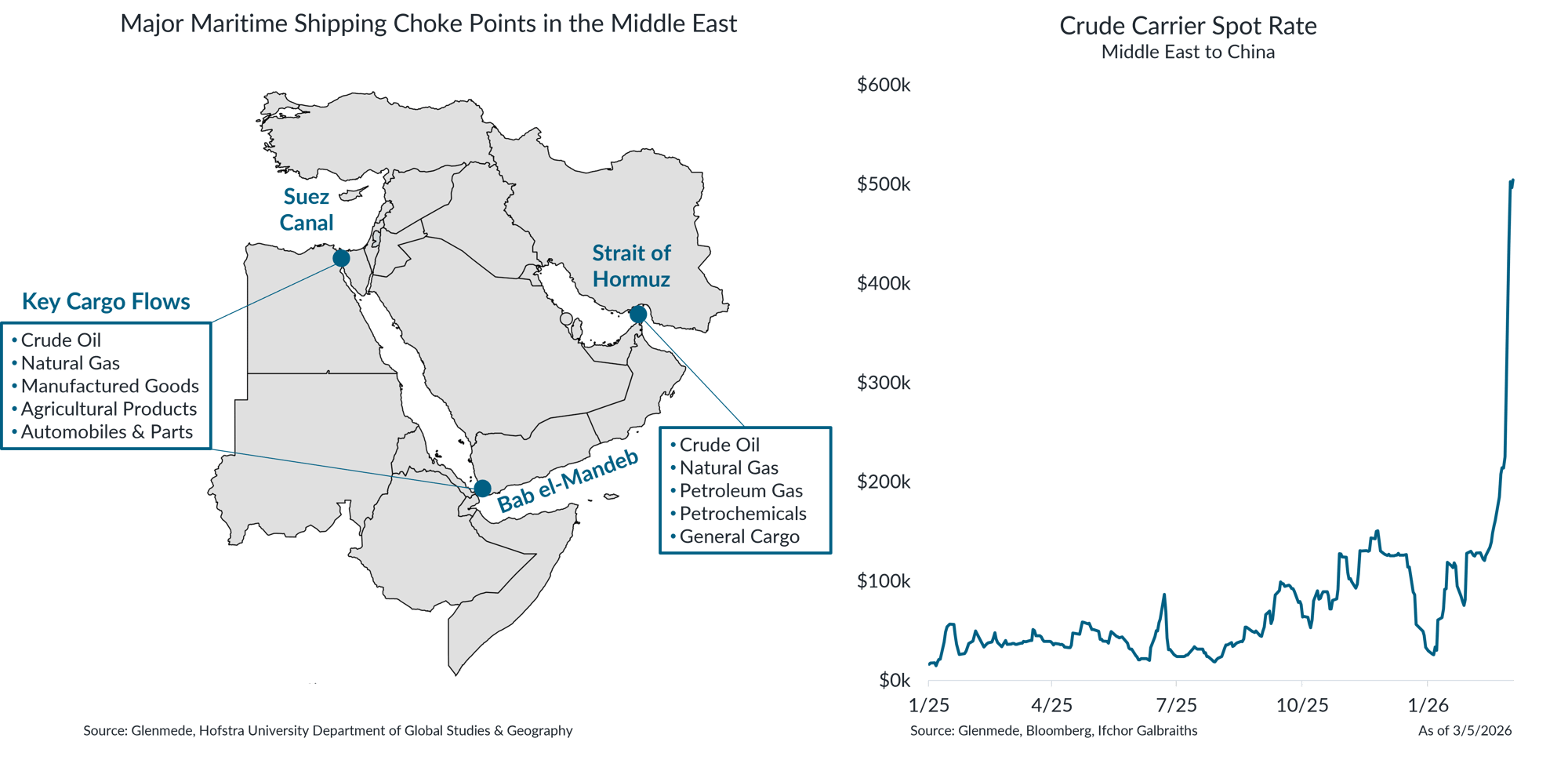
Shown on the left is a map of the Middle East and parts of Africa, with blue dots representing major maritime shipping choke points in the region. Manufactured goods include items such as electronics, textiles, appliances, and other similar goods. Shown on the right are the daily spot freight rates for very large crude carriers transporting crude oil from the Middle East to China, reflecting the prevailing market price for chartering a vessel on this route.
- Any disruption at the Strait of Hormuz, Bab el-Mandeb, or Suez Canal would likely hinder global flows of crude oil, natural gas, and manufactured goods, with the most immediate effects felt in Europe and Asia given their heavier reliance on these maritime trade routes.
- The cost to hire an oil tanker to transport crude from the Middle East to China has risen sharply in response to the conflict, indicating that the risk of disruption at these choke points can quickly drive up shipping costs and energy prices.
Shutting down Iran’s oil fields would be significant, but OPEC spare capacity may help to fill the gap
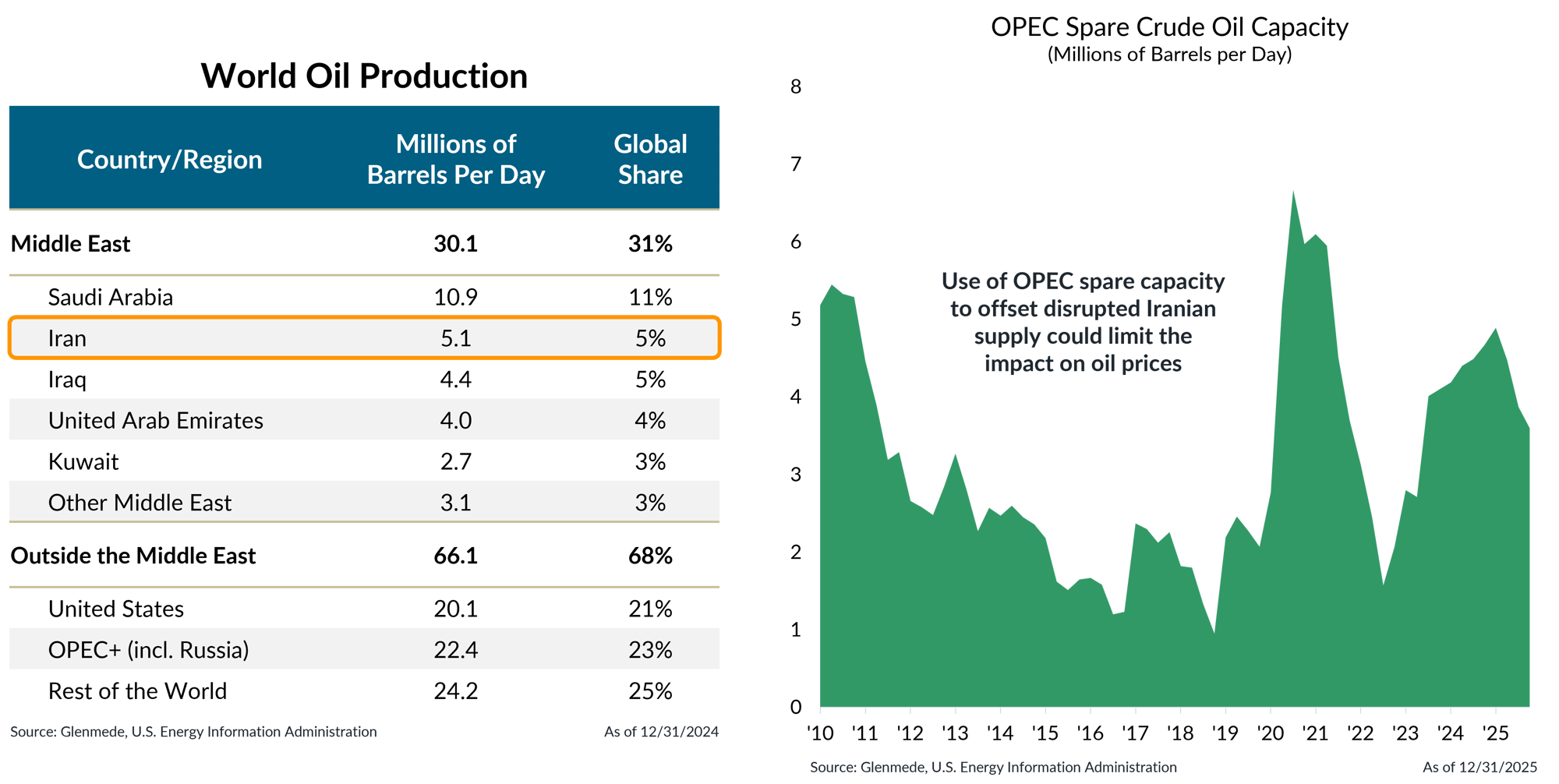
Shown on the left is a country/region breakdown of global oil production, measured in millions of barrels per day and the percentage contribution to global production. Shown on the right is the Organization of the Petroleum Exporting Countries’ (OPEC) spare crude oil production capacity (i.e., the amount of daily production that can be brought online within 30 days time) in millions of barrels per day.
- Iran accounts for roughly 5% of global oil production, but existing spare crude production capacity within OPEC could be sufficient to offset a potential loss of Iranian supply. However, getting that spare capacity to market would likely require free and safe shipping lanes.
- Broader or more prolonged disruptions that also impact other regional producers would be far more difficult to replace and could pose greater upside risk to oil prices.
Markets react to major conflicts, but lasting effects typically occur only when they coincide with recessions
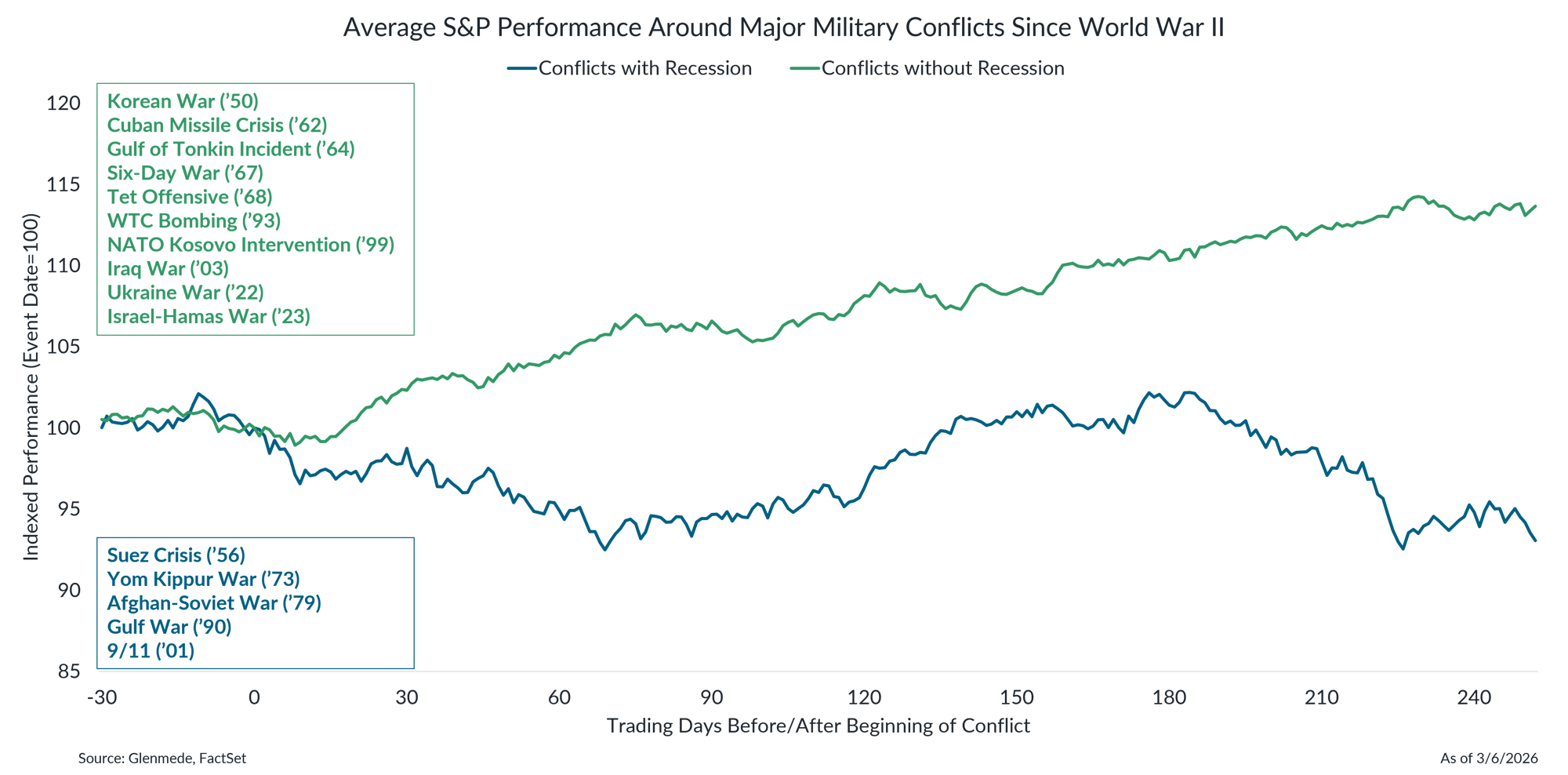
Shown is the performance of the S&P 500 excluding dividends, indexed to 100 at the start of several major military conflicts since World War II. Events are categorized as “Conflicts with Recession” if the U.S. economy was in a state of recession at any point in the 12-month period following the start of the conflict, as defined by the National Bureau of Economic Research. The S&P 500 is a market capitalization weighted index of large cap stocks in the U.S. Past performance may not be indicative of future results. One cannot invest directly in an index.
- Since World War II, U.S. equities have generally delivered positive returns following major military conflicts as long as economic growth remained intact, suggesting that geopolitics alone has not typically derailed markets.
- Periods of sustained equity market weakness have been more closely tied to conflicts that contributed to or occurred alongside recessions, reinforcing that macroeconomic conditions rather than military events themselves have been the primary drivers of market outcomes.
Rising oil prices and Middle East uncertainty are unlikely to push the U.S. into recession
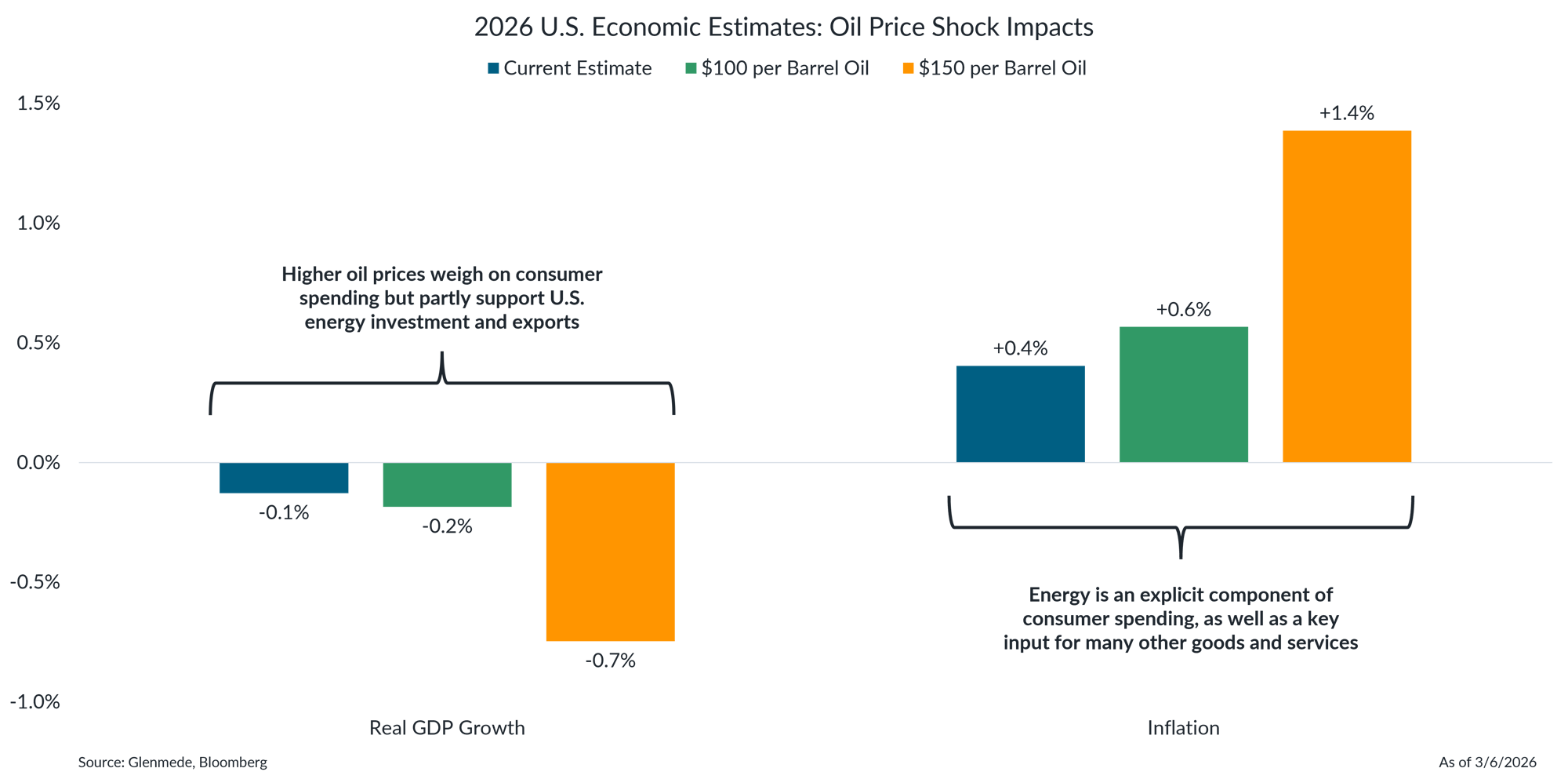
Data shown are Glenmede’s estimates for the impact on U.S. real gross domestic product growth and Consumer Price Index inflation for 2026 under three scenarios for a Q1 2026 oil price shock: Current Estimate refers to the prevailing price of crude oil as of the latest date shown; $100 Oil assumes crude oil prices rise to $100 per barrel; $150 Oil assumes crude oil prices rise to $150 per barrel. Actual results may differ materially from estimates.
- Although an oil price shock would likely weigh on real GDP growth, the estimated drag should be significantly less than prior oil price shocks in U.S. history. The U.S. is now a net exporter of energy products, so higher prices may lead to more exports and additional capital expenditures to undertake new extraction projects.
- However, the inflationary impact may be more significant, reflecting energy’s direct effect on household spending as well as its broader role as a key input in the production and transportation of goods and services.
- Investors should continue to monitor the situation as it continues to evolve and watch for unexpected second-order effects.
For more in-depth information on this topic, please reach out to your Glenmede Relationship Manager.

This material is provided solely for informational and/or educational purposes and is not intended as personalized investment advice. Interpretations of rules and statutes may be subject to legal review which could differ from the opinions expressed here or otherwise change conclusions. When provided to a client, advice is based on the client’s unique circumstances and may differ substantially from any general recommendations, suggestions or other considerations included in this material. Any opinions, recommendations, expectations or projections herein are based on information available at the time of publication and may change thereafter. Information obtained from third-party sources is assumed to be reliable but may not be independently verified, and the accuracy thereof is not guaranteed. Any company, fund or security referenced herein is provided solely for illustrative purposes and should not be construed as a recommendation to buy, hold or sell it. Outcomes (including performance) may differ materially from any expectations and projections noted herein due to various risks and uncertainties. Any reference to risk management or risk control does not imply that risk can be eliminated. All investments have risk. Clients are encouraged to discuss any matter discussed herein with their Glenmede representative.