

Investment Strategy Brief
Small Cap: Evaluating
the Size Premium
February 15, 2026

Executive Summary
- U.S. small cap equities have underperformed large caps in recent years, breaking from a long history of outperformance.
- U.S. small cap underperformance has mostly been a function of changes in valuations rather than underlying fundamentals.
- Relative performance has been shaped by large cap tech’s outsized gains and private markets retaining earlier-stage companies.
- More favorable valuations leave more room for upside, allowing earnings growth to drive longer term returns.
- Valuations, improving earnings, and a supportive macro backdrop suggest small caps can play a meaningful role in diversified portfolios.
U.S. small cap has historically exhibited a meaningful return premium
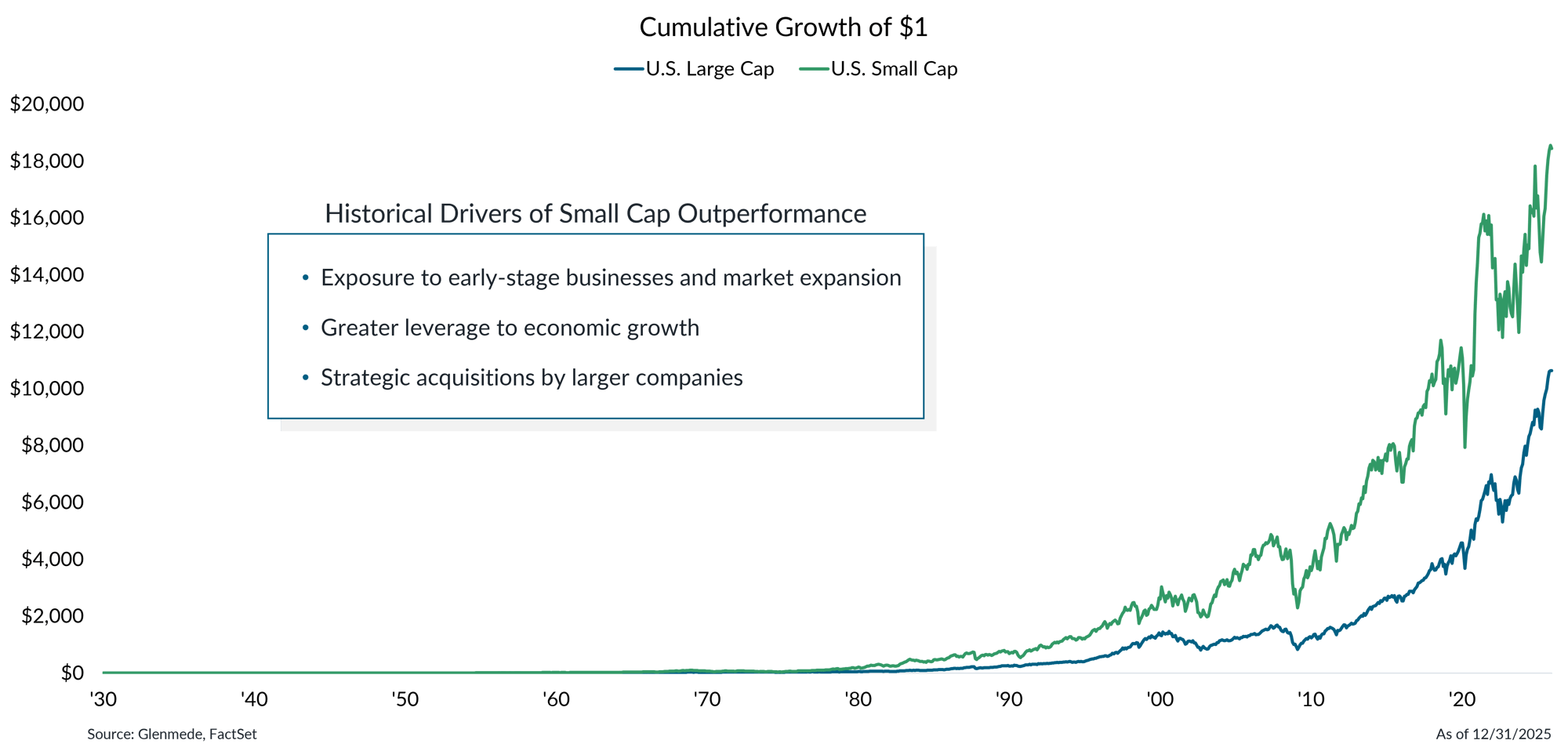
Shown are the hypothetical growth trajectories of $1 invested in each asset class on the first date shown, assuming reinvestment of all dividends and interest. The asset class returns shown reflect the returns of the following indices: U.S. Large Cap (S&P 500, backfilled with returns for the S&P composite based on data provided by Robert Shiller prior to 1970) and U.S. Small Cap (Russell 2000, backfilled with returns via Ibbotson prior to 1979). The list of historical drivers of small cap outperformance is not intended to be exhaustive, as other factors may contribute to the relative performance between larger and smaller companies. Past performance may not be indicative of future results. One cannot invest directly in an index.
- Historically, small caps have played a distinct role in diversified portfolios, offering earlier-stage growth exposure, greater sensitivity to economic inflection points, and a return profile that complemented more mature, capital-intensive large cap firms.
- In recent years, this relationship has shifted, with the performance gap between large and small cap equities widening materially over the past five to ten years, marking a clear break from prior cycles.
U.S. small cap underperformance has mostly been a function of changes in valuations
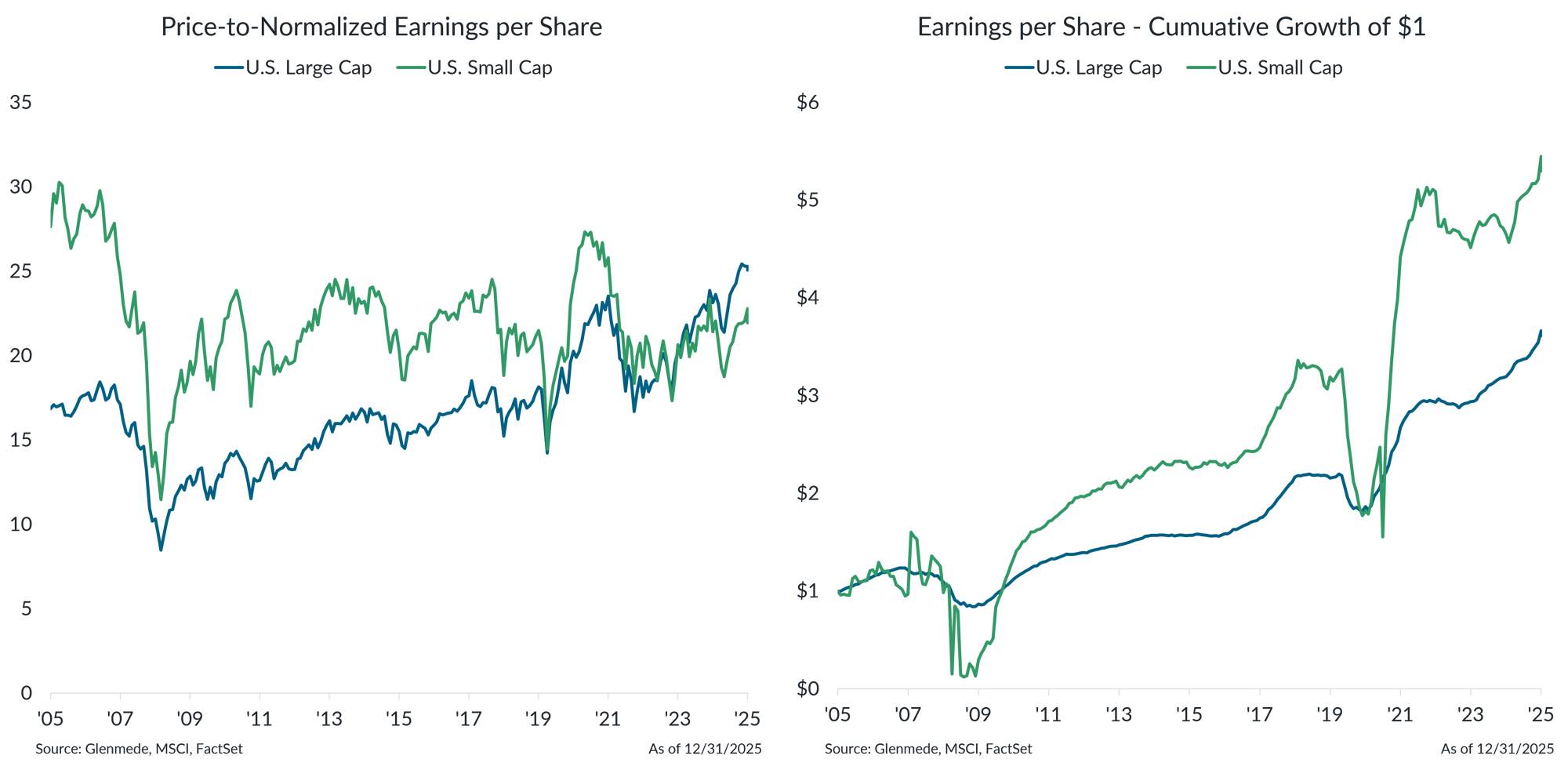
Shown on the left are price-to-normalized earnings ratios for U.S. Large Cap and U.S. Small Cap. Shown on the right are the cumulative growth in last-twelve-months earnings per share for U.S. Large Cap and U.S. Small Cap. U.S. Large Cap is represented by the MSCI USA index and U.S. Small Cap is represented by the MSCI USA Small Cap index. Past performance may not be indicative of future results. One cannot invest directly in an index.
- Changes in valuation multiples have been a meaningful driver of small cap underperformance, as the price investors are paying for a dollar of small cap earnings has remained relatively consistent alongside the upward trend for large caps.
- This phenomenon may reflect shifting investor preferences, differences in perceived earnings durability, and the rising importance of scale advantages across many industries.
- The longer-term earnings growth trend has been bumpy but has remained relatively intact. This suggests that recent underperformance is mostly a valuation story rather than one underpinned by structural fundamental deterioration.
Private equity may have kept some key technology companies out of the small cap indexes
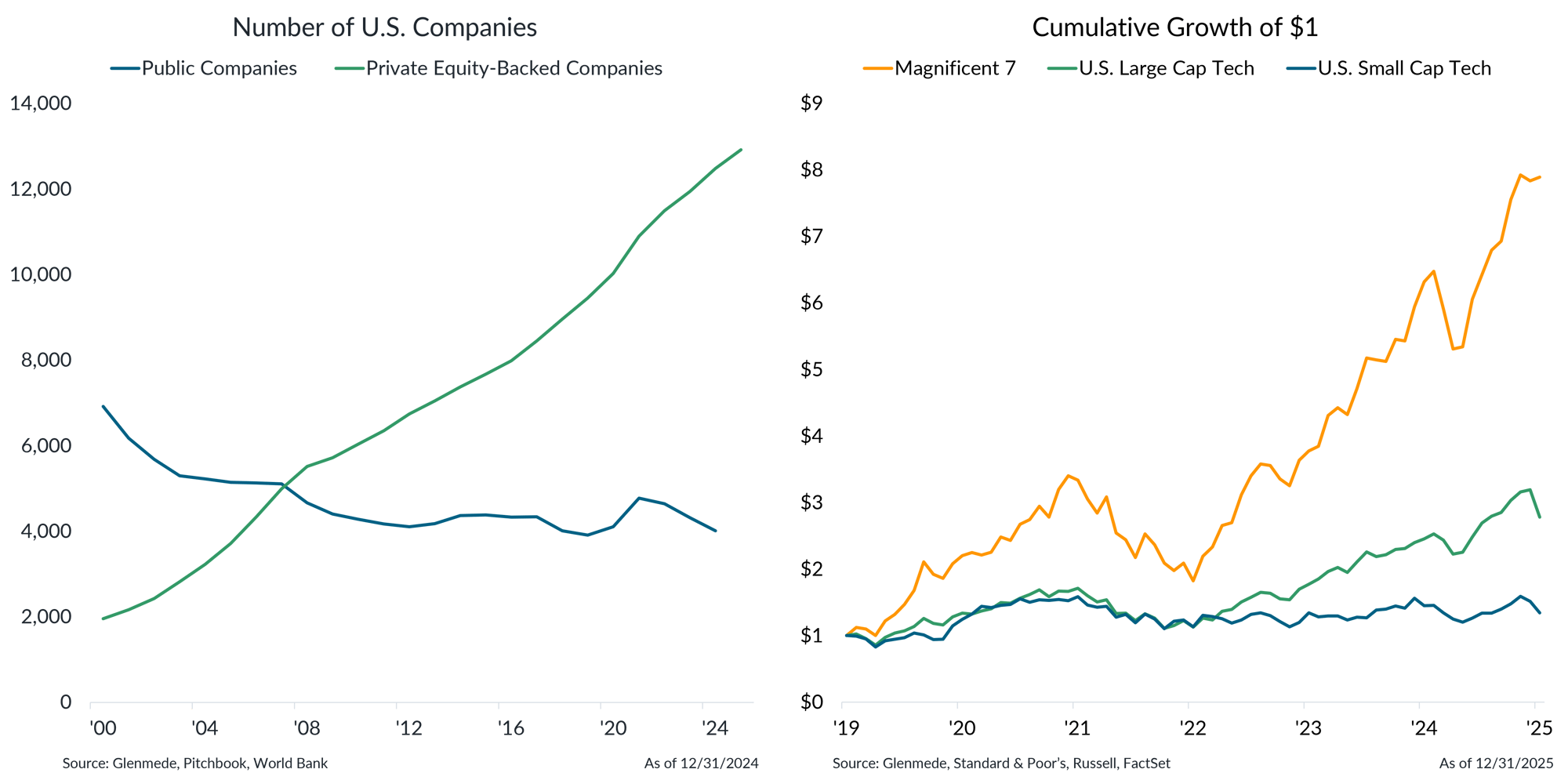
Shown on the left is the number of U.S. public companies listed on the New York Stock Exchange and Nasdaq in blue and the number of private equity-backed companies in the U.S. in green. Shown on the right are the cumulative growth of $1 invested in the Magnificent 7 and the information technology sectors for U.S. Large Cap and U.S. Small Cap based on the S&P 500 and Russell 2000 indices, respectively. The Magnificent 7 includes Apple, Amazon, Alphabet, Meta, Microsoft, Nvidia, and Telsa. Past performance may not be indicative of future results. One cannot invest directly in an index.
- The proliferation of private equity has allowed many tech companies to stay private longer. As the number of publicly-listed firms has steadily declined, this has narrowed the small cap opportunity set.
- In fact, not a single company in the Magnificent 7 has ever been a constituent of major small cap indexes. They each stayed private until they were large enough to go public at mid or large cap valuations.
- The recent outperformance of large cap has predominantly been a technology phenomenon. Large cap tech and tech-adjacent sectors have outperformed their smaller counterparts, with no small contribution from the Magnificent 7.
The performance of small cap technology has been a more persistent headwind than other factors
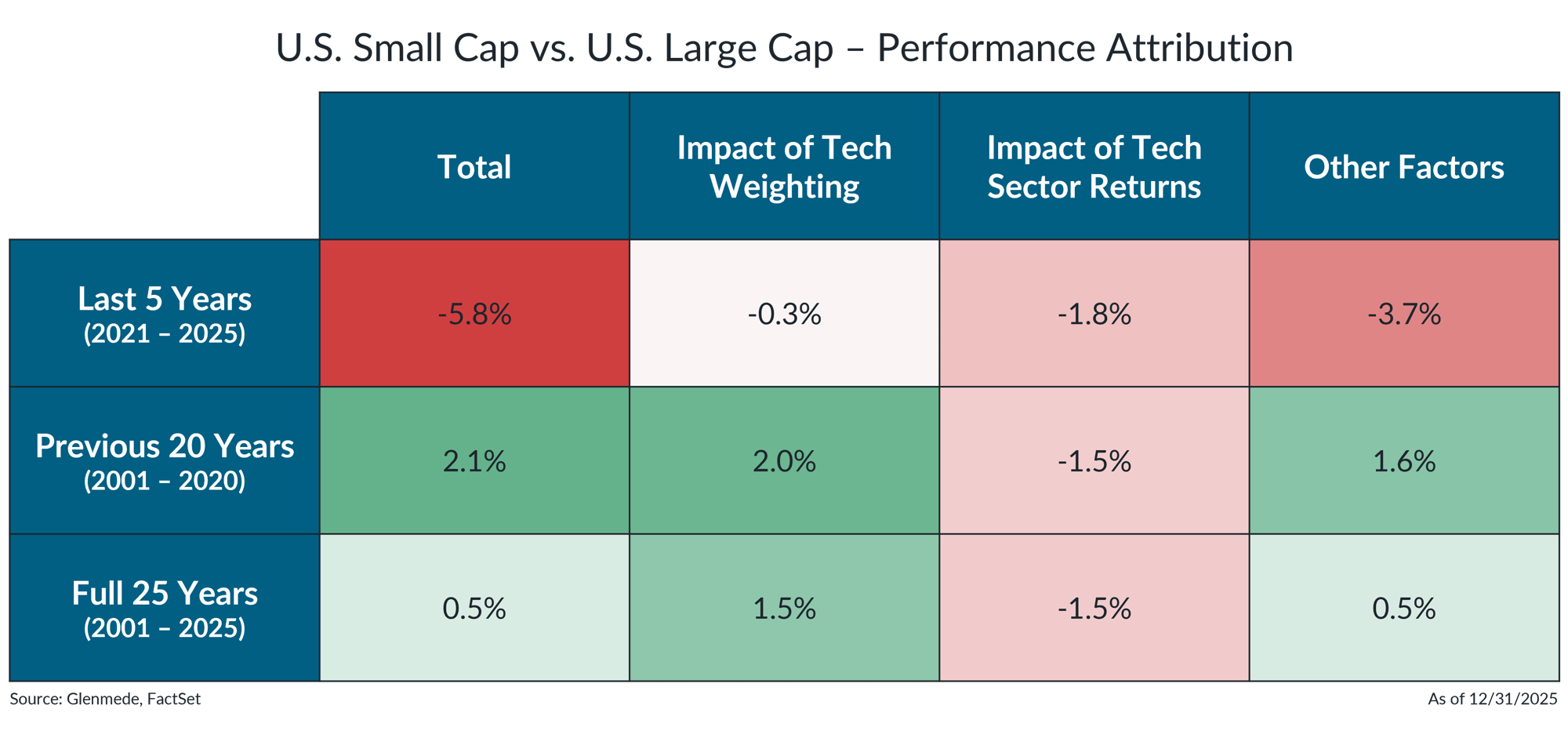
The table shown is an attribution of total returns based on the relative performance of MSCI USA and MSCI USA Small Cap Indices and sectors. Impact of Tech Allocation reflects the difference between the relative performance of the parent indices and reconstructed indices in which the sectors are equally weighted. Impact of Tech Performance reflects the difference between the relative performance of the reconstructed sector-equal-weighted indices and reconstructed sector-equal-weighted indices excluding the technology and communications sectors. Past performance may not be indicative of future results. One cannot invest directly in an index.
- Over the past five years, sector effects – both the impact of the smaller allocation to technology, as well as the relative performance of small cap and large cap tech—accounted for a substantial share of small cap underperformance.
- The performance of the companies within the technology and tech-adjacent sectors themselves, not necessarily the size of the sectors, has been one of the most consistent factors of small cap’s relative performance over the last 25 years.
More favorable valuations leave more room for upside, allowing earnings growth to drive longer term returns
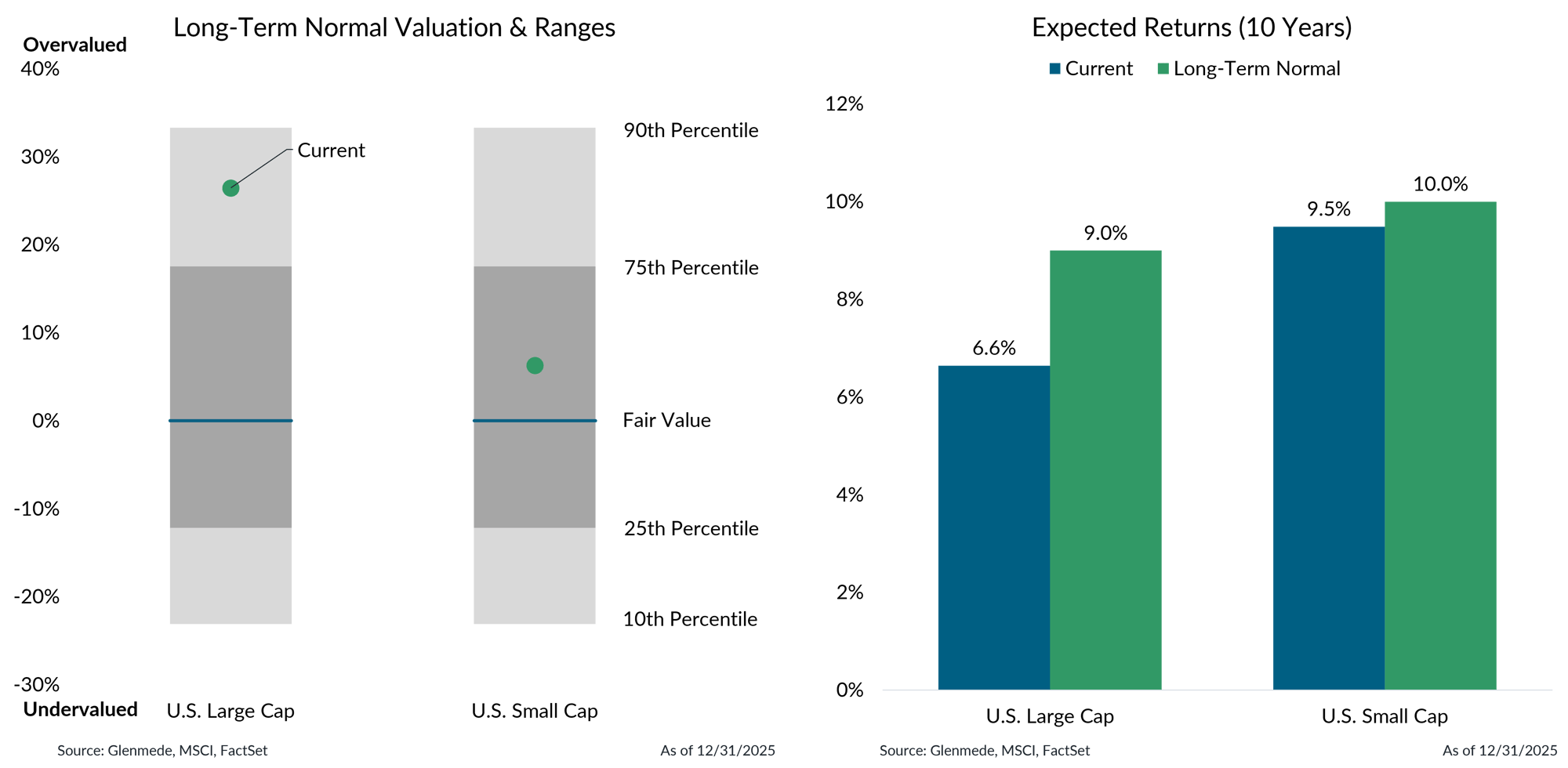
Data shown on the left are Glenmede’s estimates of long-term fair value for U.S. Large Cap (MSCI USA) and U.S. Small Cap (MSCI USA Small) based on normalized earnings, normalized cash flows, dividend yield, and book value for each index. Data shown on the right are Glenmede’s estimates of returns for the next 10 years and the long-term for the same indices. Long-Term Normal expected returns reflect how asset classes should behave over long periods of time on an annualized basis, absent the influence of fluctuations in valuations or near-term fundamentals. Glenmede’s estimates of fair value and expected returns are arrived at in good faith, but actual results may differ from expectations. One cannot invest directly in an index.
- Valuation measures indicate U.S. small caps now offer a more favorable relative entry point versus recent years, even without a material shift in sector composition.
- Improving earnings trajectories, easing cost pressures, and gradual normalization of financing conditions suggest modest growth improvements could have an outsized impact on returns.
- A more supportive macroeconomic environment, including greater interest-rate stability and targeted fiscal or industrial policy initiatives, may further benefit smaller, domestically oriented companies.
For more in-depth information on this topic, please reach out to your Glenmede Relationship Manager.

For a deeper analysis of U.S. small-cap opportunities, read the Investment Strategy & Research team’s latest white paper.
This material is provided solely for informational and/or educational purposes and is not intended as personalized investment advice. When provided to a client, advice is based on the client’s unique circumstances and may differ substantially from any general recommendations, suggestions or other considerations included in this material. Any opinions, recommendations, expectations or projections herein are based on information available at the time of publication and may change thereafter. Information obtained from third-party sources is assumed to be reliable but may not be independently verified, and the accuracy thereof is not guaranteed. Any company, fund or security referenced herein is provided solely for illustrative purposes and should not be construed as a recommendation to buy, hold or sell it. Outcomes (including performance) may differ materially from any expectations and projections noted herein due to various risks and uncertainties. Any reference to risk management or risk control does not imply that risk can be eliminated. All investments have risk. Clients are encouraged to discuss any matter discussed herein with their Glenmede representative.