

Investment Strategy Brief
Supreme Court Decision: Order in the Imports
February 22, 2026

Executive Summary
- The Supreme Court has ruled some tariffs illegal, which may have notable economic implications.
- The existing tariff regime may be quickly replaced via different means in largely the same shape and form.
- The ruling may have a material impact on net tariff collections this year if refunds occur.
- The tariff ruling should marginally enhance the already sizable fiscal stimulus predicted for this year.
- The tariff decision is likely to be an incremental tailwind for the U.S. economy, reinforcing expectations for above-trend growth in 2026.
The Supreme Court has ruled some tariffs illegal, which may have notable economic implications
.png?width=2000&height=1038&name=IS%20Brief%202026-02-23%20Chart%201%20(1).png "IS Brief 2026-02-23 Chart 1 (1)")
Shown on the left are Glenmede’s estimates of the amount of customs duties collected by the U.S. federal government since the start of 2025 through the latest date shown in billions of U.S. dollars, categorized by the authority used to impose them. IEEPA refers to the International Emergency Economic Powers Act of 1977.
- The Supreme Court has ruled that tariffs imposed under IEEPA authority are illegal, removing the legal basis for more than half of total duties collected since early 2025.
- While the Court ruled against the use of IEEPA to impose tariffs, it did not expressly mention whether refunds must occur, leaving the timing, scope, and process for any potential tariff repayments unresolved.
The existing tariff regime may be quickly replaced via different means in largely the same shape and form
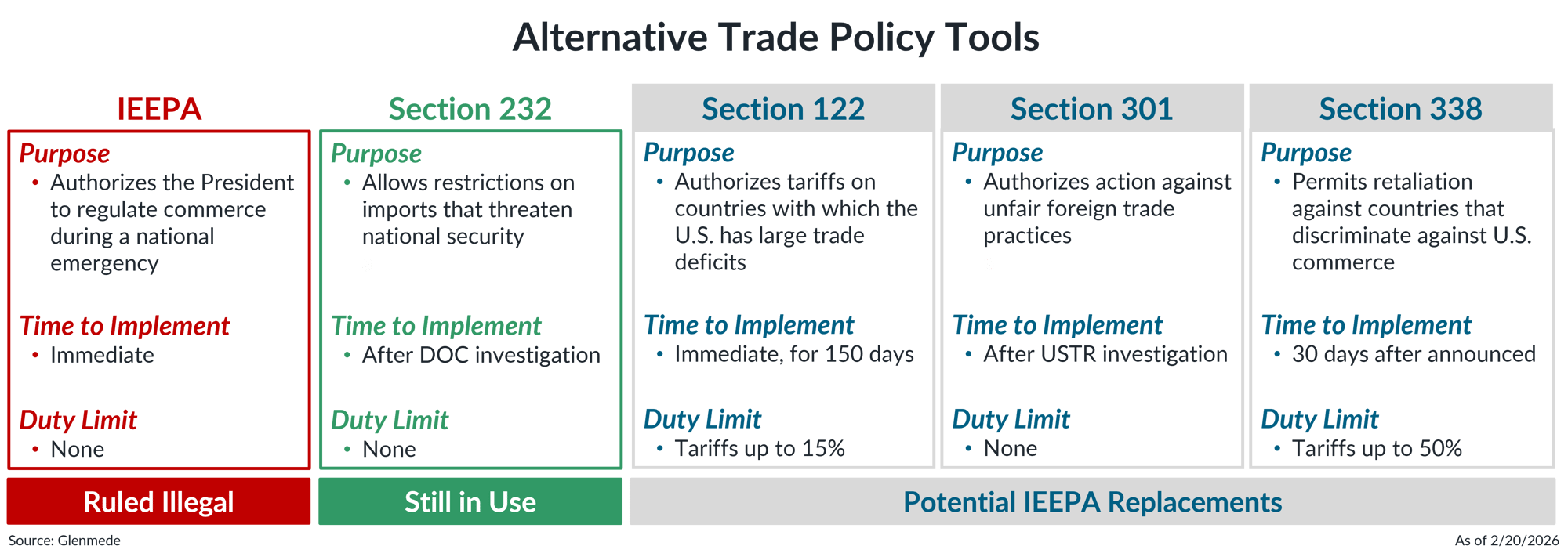
The information shown outlines some legal provisions that grant the President and Congress authority to manage trade policy. The International Emergency Economic Powers Act of 1977 (IEEPA) authorizes the President to regulate international commerce after declaration of a national emergency or in response to threats to the U.S. The Trade Expansion Act of 1962: Section 232 delegates congressional authority to the President to impose import restrictions that threaten national security. The Trade Act of 1930: Section 338 grants the President the authority to impose tariffs of up to 50% on imports from countries that discriminate against the U.S. The Trade Act of 1974: Section 122 authorizes the President to address a balance of payments deficit or to prevent an imminent and significant depreciation in the dollar. The Trade Act of 1974: Section 301 authorizes the President to take appropriate action in response to unreasonable or discriminatory burdens to U.S. commerce. DOC refers to the U.S.Department of Commerce. USTR refers to the Office of the United States Trade Representative. The options shown are not exhaustive, may be subject to judicial review, and actual trade actions taken may differ materially from those described.
- Although the tariffs imposed under IEEPA have been ruled illegal, the administration has several other tools at its disposal to re-deploy tariffs in roughly the same shape and form as they exist today.
- Existing frameworks–including Sections 232, 122, 301, and 338–provide alternative statutory bases with different timelines and duty caps, shaping how replacement tariffs would be implemented relative to IEEPA.
The ruling may have a material impact on net tariff collections this year if refunds occur
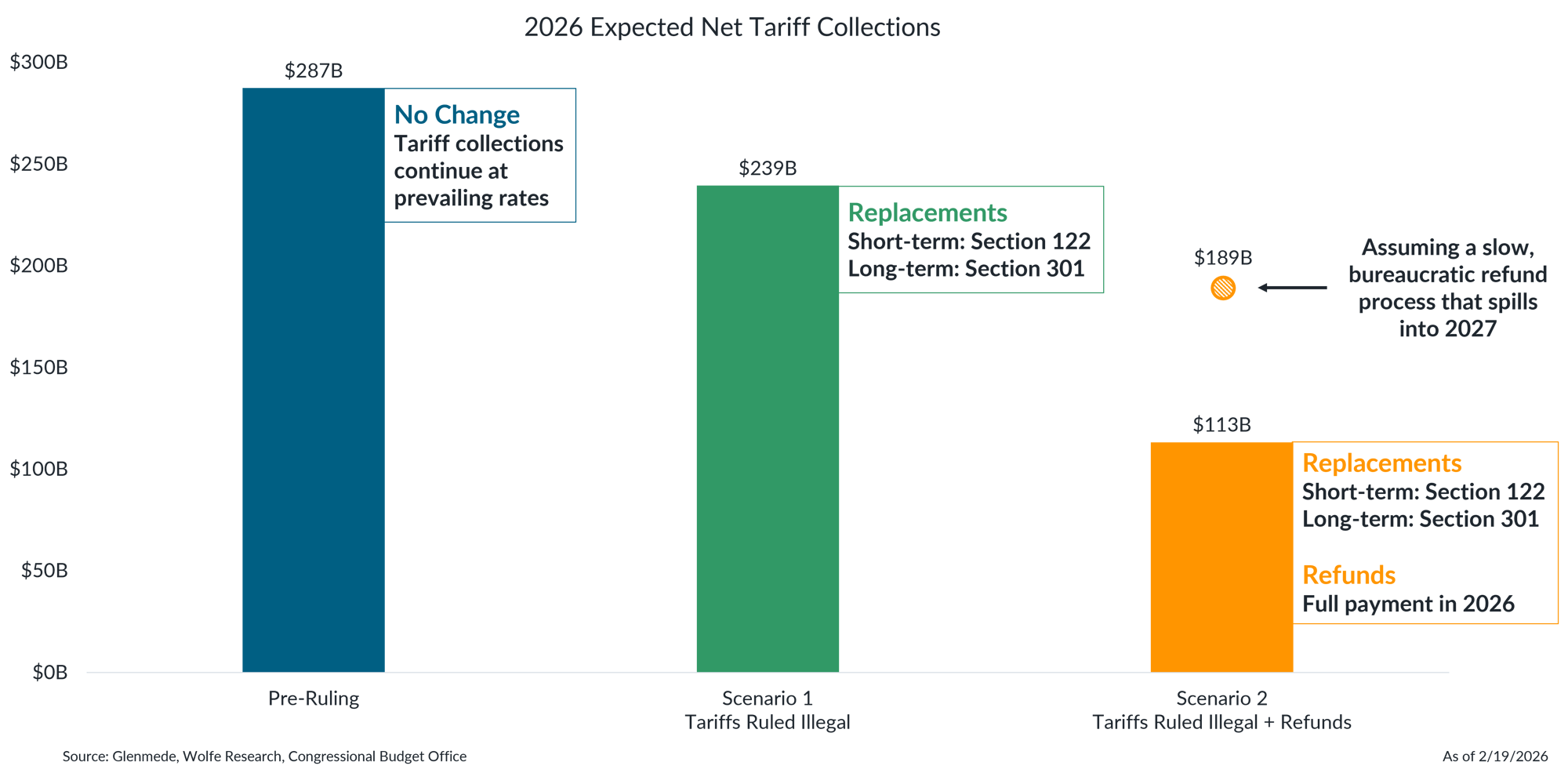
Shown are expectations for net tariff collections in 2026 (i.e., customs receipts less refunds) for 2026. Pre-Ruling refers to the expected level of revenues assuming the Supreme Court had not struckdown the use of International Emergency Economic Powers Act (IEEPA) to enact tariffs. Scenario 1 assumes IEEPA tariffs are replaced with Section 122 tariffs as a stopgap measure until theimposition of Section 301 tariffs. Scenario 2 is the same as Scenario 1, except for an additional adjustment due to refunds. Actual results may differ materially from expectations or projections.
- The administration is likely to use Section 122 tariffs as a near-term stopgap measure until it can conduct full Section 301 investigations if it wishes to fully reimpose duties.
- The amount of net tariffs collected this year (i.e., duties received minus refunds paid) may vary depending on whether refunds occur.
- If refunds occur, this could have a meaningful impact on net collections this year. However, the details of that process will matter—if the process turns into a slow, bureaucratic undertaking, some of those refunds may not come until next year.
The tariff ruling should marginally enhance the already sizable fiscal stimulus predicted for this year
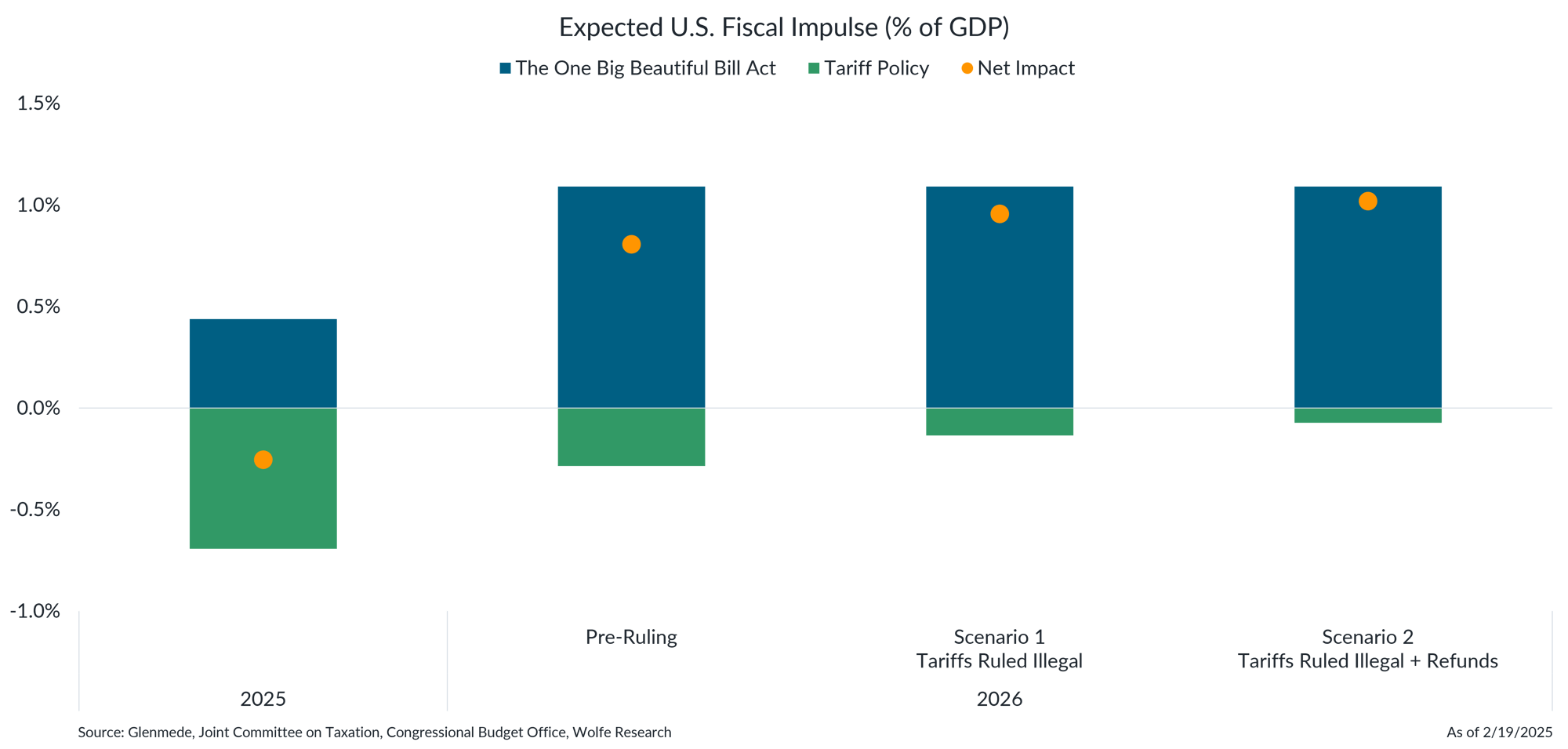
Shown are the expected fiscal stimulus effects for 2025 and 2026 due to key policy changes associated with The One Big Beautiful Bill Act (OBBBA) and Glenmede’s projections for revenuesgenerated by new tariffs. Shown are expectations for net tariff collections in 2026 (i.e., customs receipts less refunds) for 2026. Pre-Ruling refers to the expected level of revenues assuming theSupreme Court had not struck down the use of International Emergency Economic Powers Act (IEEPA) to enact tariffs. Scenario 1 assumes IEEPA tariffs are replaced with Section 122 tariffs as astopgap measure until the imposition of Section 301 tariffs. Scenario 2 is the same as Scenario 1, except for an additional adjustment due to refunds. Actual results may differ materially fromexpectations or projections.
- Fiscal conditions already point to a sizably positive impulse in 2026, driven primarily by the One Big Beautiful Bill Act and supported by an easing monetary policy backdrop.
- Tariff implementation frictions (and potential refunds) could add an incremental layer of stimulus, amplifying growth support on top of existing tailwinds.
- However, investors may want to be on the lookout for a net exports-driven slowdown in the near term. If businesses attempt to benefit from lower duties by accelerating imports, this could lead to a temporary headwind to economic growth since imports are a subtraction in GDP calculations.
For more in-depth information on this topic, please reach out to your Glenmede Relationship Manager.

This material is provided solely for informational and/or educational purposes and is not intended as personalized investment advice. Interpretations of rules and statutes may be subject to legal review which could differ from the opinions expressed here or otherwise change conclusions. When provided to a client, advice is based on the client’s unique circumstances and may differ substantially from any general recommendations, suggestions or other considerations included in this material. Any opinions, recommendations, expectations or projections herein are based on information available at the time of publication and may change thereafter. Information obtained from third-party sources is assumed to be reliable but may not be independently verified, and the accuracy thereof is not guaranteed. Any company, fund or security referenced herein is provided solely for illustrative purposes and should not be construed as a recommendation to buy, hold or sell it. Outcomes (including performance) may differ materially from any expectations and projections noted herein due to various risks and uncertainties. Any reference to risk management or risk control does not imply that risk can be eliminated. All investments have risk. Clients are encouraged to discuss any matter discussed herein with their Glenmede representative.