

Investment Strategy Brief
The Case Against the AI Doom Loop
March 1, 2026

Executive Summary
- Artificial intelligence (AI) may augment more workstreams than it automates, helping reshape job descriptions rather than simply eliminating them.
- The creative destruction that comes with innovation creates opportunities as new industries and roles emerge.
- Innovation can ease persistent price pressures, putting sustained downward pressure on inflation.
- Despite concerns, historical precedents suggest that AI’s broader economic effects may be more adaptive than destabilizing.
Concerns over the near-term economic impacts of AI led to considerable volatility to start last week
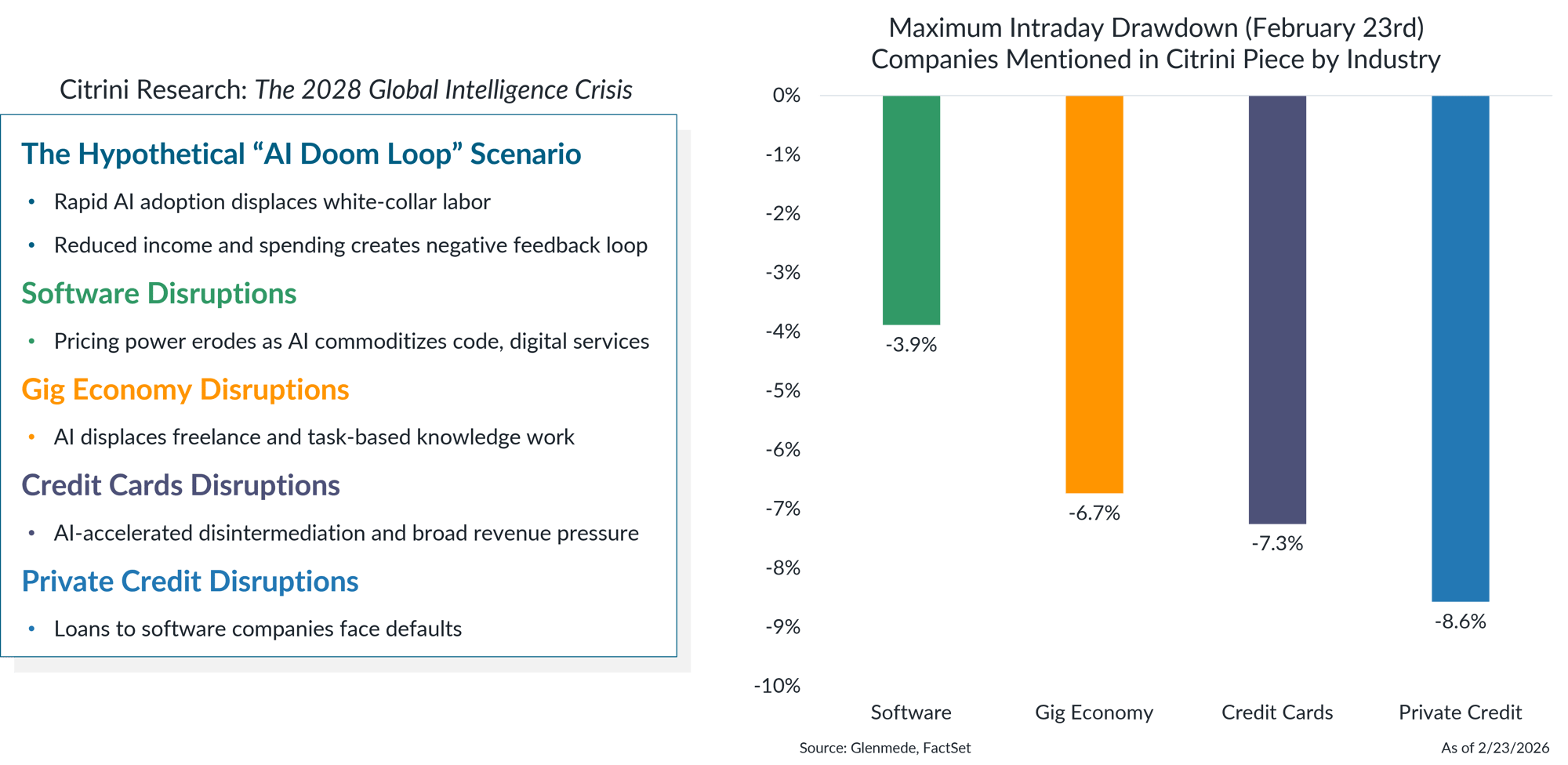
Shown on the left is a synopsis of Citrini Research’s “The 2028 Global Intelligence Crisis.” Shown on the right is the maximum intraday drawdown on February 23, 2026, for U.S.-based publicly-traded companies that were mentioned in the article, grouped by industry. Each industry is an equal-weighted basket of the following: Software (Salesforce, ServiceNow, Asana), Gig Economy (DoorDash, Uber), Credit Cards (Mastercard, Visa, American Express, Synchrony, Capital One), Private Credit (Blackstone, Apollo, Blue Owl, KKR). Past performance may not be indicative of future results. This visual should not be interpreted as a recommendation to buy, hold, or sell any specific securities or group of securities .
- Markets reacted last week to a dire scenario outlined in an investment memo published by Citrini Research, which described a hypothetical future in which AI proliferation leads to a self-reinforcing economic downturn.
- The piece highlights a couple key truths about the promise held by AI. For all of history, one of our scarcest resources has been human or human-like intelligence. But while AI continues to make impressive advancements, there are many cases where it still falls short.
- The doom-loop scenario assumes that AI affects the economy in a vacuum with no knock-on effects. But the feedback loop runs in both directions; the powerful forces of creative destruction and technology deflation make the economy much more adaptable to change.
AI has meaningful potential, but there is a key difference between automation and augmentation of work
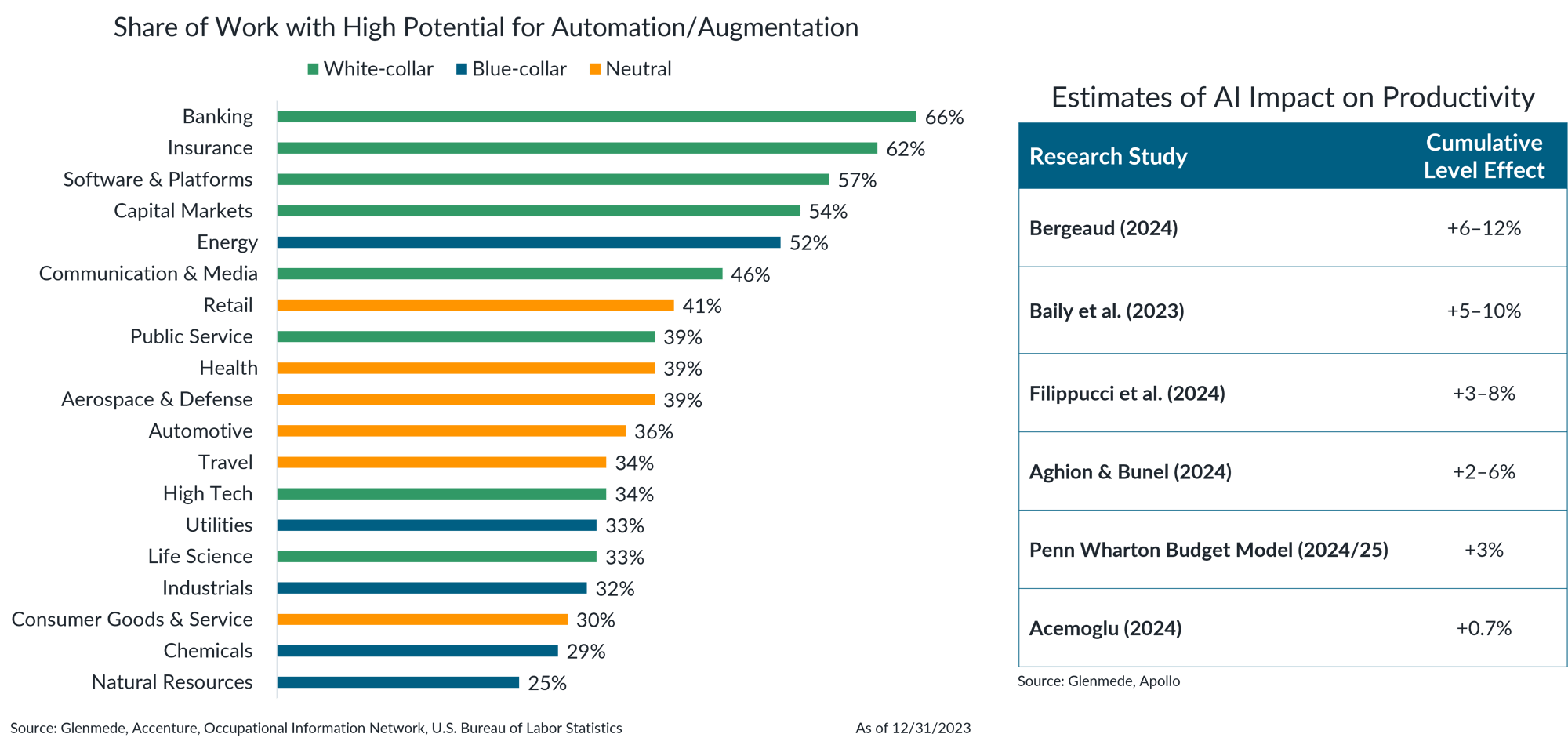
Data shown on the left are based on an analysis in which 200 tasks related to language were linked to industries using their share in each occupation and the occupations’ employment level in each job category. Tasks with high potential for automation are those taken over by large language models (LLMs) with reduced involvement from a human worker. Tasks with high potential for augmentation are those in which LLMs would need more involvement from human workers. Shown on the right are selected academic and policy research estimates of the potential impact of AI on productivity, including the cumulative level effects across varying study horizons, generally 10–20 years (10 years for Acemoglu (2024), 10–15 years for Baily et al. (2023), and 15–20 years for Filippucci et al. (2024)). Results are model-based, vary by methodology, and are subject to uncertainty. Actual results may differ materially from projections.
- The impact of AI on the labor market is likely to be more nuanced in practice. While there may be some opportunities for complete automation that displaces workers, there are others in which AI augments existing roles to make the humans occupying them more productive.
- The degree of impact that AI may have varies by industry, with white-collar sectors, such as banking, insurance, and software, showing the highest potential for AI-driven change.
- While the jury is still out on the extent to which AI may improve labor productivity, some academics have been pointing to material upside if AI meaningfully reallocates labor toward higher value-add activities.
New technologies can often reshape labor demand by expanding opportunities within industries
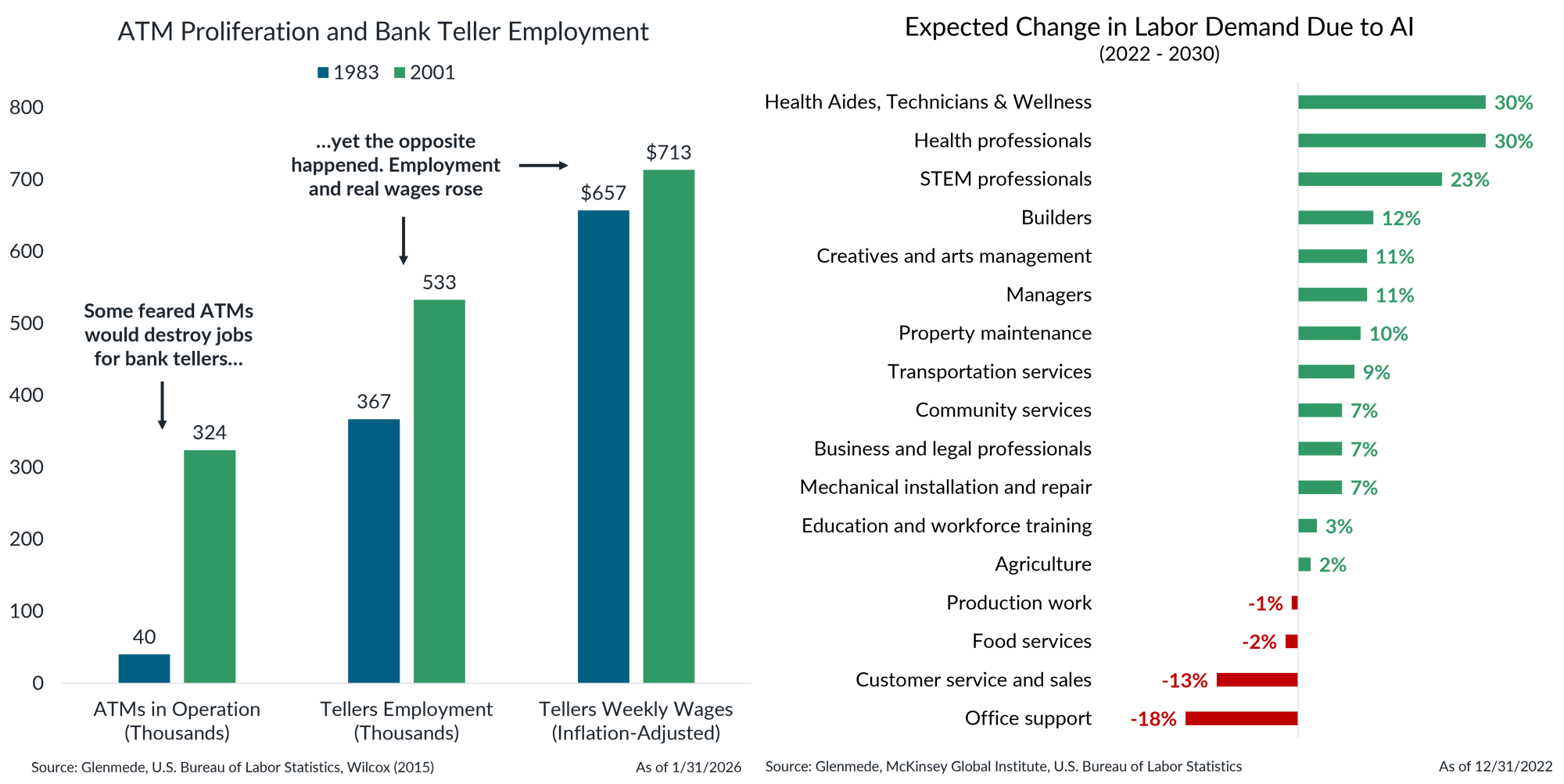
Shown on the left are figures for the U.S. retail banking industry, including the number of automated teller machines (ATMs), the number of persons employed as bank tellers, and the average weekly wages of those tellers, adjusted for inflation based on price levels as of the latest date shown. STEM refers to professions in science, technology, engineering, and mathematics. Shown on the right are projections for the change in demand for employees attributable to applications of AI in various roles by 2030. Actual results may differ materially from projections.
- There is often a perception that new technologies are coming to replace humans, but historical precedents suggest that they tend to reshape labor demand within industries rather than eliminate jobs, as automation changes the task mix and expands capacity.
- A good example of this in practice has been the rollout of ATMs. Decreasing the number of tellers needed per bank branch led to the opening of more branches, and the tellers instead focused on higher-touch transactions since the ATMs took care of the menial bill counting tasks.
- By allowing humans to focus on higher value tasks, AI has the potential to boost employment in many industries, highlighted by healthcare and STEM.
Creative destruction often creates new industries and jobs, a process that may already be underway
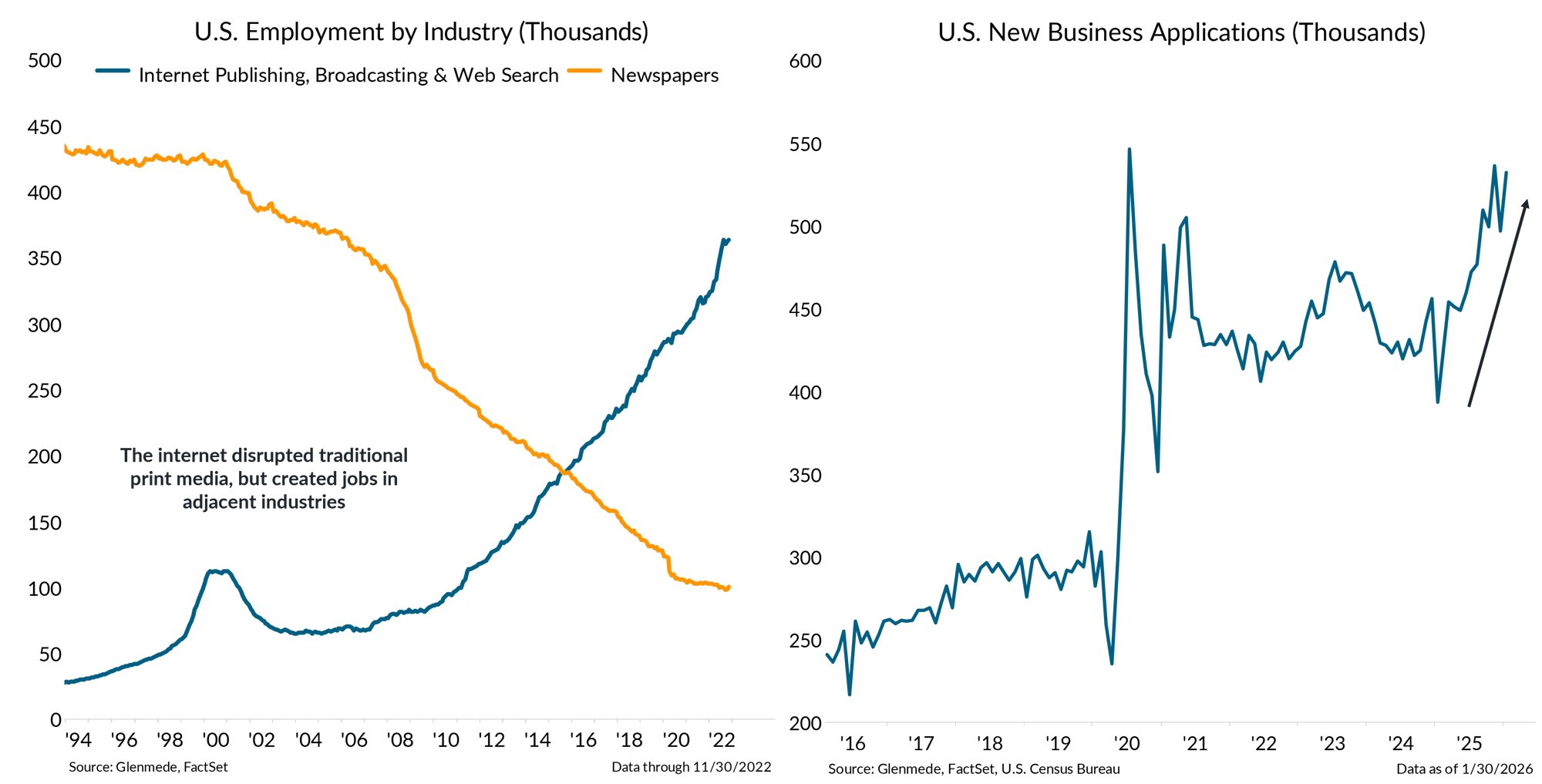
Shown on the left are the total number of employees in the U.S. for internet publishing, broadcasting, and web search (in blue) and newspaper publishing (in orange), each measured in thousands of employees. Shown on the right are monthly new business applications in the U.S., measured in thousands. Past performance may not be indicative of future results.
- While new technologies may displace some legacy industries, they have historically supported net job creation by enabling the emergence and expansion of entirely new sectors.
- The creative destruction process may already be underway; the number of new business applications has accelerated meaningfully over the last few years, as AI technology opens the door for new products and lowers hurdles for people to start new businesses.
Innovation can convert structural inflation into sustained downward pressure on prices
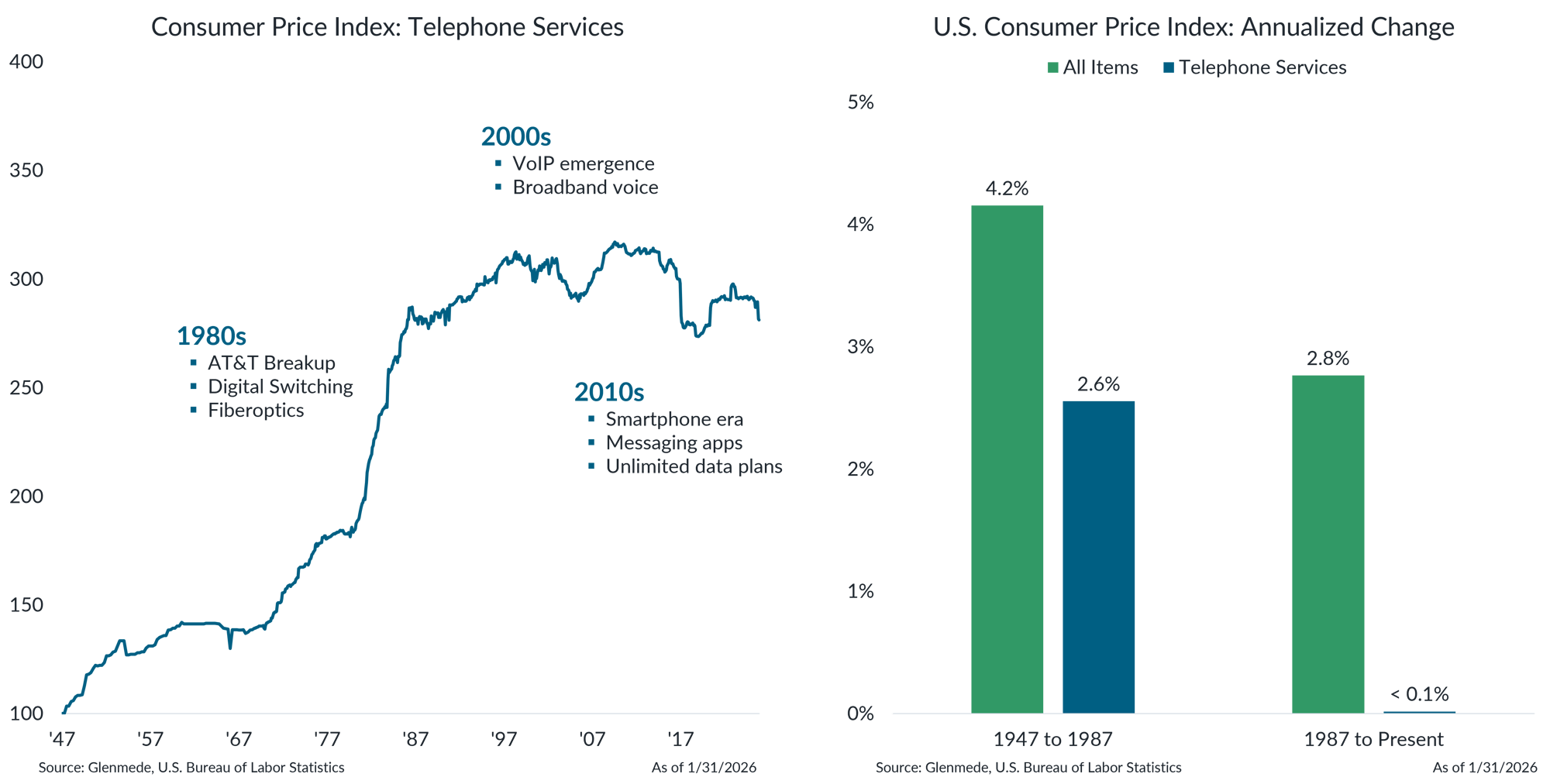
Shown on the left is the Consumer Price Index sub-component for telephone services, indexed to 100 on the first date shown. Shown on the right are the annualized rates of inflation for the standard U.S. Consumer Price Index in green and the sub-component for telephone services in blue. Past performance may not be indicative of future results.
- Innovation can transform structurally inflationary industries into deflationary ones, as technological advances reduce marginal costs, increase competition, and expand capacity over time.
- The costs of telephone services are a good case in point. After the breakup of AT&T and significant advancements in the underlying technologies, the costs of owning and operating a telephone have gone from a persistent contributor to inflation to a notable disinflationary force.
Consumers prefer human involvement over fully automated services
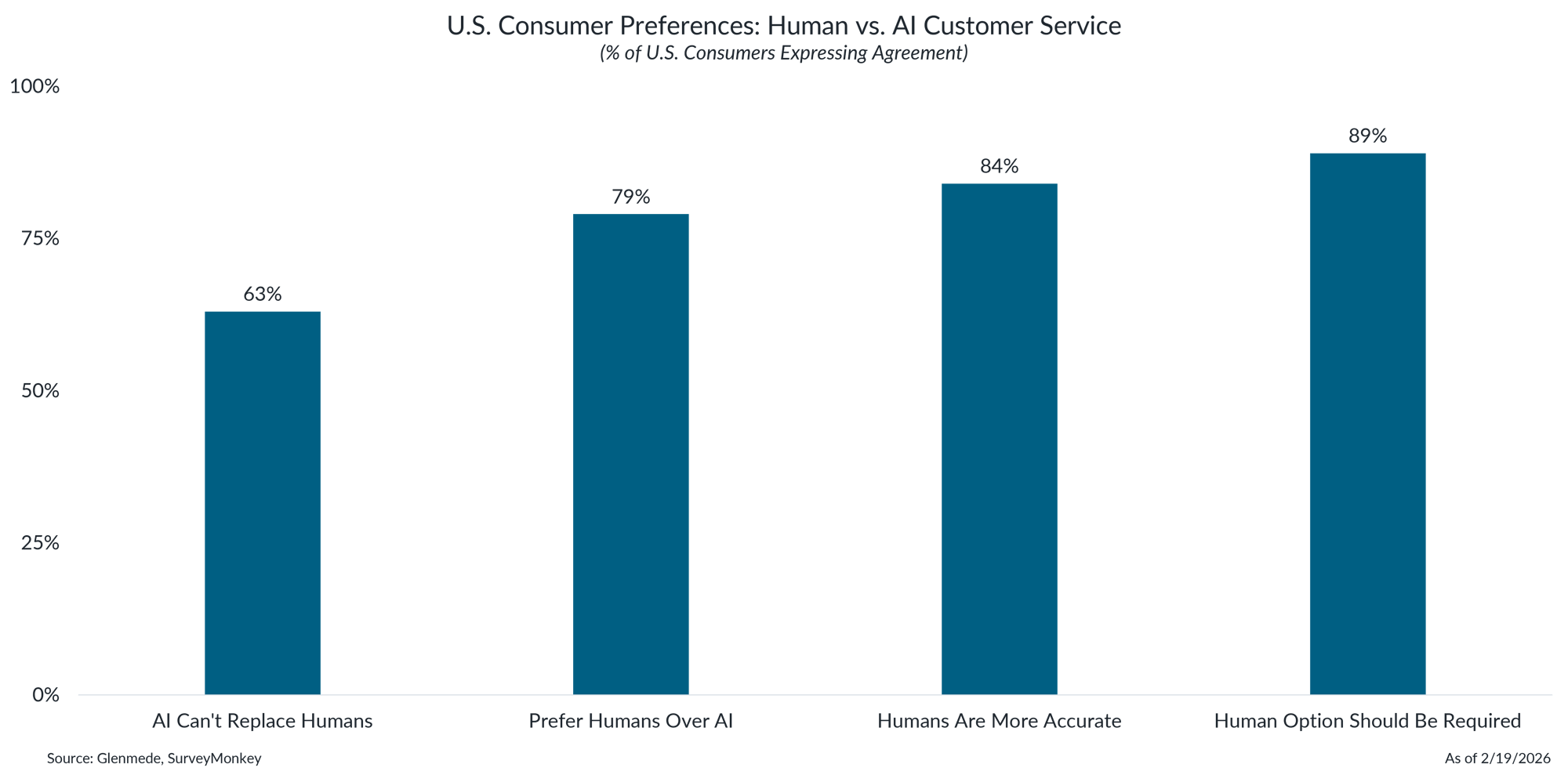
Shown is the result of an online survey conducted from December 10–11, 2025, among 2,017 U.S. adults ages 18+, drawn from a non‑probability online sample. Results are re-weighted for age, race, sex, education, and geography using the U.S. Census Bureau’s American Community Survey to reflect the overall demographic composition of the U.S.
- A hypothetical sci-fi future in which AI bots runs entire businesses without human intervention is not consistent with the vast majority of consumer preferences.
- Survey data indicate consumers continue to prefer human involvement in customer service, particularly for accuracy and accountability.
- This preference suggests there are practical limits to full automation in consumer-facing functions, even as AI adoption expands.
For more in-depth information on this topic, please reach out to your Glenmede Relationship Manager.

This material is provided solely for informational and/or educational purposes and is not intended as personalized investment advice. Interpretations of rules and statutes may be subject to legal review which could differ from the opinions expressed here or otherwise change conclusions. When provided to a client, advice is based on the client’s unique circumstances and may differ substantially from any general recommendations, suggestions or other considerations included in this material. Any opinions, recommendations, expectations or projections herein are based on information available at the time of publication and may change thereafter. Information obtained from third-party sources is assumed to be reliable but may not be independently verified, and the accuracy thereof is not guaranteed. Any company, fund or security referenced herein is provided solely for illustrative purposes and should not be construed as a recommendation to buy, hold or sell it. Outcomes (including performance) may differ materially from any expectations and projections noted herein due to various risks and uncertainties. Any reference to risk management or risk control does not imply that risk can be eliminated. All investments have risk. Clients are encouraged to discuss any matter discussed herein with their Glenmede representative.