

Investment Strategy Brief | June 7, 2026
Equity Market Exuberance: Rational or Irrational?

Executive Summary
-
The upcoming SpaceX initial public offering (IPO) is record-breaking in scale, highlighting the magnitude of market exuberance.
-
Both equity markets and bond yields have experienced a pronounced rise since the start of the year.
-
Equity valuations have become more stretched, though selective opportunities remain, while fixed income is increasingly attractive.
-
Converging expected returns have brought the probability of equity outperformance to its lowest level in almost two decades.
-
The narrowing gap between equities and fixed income provides a compelling case for proactive rebalancing.
The upcoming SpaceX IPO is record-breaking in scale, highlighting the magnitude of market exuberance
-
SpaceX is set to be the largest IPO on record, with a projected valuation of roughly $1.8 trillion, underscoring the level of enthusiasm in equity markets and a broader environment of elevated valuations.
-
Despite the headline figure, only 3 – 5% of SpaceX shares are expected to be publicly available after issuance, with the majority remaining closely held by existing investors.
-
As a result, SpaceX’s float adjusted weighting, if or when it is eventually added to the S&P 500 would be roughly 0.1% of the index. As of now, SpaceX is not expected to be immediately added to the index.
.png?width=1000&height=489&name=IS%20Brief%202026-06-08%20Chart%201%20(1).png "IS Brief 2026-06-08 Chart 1 (1)")
Shown are the five largest initial public offerings (IPOs) by market capitalization at listing and the total capital raised. SpaceX figures are estimated based on publicly reported anticipated deal terms, including expected valuation and capital to be raised. SpaceX’s free float as a percentage of total shares and the S&P 500 index weight, based on float-adjusted market capitalization, are derived from the anticipated deal terms. SpaceX is not expected to be included in the S&P 500 immediately. Past performance is not indicative of future results. Actual results may differ materially from expectations.
Both equity markets and bond yields have experienced a pronounced rise since the start of the year
-
Equity markets have seen notable movements since the start of the year, including a decline in March following the onset of the Middle East conflict and a sharp rebound after an end to the conflict seemed more likely, and a historically strong earnings season.
-
Treasury markets followed a similar path with a sell-off and subsequent recovery; however yields have remained elevated year to date as inflation expectations and the policy outlook continue to weigh on long-term rates.
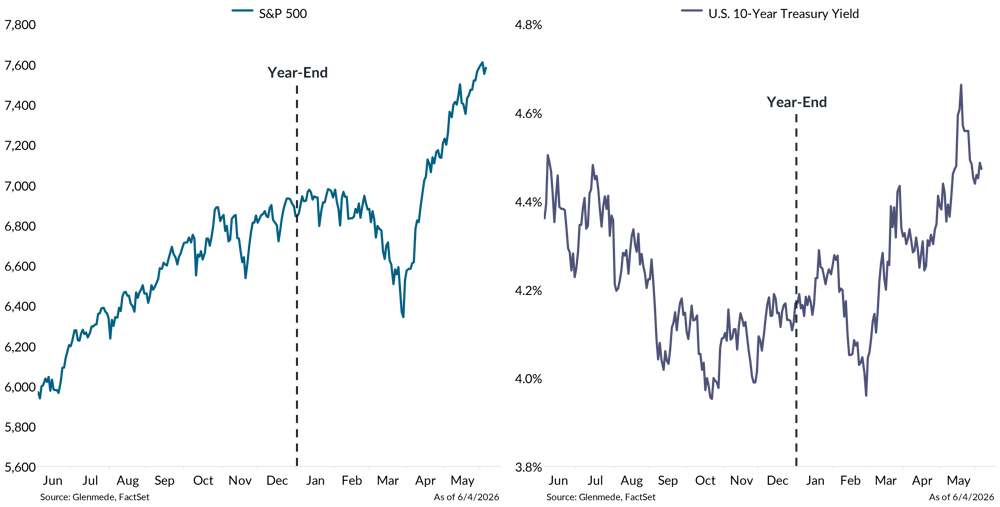
Shown on the left is the S&P 500 which is a market capitalization weighted index of U.S. large cap stocks. Shown on the right is the yield on 10-year U.S. Treasury bonds. Past performance may not be indicative of future results. One cannot invest directly in an index.
Equity valuations have risen to notable levels, but disparity still provides room for opportunity
-
U.S. large cap valuations have continued to flirt with extreme levels driven by the rebound in mega cap stocks and strong earnings momentum.
-
Other areas of the market, including U.S. small cap, international, and Japan, remain closer to fair value, suggesting opportunities still exist for investors willing to look beyond the largest U.S. names.
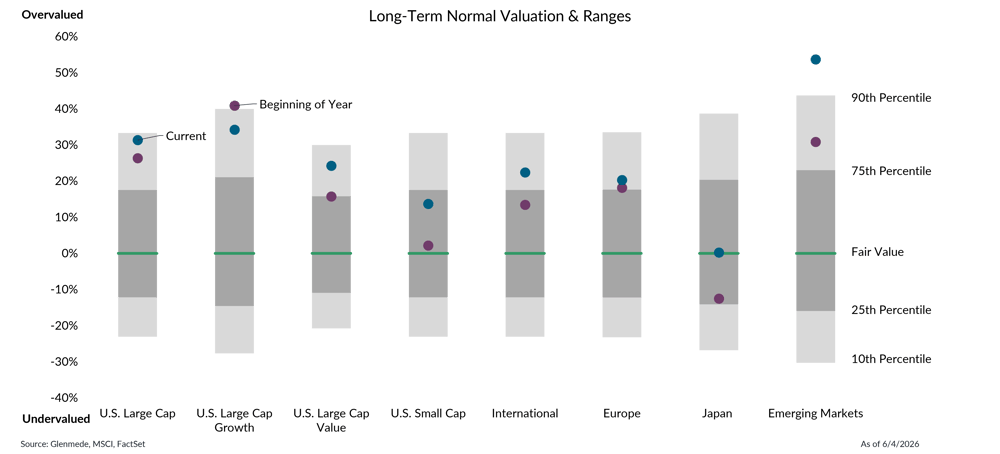
Data shown are Glenmede’s estimates of long-term fair value for U.S. Large Cap (MSCI USA), U.S. Large Cap Growth (MSCI USA Growth), U.S. Large Cap Value (MSCI USA Value), U.S. Small Cap (MSCI USA Small), International (MSCI All Country World ex-U.S.), Europe (MSCI Europe), Japan (MSCI Japan), and Emerging Markets (MSCI EM) based on normalized earnings, normalized cash flows, dividend yield, and book value for each index. Blue dots represent current valuation levels and purple dots represent valuation level as of 12/31/2025. Glenmede’s estimates of fair value are arrived at in good faith, but longer-term targets for valuation may be uncertain. One cannot invest directly in an index.
The rise in yields provides an interesting alternative for investors in diversified portfolios
-
The Treasury yield curve remains elevated relative to its 20-year average across most maturities, reflecting the cumulative effects of a more restrictive policy stance and higher inflation expectations.
-
Across the broader fixed income landscape, most major bond categories are yielding near fair value, suggesting current income levels may offer a reasonable entry point relative to long-term expectations.
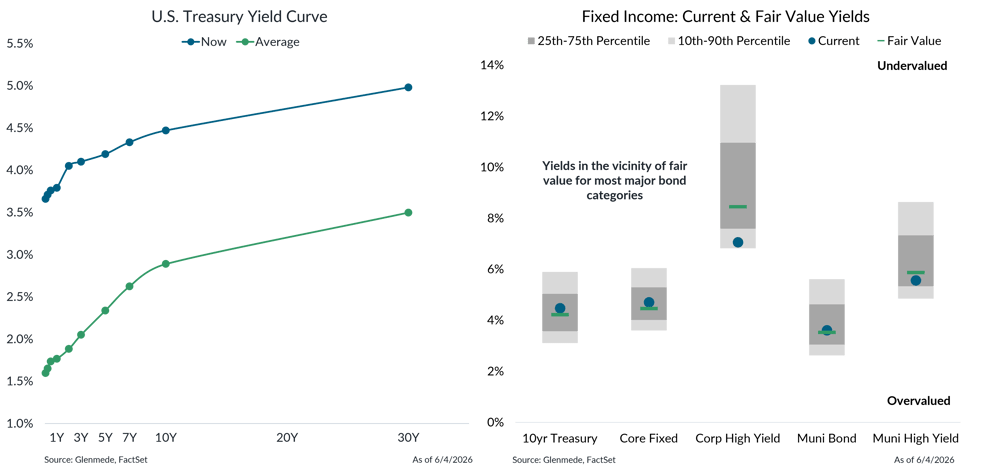
Shown on the left is a snapshot of the U.S. Treasury yield curve in blue and the average of each maturity’s yields over the past 20 years in green. Shown on the right are Glenmede’s estimates of long-term fair value for taxable and tax-exempt debt securities. Proxy indices for each asset class are as follows: Core Fixed (Bloomberg U.S. Aggregate), Corp High Yield (Bloomberg U.S. Aggregate Credit Corporate High Yield BB), Muni Bond (Bloomberg Municipal Bond), Muni High Yield (Bloomberg Municipal High Yield). Glenmede’s estimates of fair value are arrived at in good faith, but longer-term targets for valuation may be uncertain. One cannot invest directly in an index.
The expected return gap between equities and fixed income has narrowed in recent years
-
Expected returns for global equities and U.S. core fixed income have converged meaningfully in recent years, compressing a gap that was historically wide when rates were low.
-
The narrowing reflects both higher bond yields, which have improved fixed income's return outlook, and elevated equity valuations, which have moderated the expected return advantage for stocks.
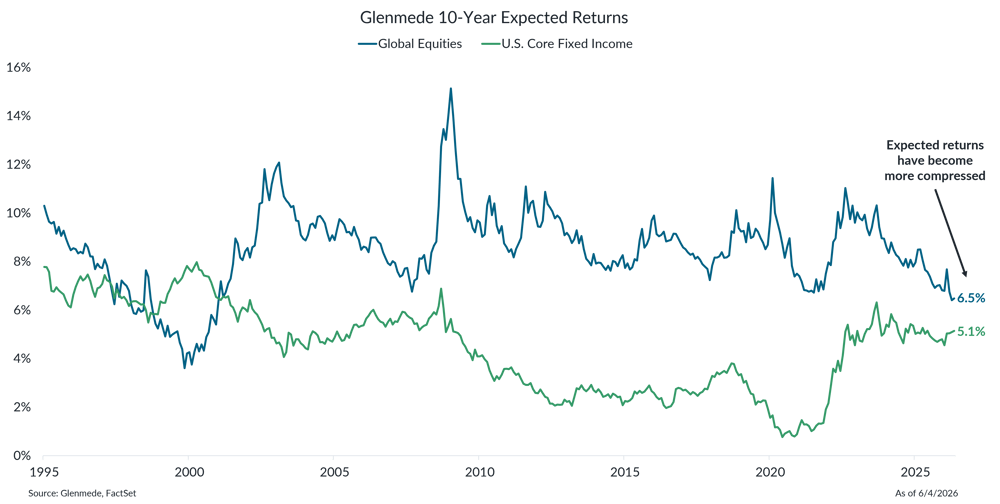
Shown are Glenmede’s proprietary 10-year expected returns for Global Equities (MSCI All Country World) and U.S. Core Fixed Income (Bloomberg U.S. Aggregate), both measured in U.S. dollars. Glenmede’s estimates of expected returns are arrived at in good faith, but longer-term targets for returns may be uncertain. Actual results may differ materially from expectations. One cannot invest directly in an index.
Converging expected returns have pushed the probability of equity outperformance to a two-decade low
-
The implied probability of equities outperforming fixed income over the next decade has fallen to roughly 68%, its lowest level in almost two decades.
-
While equities still hold a modest expected return advantage, the compressed gap suggests fixed income now plays a more competitive role in portfolio construction than it has in recent history.
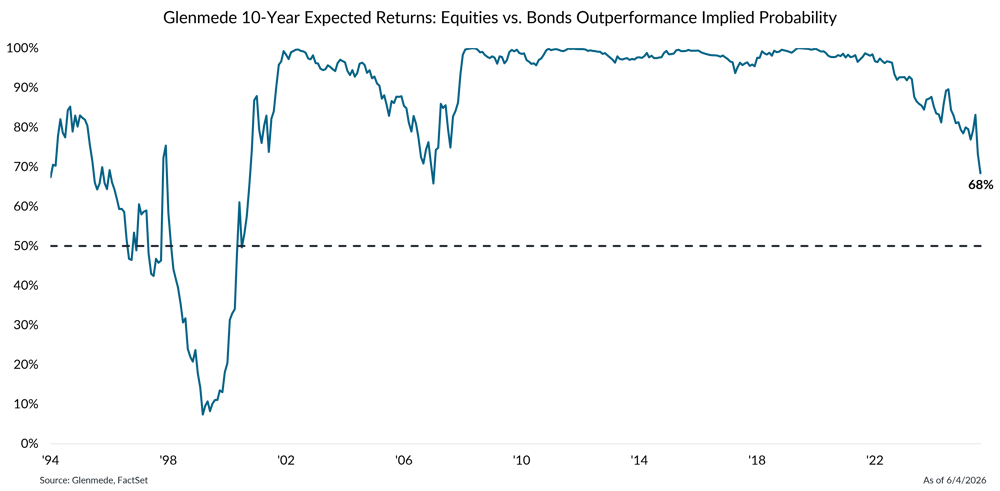
Shown is the implied probability that equities will outperform bonds over the next 10 years, based on Glenmede’s 10-year expected return assumptions for Global Equities (MSCI AC World) and U.S. Core Fixed Income (Bloomberg U.S. Aggregate), measured in U.S. dollars. The probability is estimated using the standard deviation of the difference in expected returns and assumes a normal distribution of outcomes. Glenmede’s estimates of expected returns are arrived at in good faith, but longer-term targets for returns may be uncertain. Actual results may differ materially from expectations. One cannot invest directly in an index.
For more in-depth information on this topic, please reach out to your Glenmede Relationship Manager.

This material is provided solely for informational and/or educational purposes and is not intended as personalized investment advice. When provided to a client, advice is based on the client’s unique circumstances and may differ substantially from any general recommendations, suggestions or other considerations included in this material. Any opinions, recommendations, expectations or projections herein are based on information available at the time of publication and may change thereafter. Information obtained from third-party sources is assumed to be reliable but may not be independently verified, and the accuracy thereof is not guaranteed. Any company, fund or security referenced herein is provided solely for illustrative purposes and should not be construed as a recommendation to buy, hold or sell it. Outcomes (including performance) may differ materially from any expectations and projections noted herein due to various risks and uncertainties. Any reference to risk management or risk control does not imply that risk can be eliminated. All investments have risk. Clients are encouraged to discuss any matter discussed herein with their Glenmede representative.