

Investment Strategy Brief | May 17, 2026
The Fed After Powell: Enter the Warsh Era

Executive Summary
-
Kevin Warsh has been confirmed as the next Federal Reserve Chair and is expected to bring a new perspective on key items.
-
Warsh is expected to initially focus on shifting communications and culture at the historically divided committee.
-
The Fed remains inflation-focused near term but may evolve its framework over time.
-
Markets expect no rate cuts this year, but Warsh may pursue easing if inflation and geopolitical headwinds dissipate.
-
A Warsh-led Fed is likely to pursue notable reform, but the path from intent to execution will likely be a gradual evolution.
Kevin Warsh has been confirmed as the next Fed Chair and is expected to bring a new perspective on key items
-
Warsh’s confirmation caps off a nomination process that began in early March and gained momentum after the Department of Justice dropped its investigation into Federal Reserve spending.
-
A Warsh chairmanship is likely to maintain a significant degree of policy continuity with institutional credibility. However, he also brings some fresh ideas to the table regarding the appropriate level of interest rates, the use of the Fed’s balance sheet as a policy tool, and other priorities.
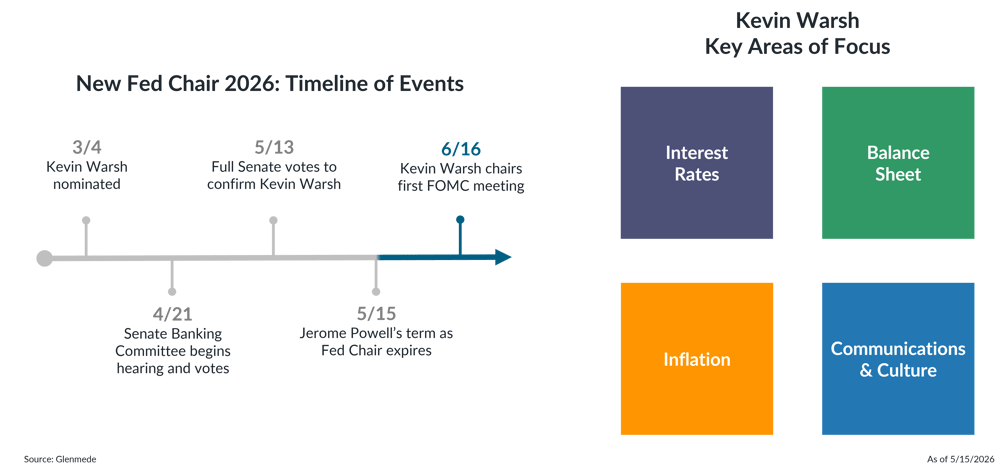
Shown on the left is an illustrative timeline outlining key events surrounding Kevin Warsh’s nomination and confirmation as Federal Reserve Chair. Shown on the right is a non-exhaustive overview of key areas of focus for Kevin Warsh as Federal Reserve Chair.
Warsh is expected to initially focus on shifting communications and culture at the historically divided committee
-
Warsh inherits a Federal Reserve that is one of the most divided in modern history, with dissenting votes nearing 19% so far this year, suggesting meaningful internal disagreement over the path of policy.
-
Rather than suppress that friction, Warsh has signaled a preference for allowing messier meetings and narrowing the Fed's mission back to its dual mandate (inflation and employment), while reducing reliance on forward guidance and potentially revisiting the role of economic projections such as the dot plot.
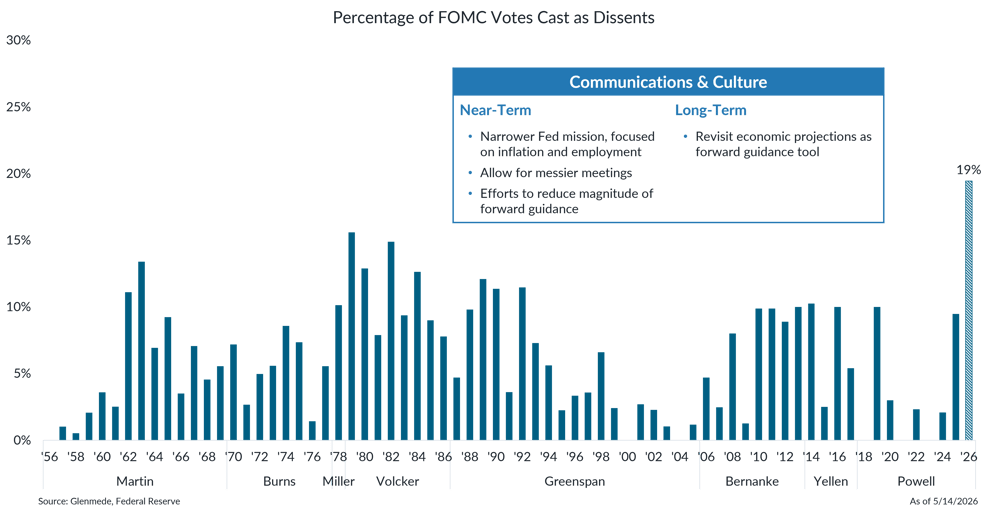
Shown are the percentage of formal Federal Open Market Committee (FOMC) policy votes cast as dissents for each calendar year. A dissent is defined as any instance when an FOMC voting member votes against the Committee’s policy decision.
The Fed remains inflation-focused near term but may evolve its framework over time
-
Core inflation has eased from 2022 peaks but remains above the Fed's 2% target. Warsh is likely to be closely watching for spillovers from Middle East-driven energy pressures while emphasizing the use of alternative inflation measures.
-
Longer term, Warsh sees AI-driven productivity as a force that could structurally lower inflation and has signaled interest in revisiting the Fed's inflation framework, a combination that could shift how the committee defines and pursues its price stability mandate.
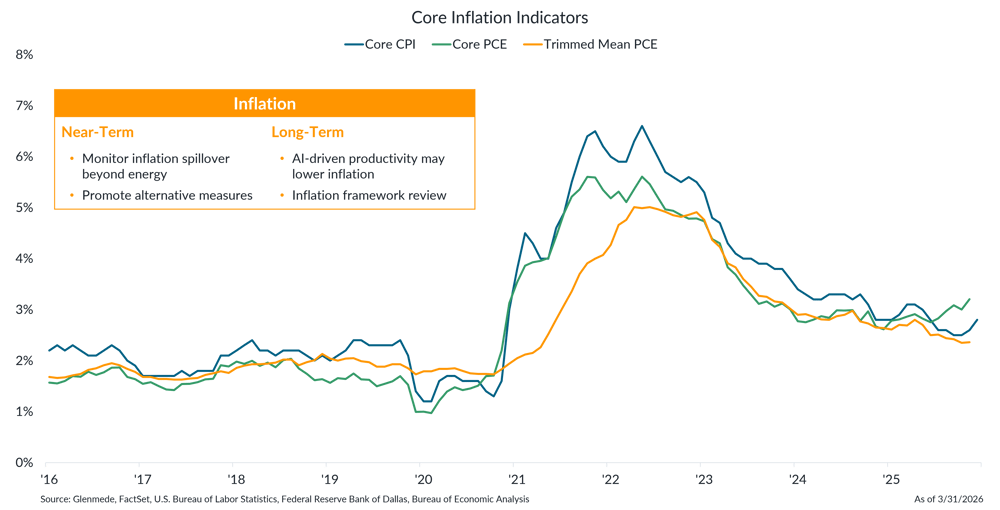
Shown are the year-over-year percent changes in the Core Consumer Price Index (CPI), which measures the cost of a basket of household goods and services excluding food and energy; Core Personal Consumption Expenditures (PCE), which is an alternative measure of inflation meant to better reflect actual spending patterns; and the Federal Reserve Bank of Dallas Trimmed Mean PCE, which removes extreme price movements to better capture underlying inflation trends.
Warsh has signaled a preference for gradually reducing the size of the Fed’s balance sheet
-
The Fed's balance sheet has expanded meaningfully from pre-Global Financial Crisis levels and remains elevated.
-
In the near term, a Warsh-led Fed is expected to continue gradually reducing mortgage-backed securities (MBS) to gradually converge toward a mostly Treasury-composed balance sheet.
-
Over time, Warsh envisions a smaller balance sheet, driven by MBS runoff, looser bank capital rules to shift intermediation to the private sector, and a discipled QE framework reserved for extraordinary crises.
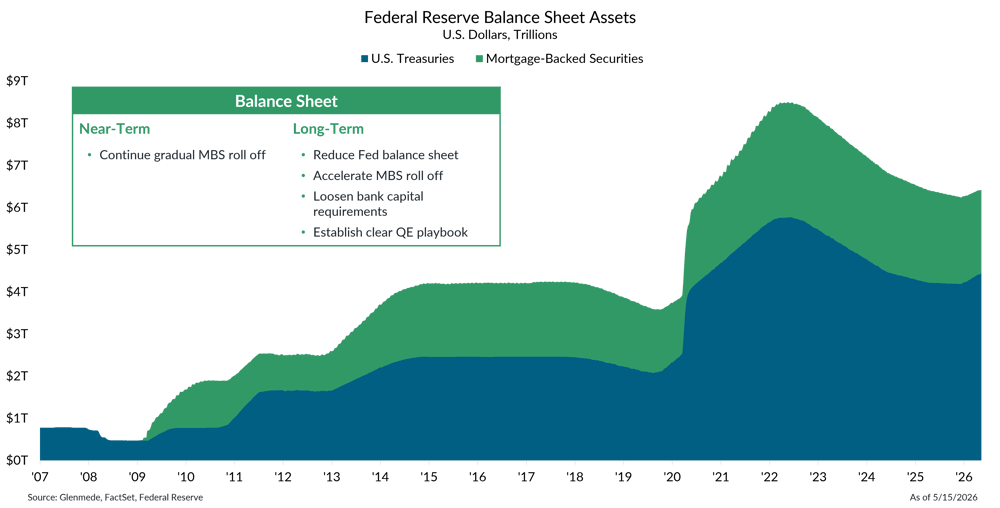
Shown is the Federal Reserve’s balance sheet composition over time, measured in trillions of U.S. dollars, with holdings of U.S. Treasury securities in blue and agency mortgage-backed securities in green.
Markets expect no cuts this year, but Warsh may pursue easing if inflation and geopolitical headwinds dissipate
-
The fed funds rate sits squarely within Glenmede's estimated neutral range, with markets expecting no change through year-end due to inflation risks that warrant patience.
-
Warsh views interest rates as the primary Fed policy tool and has signaled a preference for normalizing rates as inflation allows, with AI-driven productivity gains potentially justifying a lower neutral rate over time.
-
Overall, a Warsh-led Fed is likely to pursue notable reform, but the path from intent to execution will likely be a gradual evolution.
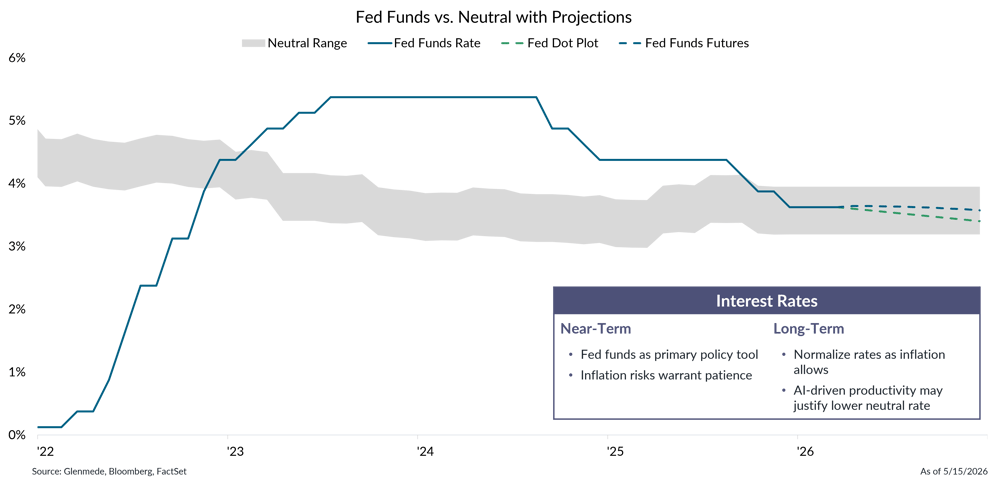
Shown on the left in gray are Glenmede’s range estimates of the neutral federal funds rate over time (i.e., the level of rates that is neither economically stimulative nor restrictive) based on expectations for real interest rates via the Holston-Laubach-Williams model and Glenmede’s inflation expectations. Fed Funds Rate in blue is the target rate midpoint. The dashed blue line represents expectations for the forward path of rates based on fed funds futures pricing. The dashed green line represents expectations for the forward path of rates based on the median respondent in the Federal Open Market Committee’s dot plot projections. Projections and expectations are arrived at in good faith, but actual results may differ materially.
For more in-depth information on this topic, please reach out to your Glenmede Relationship Manager.

This material is provided solely for informational and/or educational purposes and is not intended as personalized investment advice. When provided to a client, advice is based on the client’s unique circumstances and may differ substantially from any general recommendations, suggestions or other considerations included in this material. Any opinions, recommendations, expectations or projections herein are based on information available at the time of publication and may change thereafter. Information obtained from third-party sources is assumed to be reliable but may not be independently verified, and the accuracy thereof is not guaranteed. Any company, fund or security referenced herein is provided solely for illustrative purposes and should not be construed as a recommendation to buy, hold or sell it. Outcomes (including performance) may differ materially from any expectations and projections noted herein due to various risks and uncertainties. Any reference to risk management or risk control does not imply that risk can be eliminated. All investments have risk. Clients are encouraged to discuss any matter discussed herein with their Glenmede representative.