

Investment Strategy Brief | September 20, 2026
The Fed Laces Up Its Hiking Boots

Executive Summary
-
The Fed raised rates last week and is expected to keep rates restrictive until inflation is contained.
-
The median dot implies policymakers may see one additional rate hike before year-end.
-
Despite a higher cost of capital, tightening cycles need not be fatal to the return outlook for stocks or bonds.
-
Bond yields have become increasingly competitive, though equities still retain an expected return advantage.
- Even as the Fed raises rates, investors may be best served by maintaining diversified portfolios and rebalancing as needed.
The Fed raised rates last week and is expected to keep rates restrictive until inflation is contained
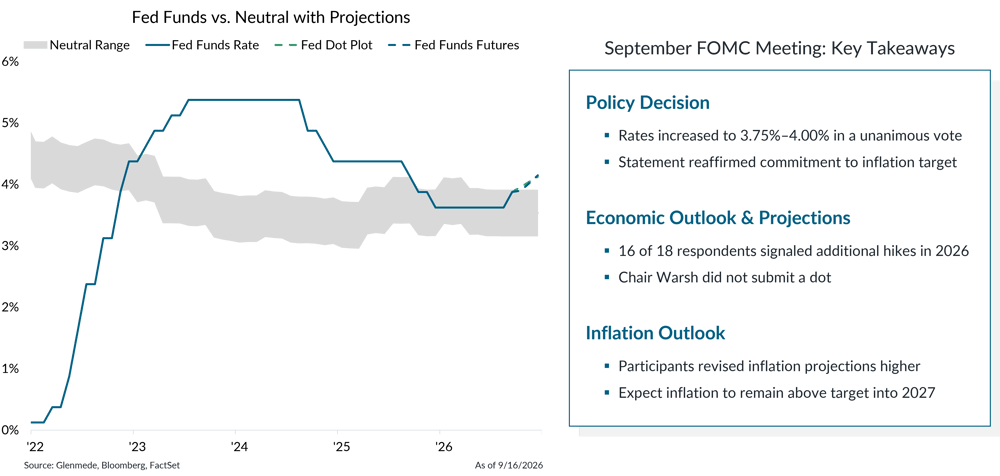
Shown on the left in gray are Glenmede’s range estimates of the neutral federal funds rate over time (i.e., the level of rates that is neither economically stimulative nor restrictive) based on expectations for real interest rates via the Holston-Laubach-Williams model and Glenmede’s inflation expectations. Fed Funds Rate in blue is the target rate midpoint. The dashed blue line represents expectations for the forward path of rates based on fed funds futures pricing. The dashed green line represents expectations for the forward path of rates based on the median respondent in the Federal Open Market Committee’s dot plot projections. Shown on the right is a non-exhaustive overview of the key takeaways from the September FOMC meeting. Projections and expectations are arrived at in good faith, but actual results may differ materially.
-
The September FOMC meeting reinforced the Fed’s focus on inflation, with policymakers delivering a rate hike and signaling that additional tightening remains likely if price pressures fail to moderate.
-
Both Fed projections and market expectations suggest rates may remain restrictive for some time, expecting that inflation may stay above target into 2027.
Recent inflation data have done little to convince policymakers that price pressures are fully contained
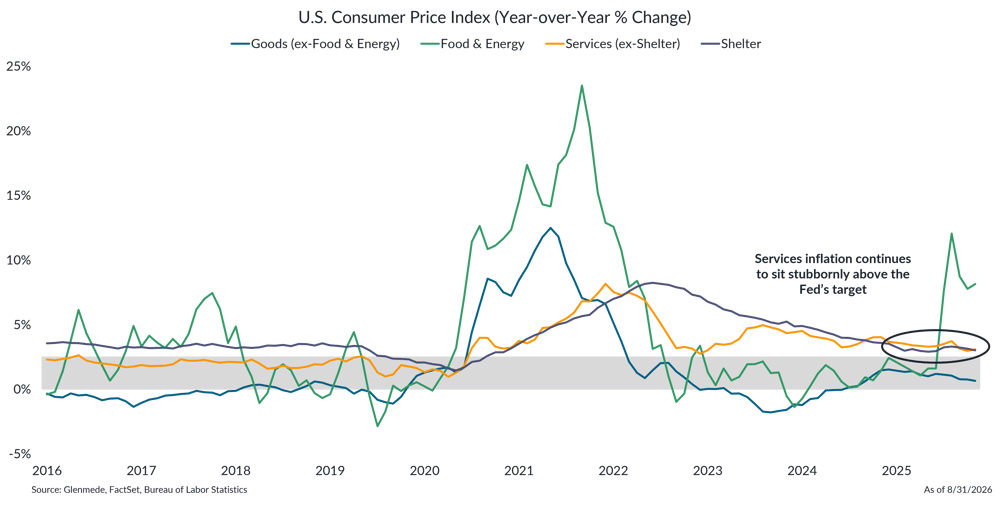
Shown are the year-over-year changes in select U.S. CPI components. Goods (ex-Food & Energy) is represented by the commodities component (excluding food & energy). Food & Energy is represented by the food & energy subcomponents. Services (ex-Shelter) is represented by Services Less Rent of Shelter. Shelter is represented by Rent of Shelter. CPI measures the price of a basket of goods & services consumed by U.S. households. The gray band represents the Federal Reserve’s target range consistent with its price stability objective.
-
While goods inflation has largely returned to normal, services inflation (including and excluding shelter) remains elevated relative to the Fed’s target range, suggesting underlying price pressures have yet to fully subside.
-
Recent inflation data reinforce the Fed’s concern that progress toward its 2% target has stalled, particularly across labor-intensive service categories that tend to be slower moving.
-
The persistence of services inflation may make policymakers hesitant to ease financial conditions prematurely, even as several inflation categories have cooled significantly.
The median dot implies policymakers see one additional rate hike before year-end
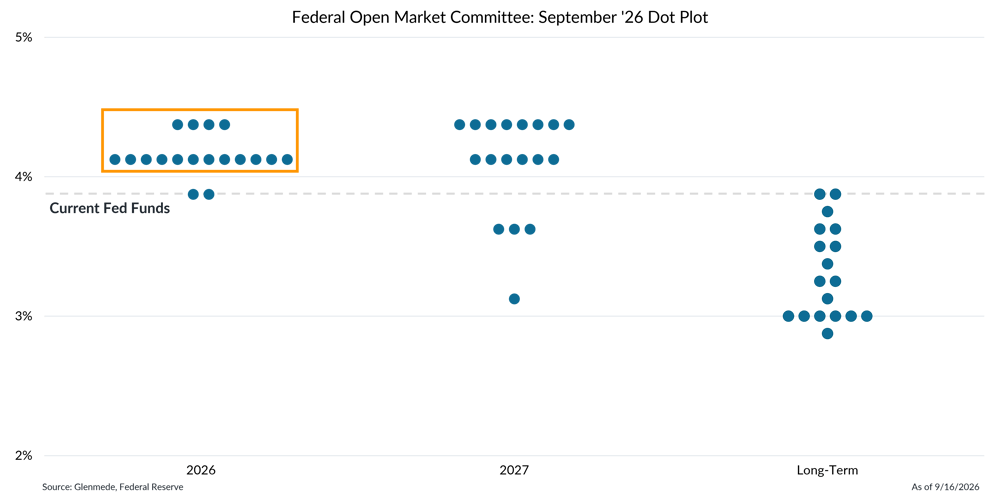
Shown are the Federal Open Market Committee’s dot plot projections from September 2026. Each dot represents the response of one Fed official regarding where they expect the federal funds rate to sit at the end of each of the next two calendar years, as well as their estimate of the longer run level of federal funds. Actual results may differ materially from projections.
-
Sixteen of 18 respondents to the September dot plot project at least one more rate hike this year as policymakers continue to prioritize returning inflation to target.
-
The 2027 dots reflect more uncertainty, as the spread in dots is more than twice as wide as for 2026. That combination reads as a committee largely united on the need to tighten now but not quite sold on the pace and duration of the tightening cycle from here.
Despite a higher cost of capital, tightening cycles need not be fatal to the return outlook for stocks or bonds
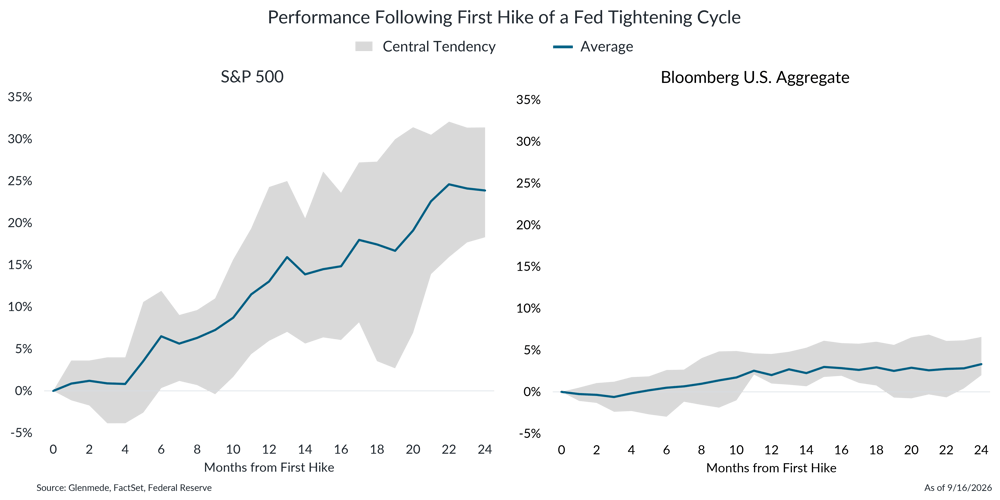
The information shown represents the performance of the S&P 500 and Bloomberg U.S. Aggregate in the ensuing months following the first rate hike of every Fed tightening cycle since 1954. The blue lines represent the average market path in these scenarios and the gray range represents the central tendency (25th to 75th percentiles). Tightening cycles are dropped from the dataset after the last hike of the cycle. Performance figures are cumulative, not annualized. Past performance may not be indicative of future results. One cannot invest directly in an index.
-
Even though a Fed tightening cycle may raise the cost of capital, such changes by themselves are unlikely to impair longer-term returns in either stocks or bonds.
-
Since 1954, the average path of both stock and bond markets during Fed tightening cycles has been roughly flat in the months immediately following the first hike. Although the range of outcomes is notably wide, the general direction has been mostly constructive.
Bond yields have become increasingly competitive, though equities still retain an expected return advantage
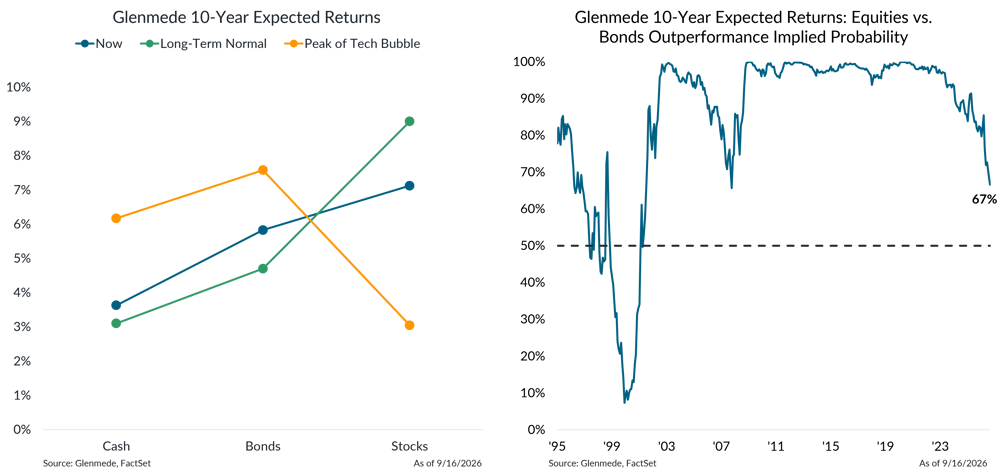
Shown on the left are Glenmede’s 10-year expected returns for Cash (Bloomberg Treasury Bellwethers 3M), bonds (Bloomberg U.S. Aggregate), and stocks (S&P 500) at select points in time. Shown on the right is the implied probability that equities will outperform bonds over the next 10 years, based on Glenmede’s 10-year expected return assumptions for Global Equities (MSCI AC World) and U.S. Core Fixed Income (Bloomberg U.S. Aggregate), both measured in U.S. dollars. The probability is estimated using the standard deviation of the difference in expected returns and assumes a normal distribution of outcomes. Glenmede’s estimates of expected returns are arrived at in good faith, but longer-term targets for returns may be uncertain. Actual returns may differ materially from projections. One cannot invest directly in an index.
-
Higher bond yields have improved fixed income return prospects, narrowing the expected return advantage that equities have enjoyed for much of the past several years.
-
Despite more attractive bond valuations, equities continue to be favored for long-term investors, with stocks still expected to outperform bonds in most long-term scenarios.
- Even as the Fed raises rates, investors may be best served by maintaining diversified portfolios and rebalancing as needed.
For more in-depth information on this topic, please reach out to your Glenmede Relationship Manager.

This material is provided solely for informational and/or educational purposes and is not intended as personalized investment advice. When provided to a client, advice is based on the client’s unique circumstances and may differ substantially from any general recommendations, suggestions or other considerations included in this material. Any opinions, recommendations, expectations or projections herein are based on information available at the time of publication and may change thereafter. Information obtained from third-party sources is assumed to be reliable but may not be independently verified, and the accuracy thereof is not guaranteed. Any company, fund or security referenced herein is provided solely for illustrative purposes and should not be construed as a recommendation to buy, hold or sell it. Outcomes (including performance) may differ materially from any expectations and projections noted herein due to various risks and uncertainties. Any reference to risk management or risk control does not imply that risk can be eliminated. All investments have risk. Clients are encouraged to discuss any matter discussed herein with their Glenmede representative.