

Investment Strategy Brief | May 31, 2026
The Forces Fueling the Rate Climb

Executive Summary
-
U.S. Treasuries have seen a material rise in yields largely due to inflation concerns and shifting expectations for Federal Reserve policy.
-
The conflict with Iran and rising energy prices are the primary drivers of inflationary pressures.
-
Markets now view a Fed rate hike as more likely than a rate cut as policymakers seek to contain inflation.
-
Debt sustainability concerns have modestly inched up term premiums, but the risk of an imminent default appears low.
-
The direction of long-term rates is more dependent on the outcome of the Iran conflict than shifting perceptions of U.S. debt sustainability.
U.S. Treasuries have seen a material rise in yields since the beginning of the year
-
U.S. Treasury yields have moved meaningfully higher across most maturities year to date, with the increase particularly notable in longer-duration securities such as the 10-year and 30-year.
-
The Treasury yield curve now has a much more normal, upward sloping shape than it did to start the year, more consistently compensating investors for taking extra duration risk.
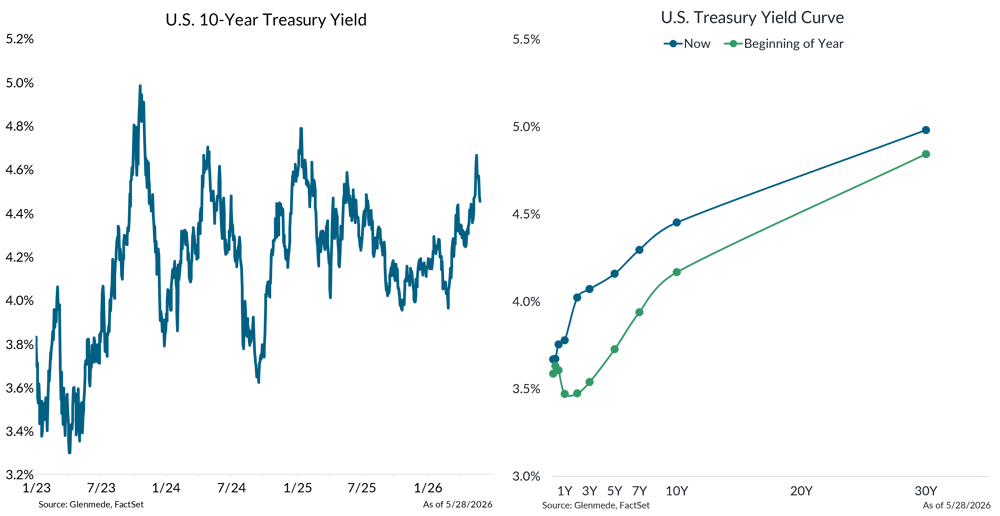
Shown on the left is the yield on 10-year U.S. Treasury bonds. Shown on the right is a snapshot of the U.S. Treasury yield curve as of the date shown in blue and as of 12/31/2025 in green. Past performance may not be indicative of future results.
Increasing yields are largely due to inflation concerns and the Fed’s response rather than a broad fiscal scare
-
Roughly 80% of the increase in the 10-year yield reflects higher inflation expectations and real short-term rates, indicating the move has been driven primarily by changing expectations for inflation and resulting Fed policy.
-
The contribution from the term premium, which is the portion of yield in which default risks would likely emerge, has remained relatively modest. This suggests the recent increase in rates is not primarily being driven by concerns over debt sustainability at this time.
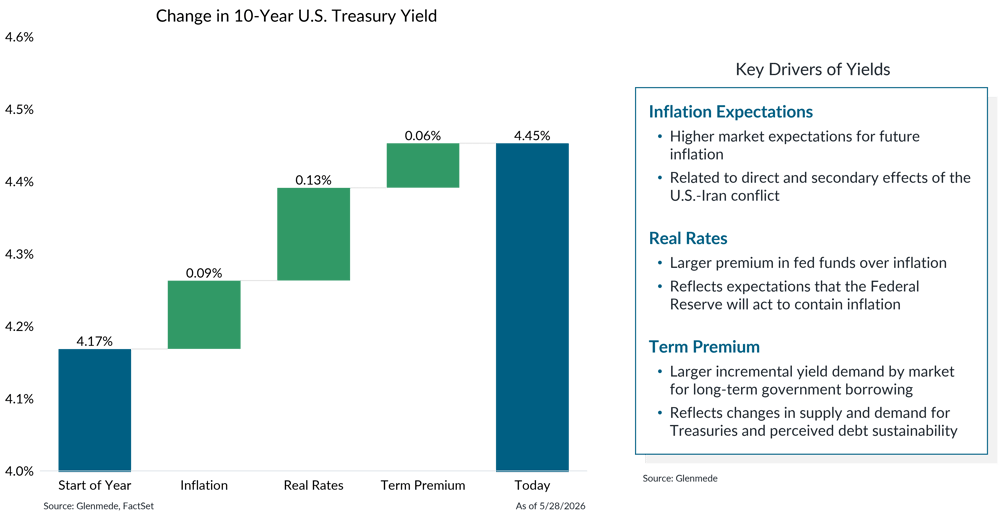
Shown is the change in the 10-Year U.S. Treasury yield from the start of the year to the as of date, decomposed into three drivers: inflation expectations, real short-term policy rates, and the term premium. Inflation expectations are measured by a combination of Treasury Inflation Protected Securities breakevens and inflation swaps. Real rates are measured by the expected nominal 10-year fed funds rate minus inflation expectations. Term premium is measured by the residual portion of the yield.
The conflict with Iran and rising energy prices are the primary drivers of inflationary pressures
-
Inflation pressures remain largely concentrated in food and energy, with recent data showing a sharp acceleration in those components following the conflict in the Middle East.
-
Other components of the inflation basket, such as core goods, have remained relatively contained, but the key question is whether higher energy prices begin to spill over into broader inflation pressures and justify a Fed response.
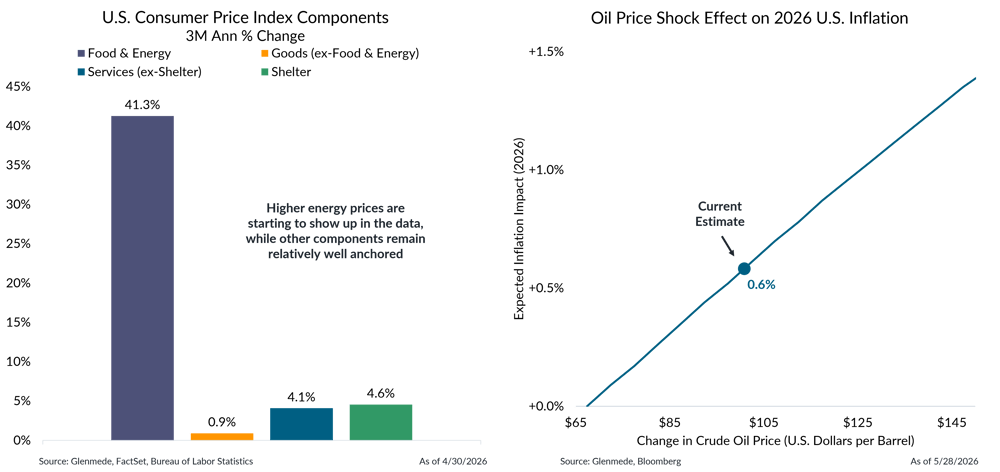
Shown on the left are the 3-month annualized percent changes in the U.S. CPI components. Food & Energy is represented by the food & energy subcomponents. Services (ex. Shelter) is represented by Services Less Rent of Shelter. Shelter is represented by Rent of Shelter. Goods (ex-Food & Energy) is represented by the commodities component (excluding food & energy). CPI measures the price of a basket of goods & services consumed by U.S. households. Shown on the right are Glenmede’s estimates for the impact of a one-time shock in the price of crude oil on the year-over-year growth for the U.S. Consumer Price Index in 2026. The line represents a spectrum of sensitivities for a range of changes in crude oil prices from no change to an increase of $100 per barrel. The dot represents the average Brent crude oil price since the start of the conflict. Actual results may differ materially from projections, and nothing herein represents expected outcomes for any specific portfolio.
Markets currently expect the Federal Reserve to be forced into rate hikes in order to contain inflation
-
Markets have gone from pricing in roughly two rate cuts at the start of the year to now pricing in a potential hike, as persistent inflation concerns have pushed real rate expectations higher.
-
However, that expectation is highly conditional as it depends on inflation pressures extending beyond energy prices, meaning current market pricing may prove incorrect if those dynamics fail to materialize.
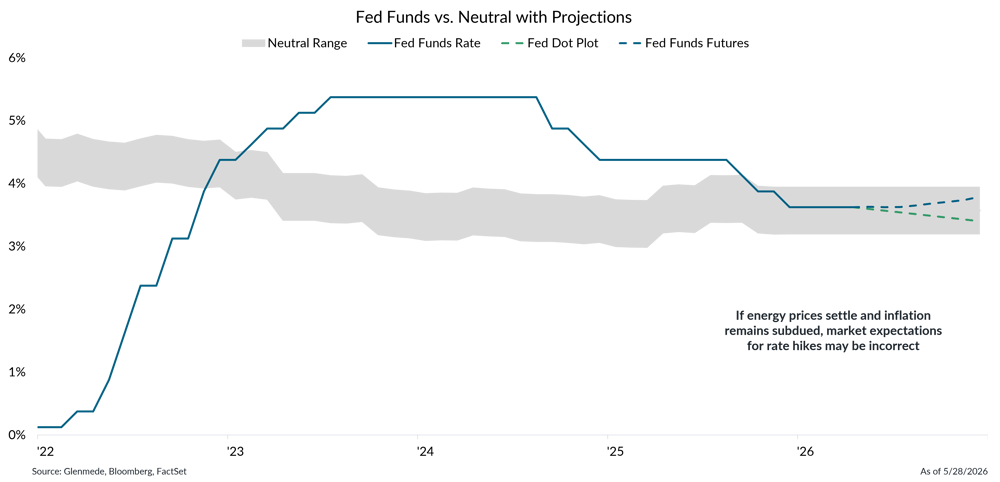
Shown in gray are Glenmede’s range estimates of the neutral federal funds rate over time (i.e., the level of rates that is neither economically stimulative nor restrictive) based on expectations for real interest rates via the Holston-Laubach-Williams model and Glenmede’s inflation expectations. Fed Funds Rate in blue is the target rate midpoint. The dashed blue line represents expectations for the forward path of rates based on fed funds futures pricing. The dashed green line represents expectations for the forward path of rates based on the median respondent in the Federal Open Market Committee’s dot plot projections. Opinions, projections, and expectations are arrived at in good faith, but actual results may differ materially.
Government interest costs may soon justify budget adjustments, but the risk of default appears low
-
Government interest costs have risen meaningfully as a share of tax revenues and are projected to continue climbing. If unaddressed by lawmakers, this could contribute to a higher term premium over time as investors demand more compensation for holding long-term debt.
-
While this is a notable long-term concern, the near-term risk of default remains low, suggesting the recent rise in yields is still being driven primarily by inflation concerns and policy expectations rather than concerns about debt sustainability.
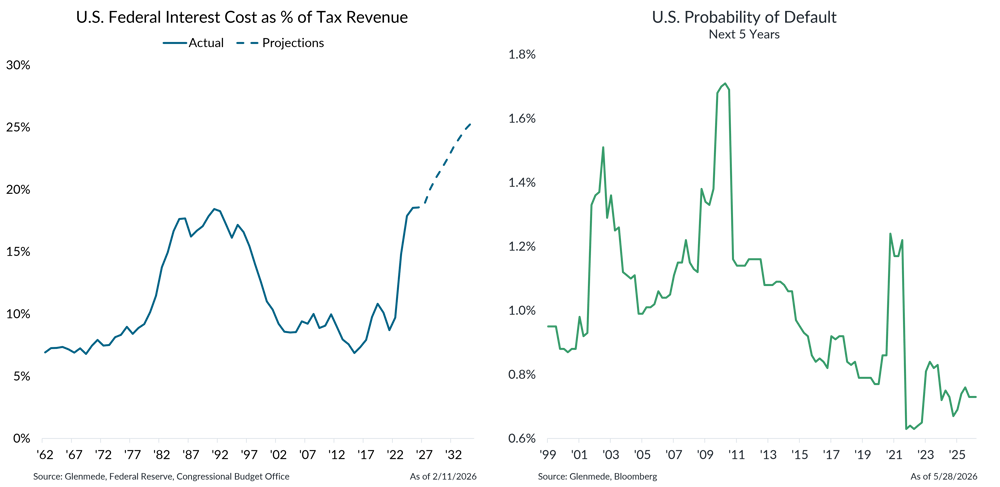
Shown on the left are U.S. federal government net interest costs (total interest paid minus interest received) as a percent of tax revenues collected each year. The dotted line represents projections based on Congressional Budget Office estimates. Shown on the right is the output of Bloomberg’s Sovereign Risk Model, which provides an estimate of the probability of sovereign default based on financial, macroeconomic, and political risk factors. Actual results may differ materially from estimates or projections.
For more in-depth information on this topic, please reach out to your Glenmede Relationship Manager.

This material is provided solely for informational and/or educational purposes and is not intended as personalized investment advice. When provided to a client, advice is based on the client’s unique circumstances and may differ substantially from any general recommendations, suggestions or other considerations included in this material. Any opinions, recommendations, expectations or projections herein are based on information available at the time of publication and may change thereafter. Information obtained from third-party sources is assumed to be reliable but may not be independently verified, and the accuracy thereof is not guaranteed. Any company, fund or security referenced herein is provided solely for illustrative purposes and should not be construed as a recommendation to buy, hold or sell it. Outcomes (including performance) may differ materially from any expectations and projections noted herein due to various risks and uncertainties. Any reference to risk management or risk control does not imply that risk can be eliminated. All investments have risk. Clients are encouraged to discuss any matter discussed herein with their Glenmede representative.