

Investment Strategy Brief | June 28, 2026
The Long and Short of the Tariff Chess Match

Executive Summary
-
Emergency tariffs were ruled illegal by the Supreme Court but should be largely replaced by Section 301 tariffs.
-
Through trial and error, tariff policy is shifting toward a more durable and enforceable framework.
-
Near-term, companies have an opportunity to capitalize on tariff implementation gaps and apply for notable refunds.
-
Section 301 tariffs could largely restore lost revenue from International Emergency Economic Powers Act (IEEPA), but implementation gaps and refunds create a near-term hole.
-
The Supreme Court's constraints on tariff authority have introduced meaningful frictions that have moderated the expected drag on growth.
Emergency tariffs were ruled illegal by the Supreme Court but are being reinstated through other means
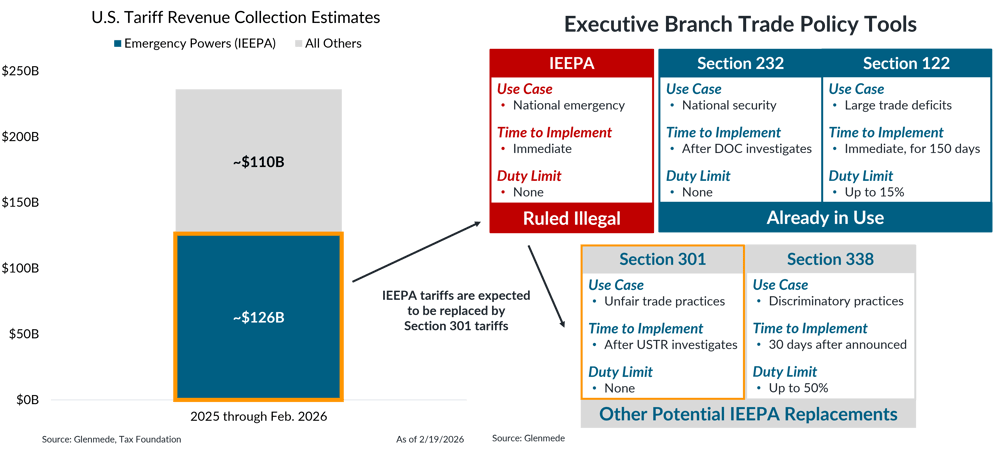
Shown on the left are Glenmede's estimates of the amount of customs duties collected by the U.S. federal government since the start of 2025 through the latest date shown, the date of the Supreme Court IEEPA decision. The information shown on the right outlines legal provisions that grant the President authority to manage trade policy. The International Emergency Economic Powers Act of 1977 (IEEPA) authorizes the President to regulate international commerce after declaration of a national emergency or in response to threats. The Trade Expansion Act of 1962: Section 232 delegates congressional authority to the President to impose import restrictions that threaten national security. The Tariff Act of 1930: Section 338 grants the President the authority to impose tariffs of up to 50% on imports from countries that discriminate against the U.S. The Trade Act of 1974: Section 122 authorizes the President to address a balance of payments deficit or to prevent an imminent and significant depreciation in the dollar. The Trade Act of 1974: Section 301 authorizes the President to take appropriate action in response to unreasonable or discriminatory burdens to U.S. commerce. DOC refers to the U.S. Department of Commerce. USTR refers to the Office of the United States Trade Representative. The options shown are not exhaustive and actual trade actions taken may differ materially from those described.
-
The Supreme Court’s February ruling invalidating tariffs imposed under emergency powers forced a shift in trade policy but did not eliminate the administration’s ability to levy tariffs, prompting the temporary use of Section 122 tariffs limited to a 150-day duration.
-
As those tariffs near their expiration date, the administration is now turning to alternative tools, including Section 301 tariffs, which are viewed as more legally durable but require a slower and more complex implementation process due to formal investigations.
-
Proposed Section 301 tariffs, such as 10% to 12.5% duties on countries that have not adequately prohibited or enforced bans on imports made with forced labor, illustrate how the administration is seeking to rebuild much of the prior tariff structure through a different legal framework.
Section 301 tariffs may restore lost IEEPA revenue, but implementation gaps create a near-term hole
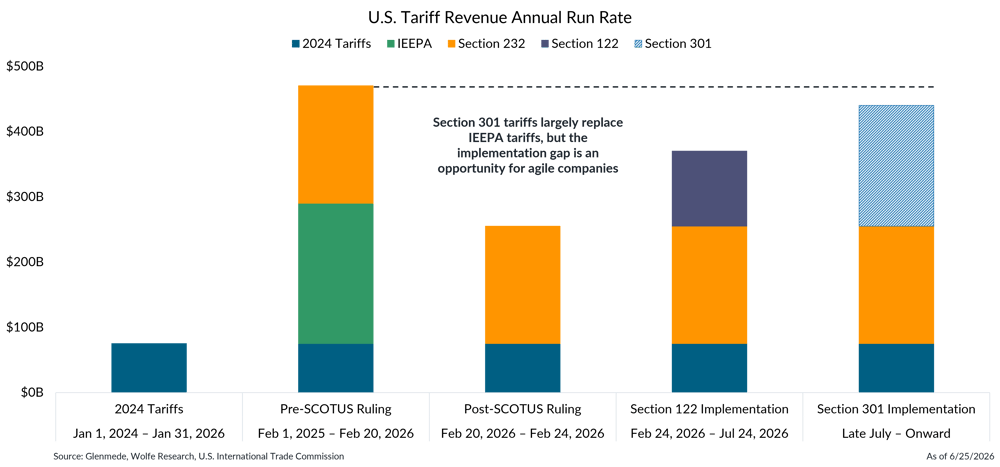
Shown is an estimated breakdown of the annualized run rate of U.S. tariff revenue across various scenarios and legal authorities. The International Emergency Economic Powers Act of 1977 (IEEPA) authorizes the President to regulate international commerce after declaration of a national emergency or in response to threats to the U.S. The Trade Expansion Act of 1962: Section 232 delegates congressional authority to the President to impose import restrictions that threaten national security. The Trade Act of 1974: Section 122 authorizes the President to address a balance of payments deficit or to prevent an imminent and significant depreciation in the dollar. The Trade Act of 1974: Section 301 authorizes the President to take appropriate action in response to unreasonable or discriminatory burdens to U.S. commerce. SCOTUS refers to the Supreme Court of the United States. Estimates are based on available trade data and proposed policy actions. These figures are projections which, though arrived at in good faith, are not guaranteed. Actual results may differ materially from projections.
-
Although the Supreme Court ruling led to a near-term drop in tariff revenue, the Section 301 framework is designed to rebuild much of that shortfall, resulting in a structure that ultimately resembles the pre-ruling environment.
-
This transition could result in a timing gap in tariff implementation; temporary reliance on Section 122 and the phased rollout of Section 301 could create a window in which companies may accelerate imports at temporarily lower tariff rates.
Tariff refunds have picked up significantly, with individual refunds reaching into the billions of dollars
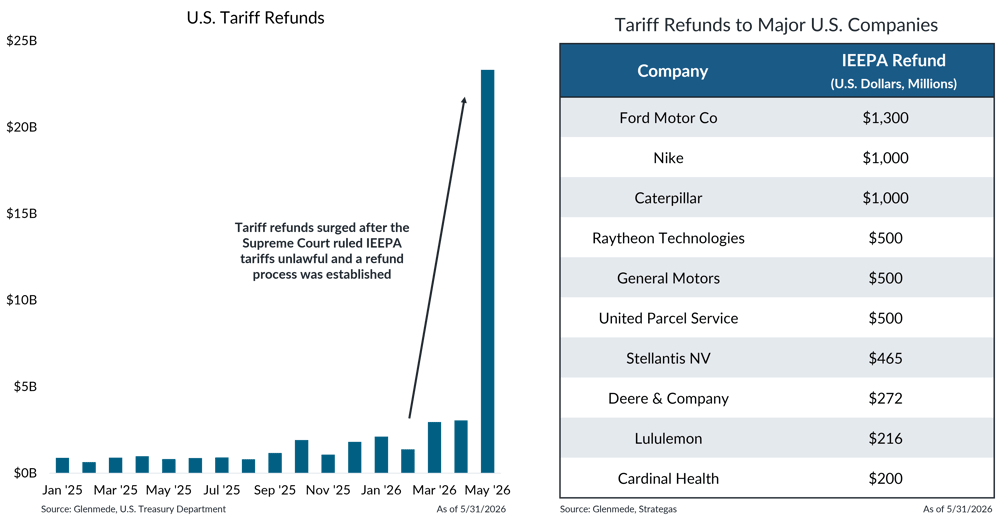
Shown on the left are total daily U.S. Treasury cash withdrawals for U.S. Customs and Border Protection, aggregated on a monthly basis. Shown on the right are recognized or anticipated tariff refunds under the International Emergency Economic Powers Act (IEEPA). Actual refund amounts and timing may differ materially from those shown and remain subject to administrative and legal determination. References to individual stocks should not be construed as a recommendation to buy, hold, or sell.
-
Tariff refunds accelerated notably in May, with payouts rising as a formal process was established to begin the disbursement process following the ruling.
-
Individual refunds have reached into the billions of dollars, with large multinational companies receiving substantial reimbursements, highlighting the scale of prior tariff collections.
Tariff refunds fully offset collections in May as the refund process continues to gain traction
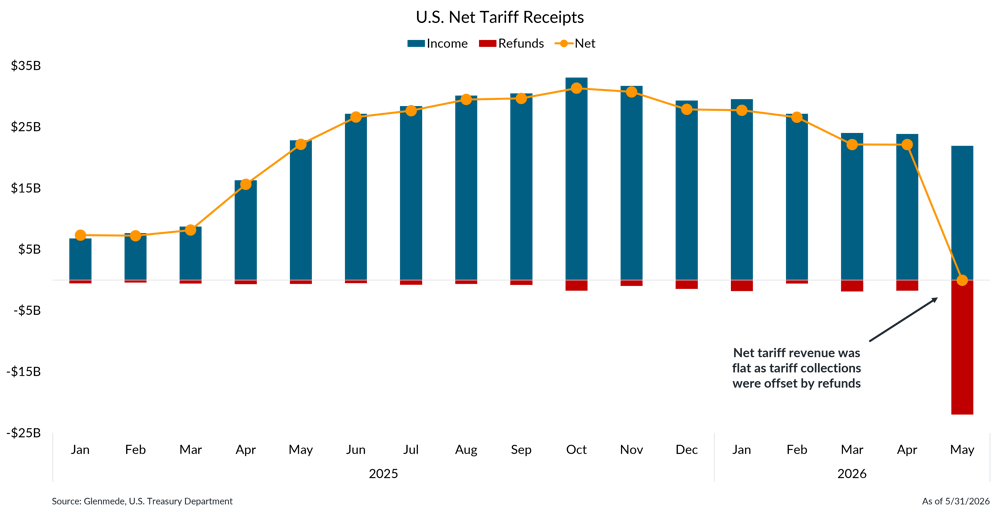
Shown are monthly customs duties collected by the U.S. Treasury in blue, customs refunds in red, and net tariff receipts represented by the orange dots, in billions of U.S. dollars.
-
Net tariff revenue declined sharply in May as a surge in refunds fully offset collections, interrupting the prior upward trend in tariff receipts.
-
The May outcome highlights how refund dynamics can temporarily outweigh ongoing tariff inflows, effectively neutralizing revenue even as tariffs continue to be collected and implemented.
Tariffs are expected to pose only a modest headwind to economic growth this year
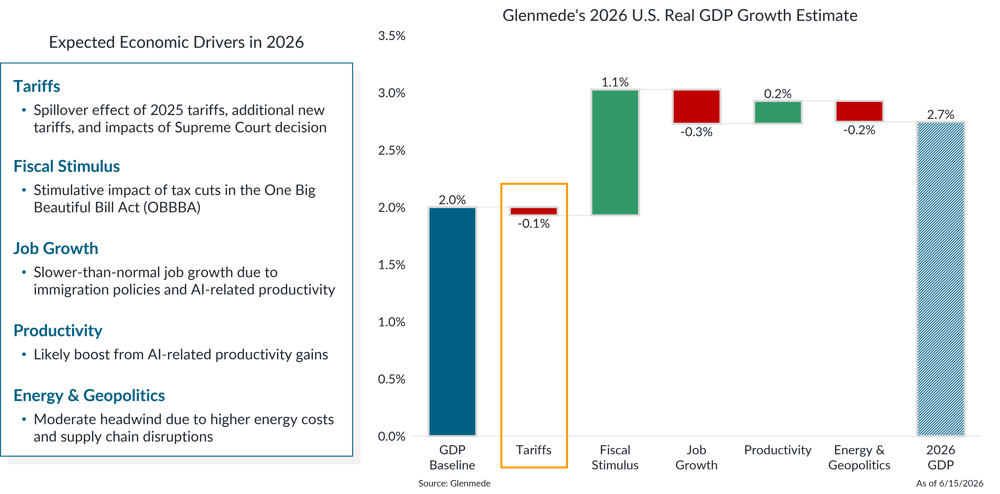
Shown on the left is a brief breakdown of major expected economic drivers in 2026. Shown on the right are the drivers and their estimated impact on U.S. real gross domestic product (GDP) growth. GDP Baseline is an assumed long-term growth rate for the U.S. economy that is consistent with estimates used by both the Congressional Budget Office (CBO) and the Federal Reserve. Though created in good faith, there can be no guarantee that these indicators will be accurate. Actual results may differ materially from projections.
-
Tariffs were initially expected to be a roughly 0.3% drag on U.S. GDP this year, but gaps in collections and substantial refunds have meaningfully reduced that near-term headwind.
-
With temporarily lower effective tariff rates and the phased rollout of Section 301 measures, the overall impact on growth is expected to be broadly neutral, if not a very slight headwind for the U.S. economy in 2026.
For more in-depth information on this topic, please reach out to your Glenmede Relationship Manager.

This material is provided solely for informational and/or educational purposes and is not intended as personalized investment advice. When provided to a client, advice is based on the client’s unique circumstances and may differ substantially from any general recommendations, suggestions or other considerations included in this material. Any opinions, recommendations, expectations or projections herein are based on information available at the time of publication and may change thereafter. Information obtained from third-party sources is assumed to be reliable but may not be independently verified, and the accuracy thereof is not guaranteed. Any company, fund or security referenced herein is provided solely for illustrative purposes and should not be construed as a recommendation to buy, hold or sell it. Outcomes (including performance) may differ materially from any expectations and projections noted herein due to various risks and uncertainties. Any reference to risk management or risk control does not imply that risk can be eliminated. All investments have risk. Clients are encouraged to discuss any matter discussed herein with their Glenmede representative.