

Investment Strategy Brief | August 23, 2026
The Market's Rate Reset

Executive Summary
-
U.S. Treasuries have seen a material rise in yields since the beginning of the year.
-
The drivers of higher Treasury yields have shifted from inflation and real rates to the term premium.
-
While federal debt has increased sharply, it has not translated into materially higher default risk.
-
A rising term premium appears consistent with normalization driven by Fed policy and stronger economic growth.
-
Investors who have been underweight fixed income may have a more attractive entry point to rebalance back toward their targets.
U.S. Treasuries have seen a material rise in yields since the beginning of the year
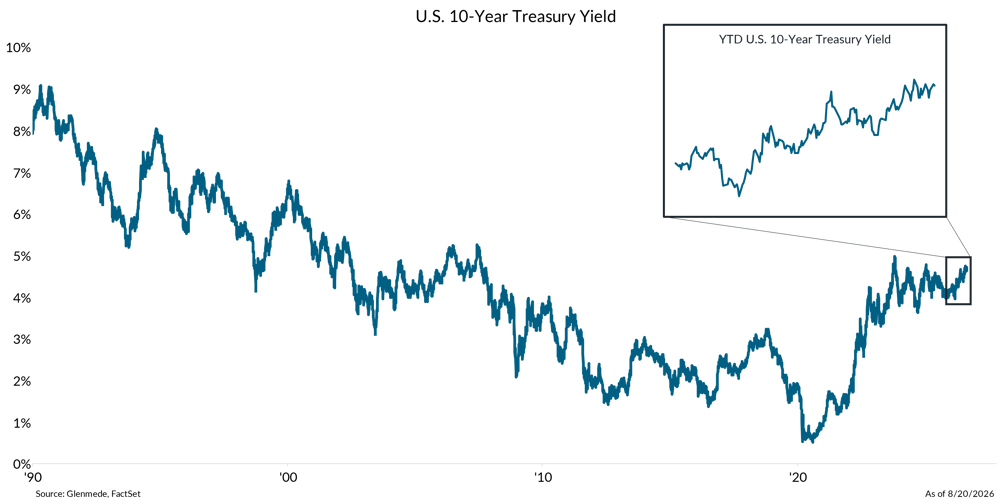
Shown is the yield on 10-year U.S. Treasury bonds. The inset chart shows the year-to-date path of the 10-year U.S. Treasury bond yield. Past performance may not be indicative of future results.
-
U.S. Treasury yields have moved higher this year across most maturities, with the largest increases occurring in longer-dated securities such as the 10-year and 30-year.
-
While yields may appear elevated, a longer historical perspective suggests they are moving back toward levels that were common before quantitative easing (QE), the Federal Reserve's bond-buying programs that helped keep interest rates unusually low after the Global Financial Crisis.
The drivers of higher Treasury yields have shifted from inflation and real rates to the term premium
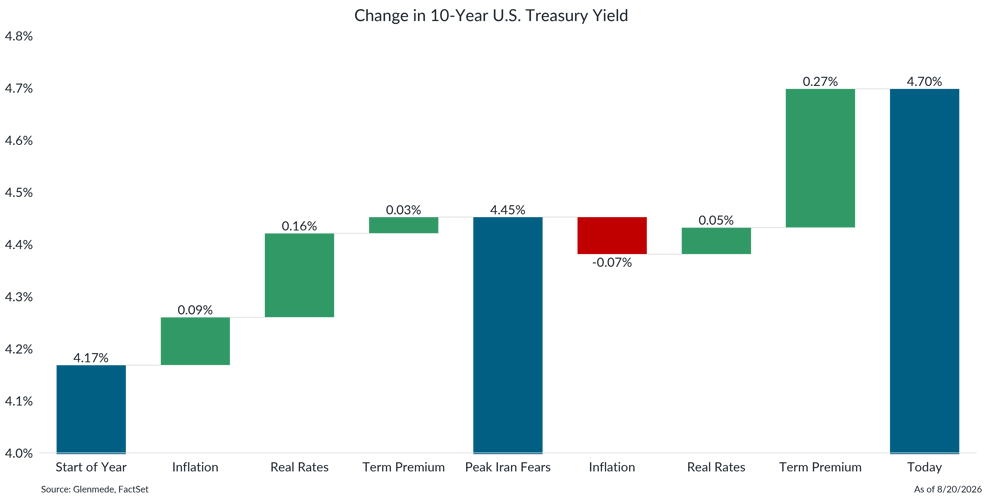
Shown is the change in the 10-Year U.S. Treasury yield from the start of the year to the peak in Iran-related market concerns (6/11/2026) and from that point through the latest date shown. Changes in yields are decomposed into three components: inflation expectations, real rates, and term premium. Inflation expectations are estimated using a combination of Treasury Inflation-Protected Securities (TIPS) breakevens and inflation swaps. Real rates are measured as the expected nominal 10-year federal funds rate less inflation expectations. Term premium represents the residual component of the yield.
-
The rise in Treasury yields through the peak of the Iran-related market concerns in mid-June was driven primarily by higher inflation expectations and rising real interest rates, reflecting the bond market’s view that the Fed might have to raise rates due to conflict-driven inflation.
-
Since then, inflation expectations have fully retraced. It has been the term premium, which is the extra yield demanded by investors to hold longer-term bonds, that has been responsible for the recent rise in yields.
While federal debt has increased sharply, it has not translated into materially higher default risk
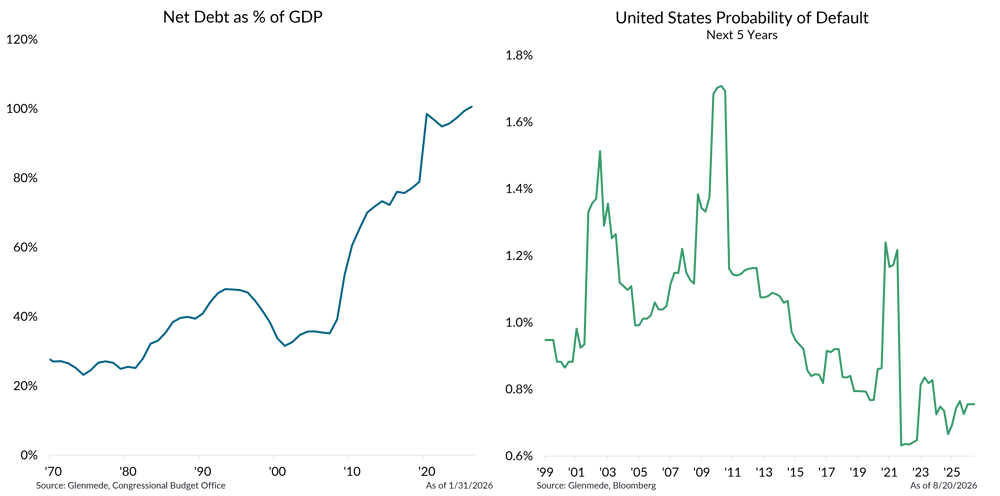
Shown on the left is U.S. federal government net debt as a percent of Gross Domestic Product (GDP) figures. Shown on the right is the output of Bloomberg’s Sovereign Risk Model, which provides an estimate of the probability of sovereign default based on financial, macroeconomic, and political risk factors. Actual results may differ materially from estimates or projections.
-
Some have interpreted a higher term premium as a reflection of market jitters around the U.S. government’s fiscal position.
-
Although federal debt has continued to rise to new highs, market-based measures suggest investors still view the likelihood of a U.S. default as extremely low.
-
Higher debt levels may influence Treasury supply and borrowing costs over time, but current market indicators suggest concerns about U.S. default are not the primary driver of rising Treasury yields.
The Federal Reserve's shrinking presence in Treasury markets may be contributing to a more normal term premium
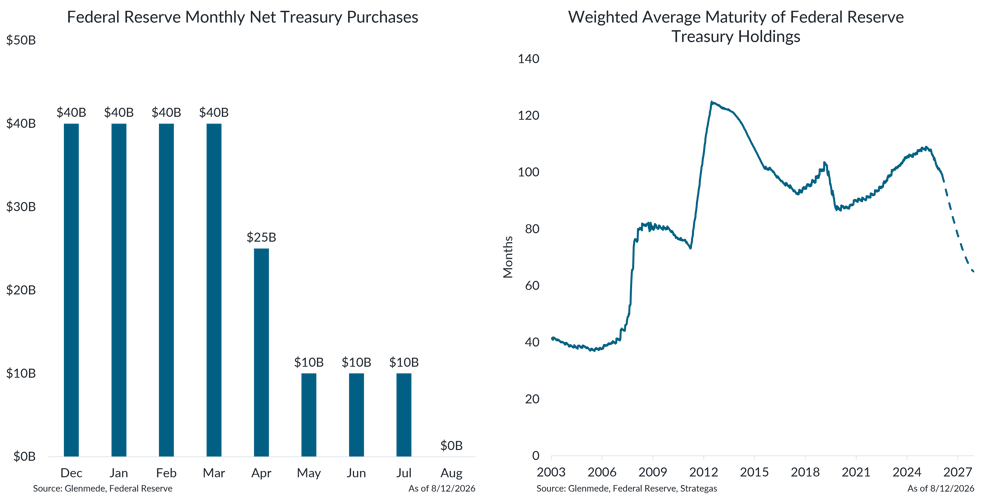
Shown on the left are the Federal Reserve's monthly net purchases of Treasury securities for reserve management purposes. Shown on the right is the weighted average maturity of the Federal Reserve's System Open Market Account (SOMA) Treasury holdings. The dotted line represents projections. Actual results may differ materially from estimates or projections.
-
The Federal Reserve's QE programs helped suppress term premiums for much of the post-financial-crisis period by increasing demand for longer-dated Treasury securities.
-
As the Federal Reserve reduces its presence in long-term Treasury markets through its balance sheet policy and a shorter-duration portfolio, term premiums appear to be moving back toward more historically typical levels.
A rising term premium appears consistent with normalization driven by Fed policy and stronger growth
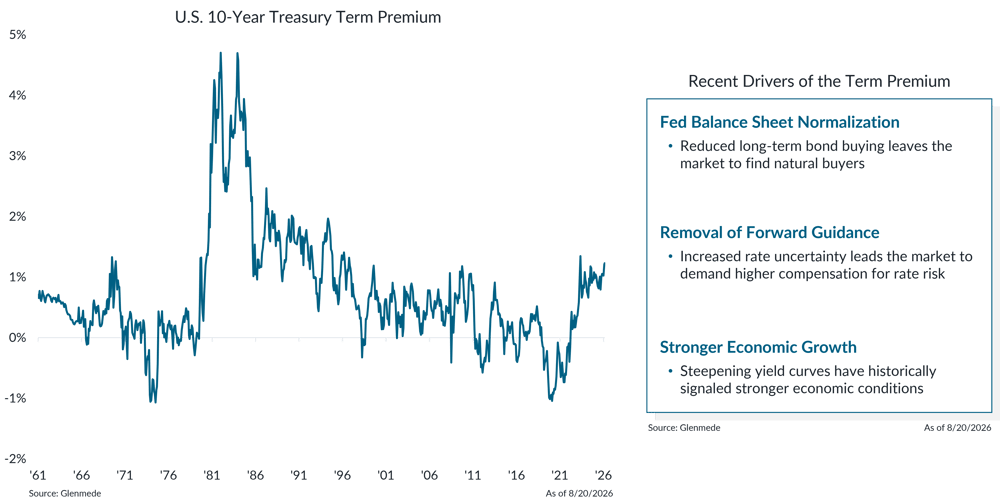
Shown is the estimated term premium on the 10-Year U.S. Treasury yield. Term premium represents the portion of a long-term Treasury yield that compensates investors for the risks associated with holding longer-maturity bonds. Past performance may not be indicative of future results.
-
As the Federal Reserve withdraws from proactive bond buying and shifts its holdings toward shorter-maturity securities, long-duration Treasury debt markets appear to be adjusting to a new equilibrium without the same level of central bank support.
-
At the same time, reduced forward guidance, uncertainty surrounding the future path of interest rates, and resilient economic growth may be contributing to a return toward more historically typical term premium levels.
10-year Treasury yields sit modestly above fair value, which may provide a more compelling entry point for investors
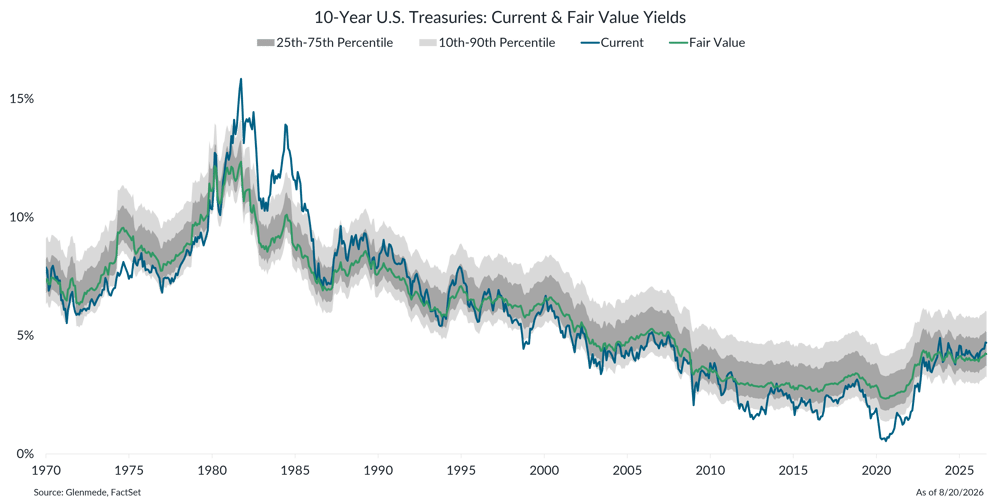
Shown are Glenmede’s estimates of long-term fair value for 10-year U.S. Treasury bonds. Glenmede’s estimates of fair value are arrived at in good faith, but longer-term targets for valuation may be uncertain. One cannot invest directly in an index. Fair value estimates are derived from Glenmede’s proprietary methodology, are subject to significant limitations, and may change without notice. Nothing herein is a recommendation to buy, hold, or sell any security.
-
For much of the time since the 2010s, 10-year Treasury yields sat notably below estimates of longer-term fair value, suggesting investors were poorly compensated for owning longer duration government bonds.
-
Given the strong run in equity markets over the last few years, many investors may find themselves underallocated to fixed income. The recent rise in yields now appears to offer a more attractive entry point for investors to rebalance back toward their longer-term targets.
For more in-depth information on this topic, please reach out to your Glenmede Relationship Manager.

This material is provided solely for informational and/or educational purposes and is not intended as personalized investment advice. When provided to a client, advice is based on the client’s unique circumstances and may differ substantially from any general recommendations, suggestions or other considerations included in this material. Any opinions, recommendations, expectations or projections herein are based on information available at the time of publication and may change thereafter. Information obtained from third-party sources is assumed to be reliable but may not be independently verified, and the accuracy thereof is not guaranteed. Any company, fund or security referenced herein is provided solely for illustrative purposes and should not be construed as a recommendation to buy, hold or sell it. Outcomes (including performance) may differ materially from any expectations and projections noted herein due to various risks and uncertainties. Any reference to risk management or risk control does not imply that risk can be eliminated. All investments have risk. Clients are encouraged to discuss any matter discussed herein with their Glenmede representative.