

Investment Strategy Brief
Upside Risks to Inflation in 2026
December 7, 2025

Executive Summary
- Tariffs should continue to flow through to consumer prices, but should be a one-time price level adjustment.
- Inflation tends to come in waves as was the case in the 1970s.
- Unprecedented late-cycle fiscal stimulus runs the risk of rekindling inflation.
- An upside surprise in inflation could put the Federal Reserve’s rate cut plan at risk.
- Investors should view an upside surprise to inflation as an important risk factor to monitor in 2026.
Tariffs should continue to flow through to consumer prices, but should be a one-time price level adjustment

Data shown in blue is the year-over-year percent change in the U.S. Consumer Price Index (CPI). The dashed blue line represents Glenmede’s base case projection and the gray region represents a range of plausible outcomes. Projections assume all price increases are passed on to consumers. Actual results may differ materially from expectations or projections.
- Some of the anticipated 0.5-1.0% tariff impact has already flowed through to consumer prices, though additional pass-through is expected to show up in headline inflation during 2026.
- Even with this additional adjustment ahead, the effect of tariffs should be a one-time price level increase rather than a source of ongoing inflation pressure.
Inflation tends to come in waves as was the case in the 1970s
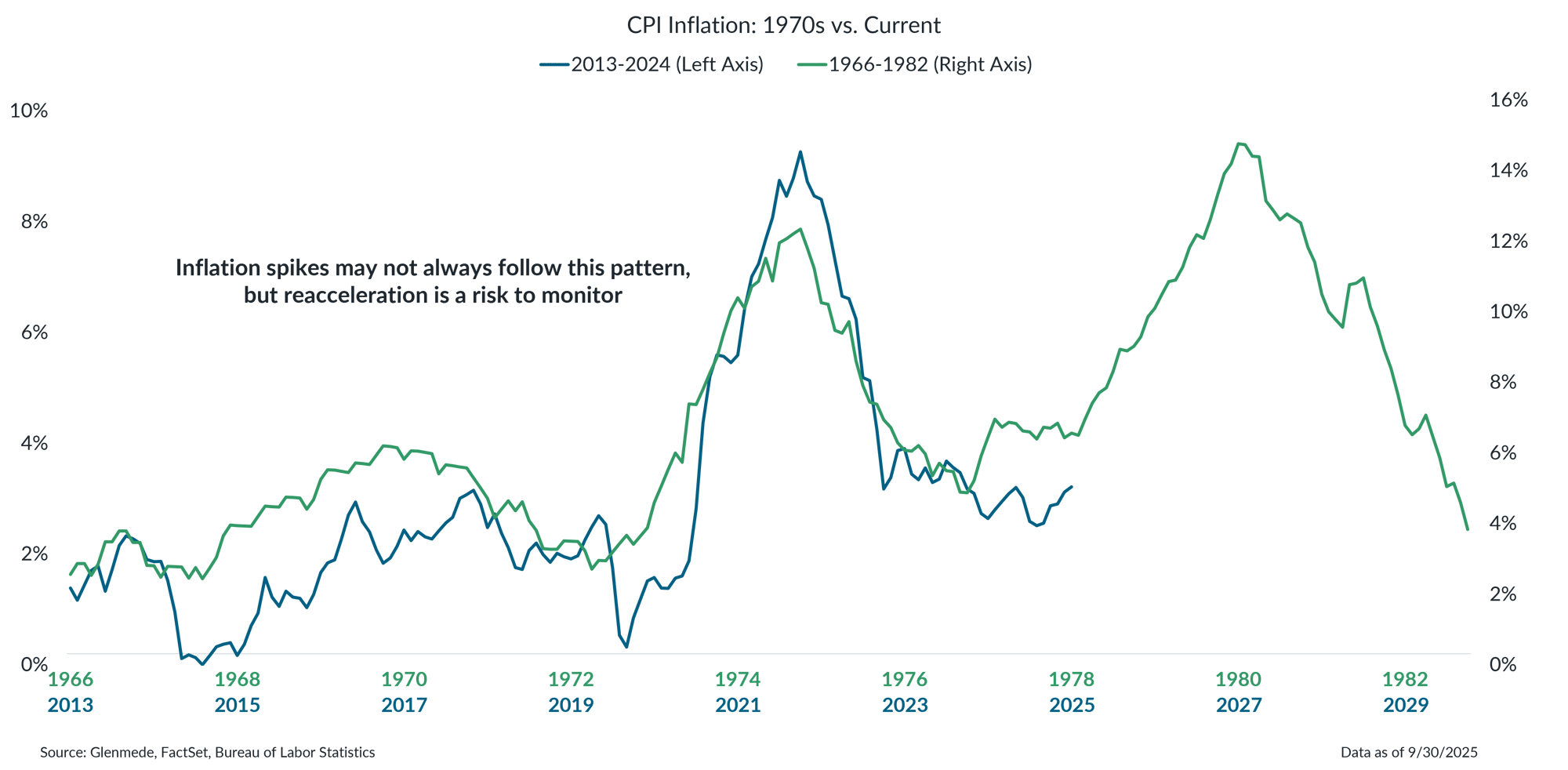
Data shown are annual growth figures in the U.S. CPI from the years 1966 to 1982 (green, graphed along the right side of the y-axis) and current CPI from 2013 through present (blue, graphed along the left side of the y-axis). Past performance may not be indicative of future results.
- Historically, major inflation spikes have come with aftershocks a few years down the line.
- After inflation cools, as it has recently, monetary and fiscal policy often ease, increasing the risk of a potential second wave and underscoring the idea that the recent progress may not be durable.
- While the current trajectory does not perfectly mirror the 1970s, past episodes show that a potential reacceleration remains an important risk for investors to continue monitoring.
Unprecedented late-cycle fiscal stimulus runs the risk of rekindling inflation

Data shown in blue comprise the Hutchins Center Fiscal Impact measure, which measures fiscal policy’s contribution to real gross domestic product growth in the U.S. on a quarterly, seasonally-adjusted annualized basis. Solid blue figures represent actual results and dash blue figures represent projections. Gray shaded regions represent period of recession in the U.S. Actual results may differ materially from projections
- Fiscal policy is unusually strong this late in the economic cycle, a pattern typically only seen during recessions, raising the risk of renewed inflation.
- Early 2021 is the closest comparison, when aggressive fiscal stimulus during a non-recession period helped trigger the highest U.S. inflation in decades.
An upside surprise in inflation could put the Federal Reserve's rate cut plan at risk
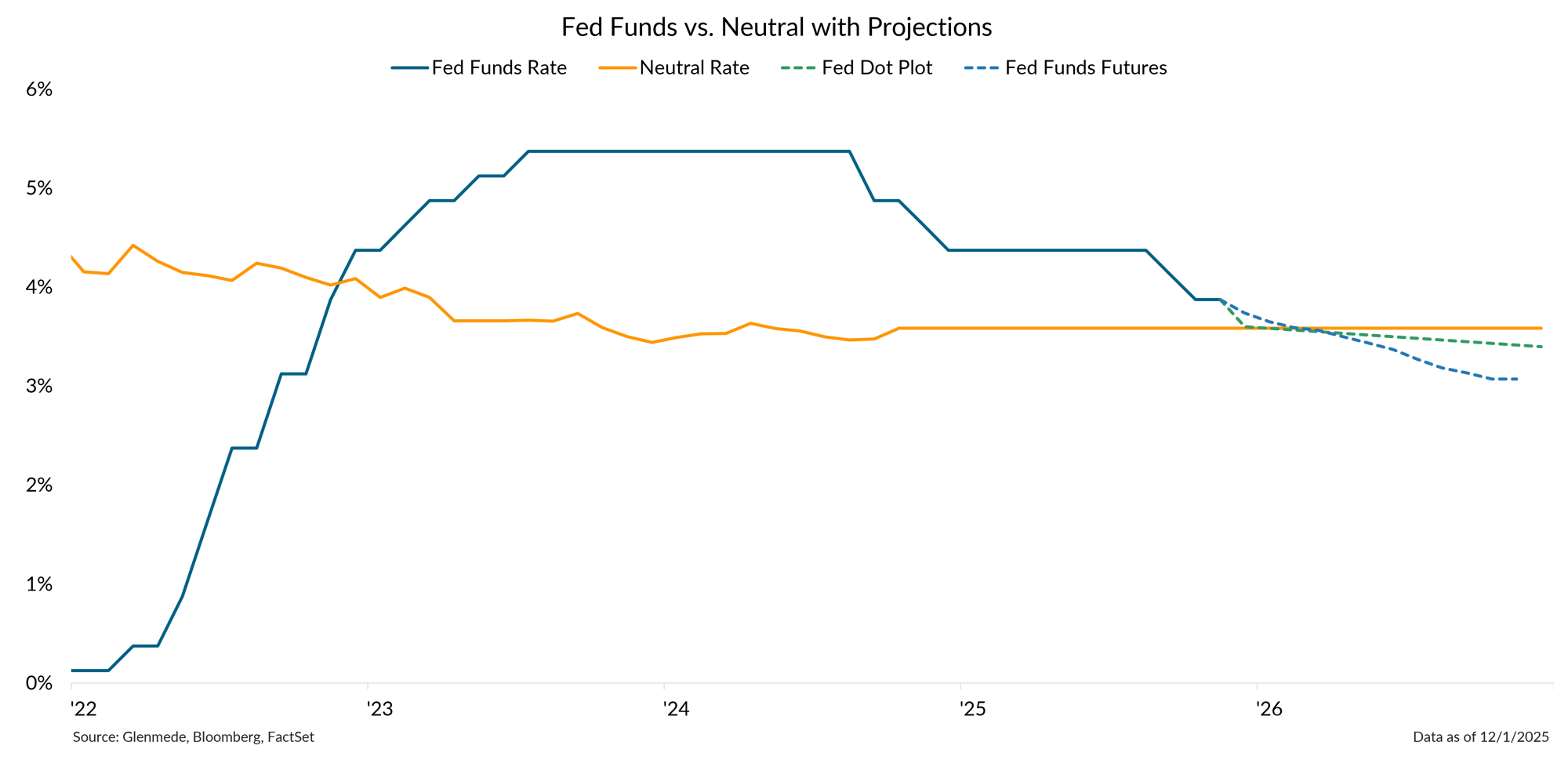
Data shown in orange are Glenmede’s estimates of the neutral federal funds rate over time (i.e., the level of rates that is neither economically stimulative nor restrictive) based on expectations for real interest rates via the Holston-Laubach-Williams model and Glenmede’s inflation expectations. Fed Funds Rate in blue is the target rate midpoint. The dashed blue line represents expectations for the forward path of rates based on fed funds futures pricing. The dashed green line represents expectations for the forward path of rates based on the median respondent in the Federal Open Market Committee’s dot plot projections. Actual results may differ materially from probabilities shown or projections.
- The debate between protecting against inflation and supporting employment will be front and center at this week’s FOMC meeting, with those favoring another rate cut likely to win the argument.
- Independent of the outcome of December meeting, market pricing and the Fed’s own projections indicate an ongoing rate cut cycle into 2026, with the market marginally more aggressive on rate cuts.
- If inflation reaccelerates, it could put the Fed’s planned easing cycle at risk, likely forcing policymakers to delay or scale back rate cut plans, keeping policy tighter for longer than investors currently assume.
For more in-depth information on this topic, please reach out to your Glenmede Relationship Manager.

This material is provided solely for informational and/or educational purposes and is not intended as personalized investment advice. When provided to a client, advice is based on the client’s unique circumstances and may differ substantially from any general recommendations, suggestions or other considerations included in this material. Any opinions, recommendations, expectations or projections herein are based on information available at the time of publication and may change thereafter. Information obtained from third-party sources is assumed to be reliable but may not be independently verified, and the accuracy thereof is not guaranteed. Any company, fund or security referenced herein is provided solely for illustrative purposes and should not be construed as a recommendation to buy, hold or sell it. Outcomes (including performance) may differ materially from any expectations and projections noted herein due to various risks and uncertainties. Any reference to risk management or risk control does not imply that risk can be eliminated. All investments have risk. Clients are encouraged to discuss any matter discussed herein with their Glenmede representative.