

Investment Strategy Brief
Warsh Watch: The Path to a New Fed Chair
February 1, 2026
Executive Summary
- The administration has announced Kevin Warsh as the nominee for chairman of the Federal Reserve.
- Warsh is a well-credentialed candidate with an extensive background in economics and direct Fed experience.
- The Fed leadership transition is expected in mid-May, subject to Senate confirmation.
- Markets may price in a modest acceleration of rate cuts, but an aggressive easing cycle appears unlikely.
- Fed rate cuts are expected to be more gradual in 2026, even under the leadership of a new chair.
The administration has announced Kevin Warsh as its nominee for Federal Reserve chairman
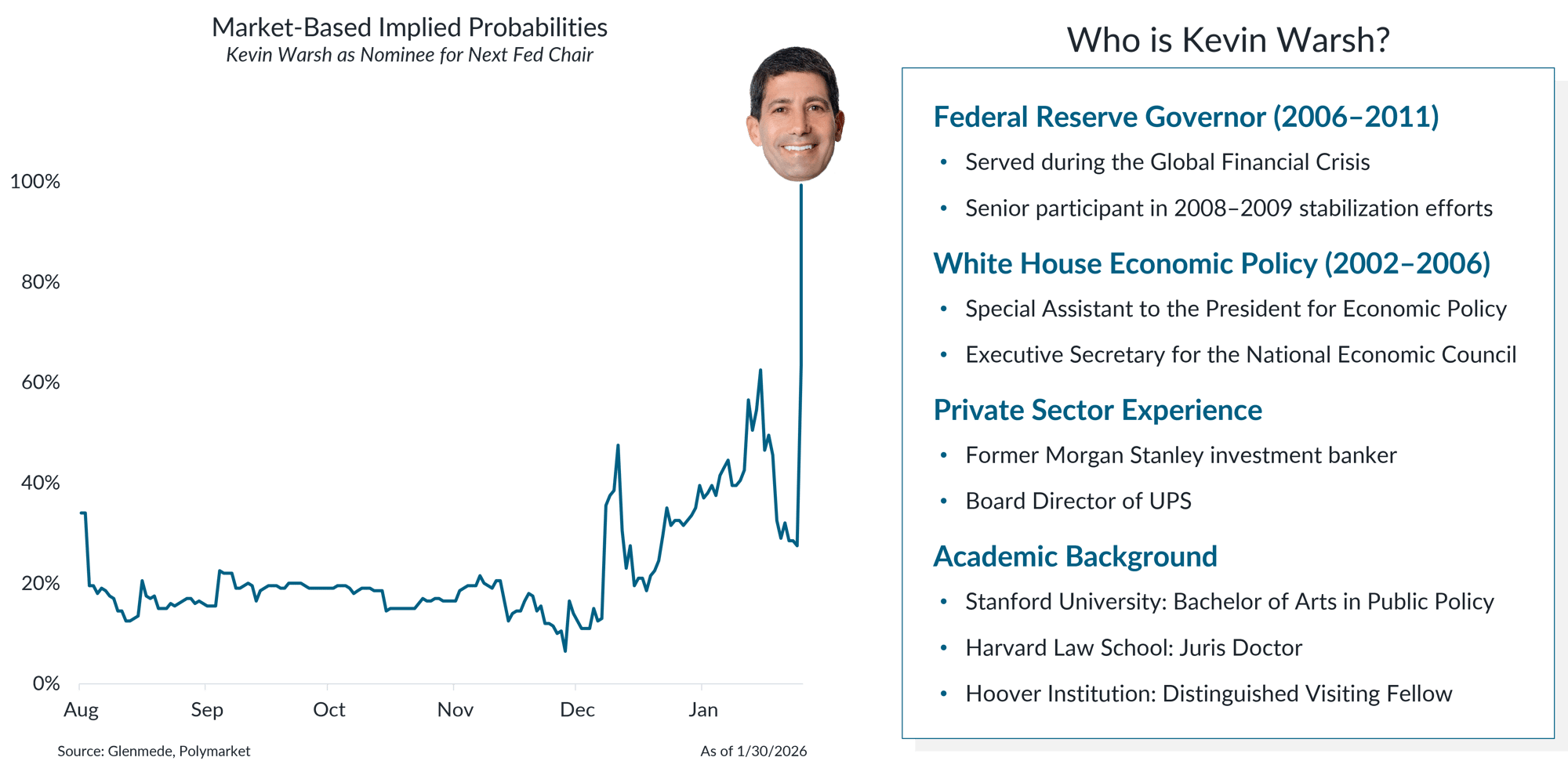
Data shown on the left are market-based odds of Warsh being announced as the administration’s nominee for chair of the Federal Reserve via Polymarket. Polymarket is a prediction market where investors can place bets on various future events. References to Polymarket and use of its data herein in no way should be interpreted as an endorsement or recommendation of Polymarket by Glenmede. Probabilities or likelihoods shown are not the opinions of Glenmede and are shown for illustrative purposes only. Actual results may differ materially from probabilities shown or projections, particularly for prediction markets with low trading volume.
- President Trump announced Warsh as his nominee for chair of the Federal Reserve on Friday morning.
- Warsh brings extensive economic policy experience. He served as the youngest Federal Reserve Governor in history, including during the Global Financial Crisis, and held senior advisory roles in the Bush administration.
The Federal Reserve leadership transition is expected in mid-May, subject to Senate confirmation
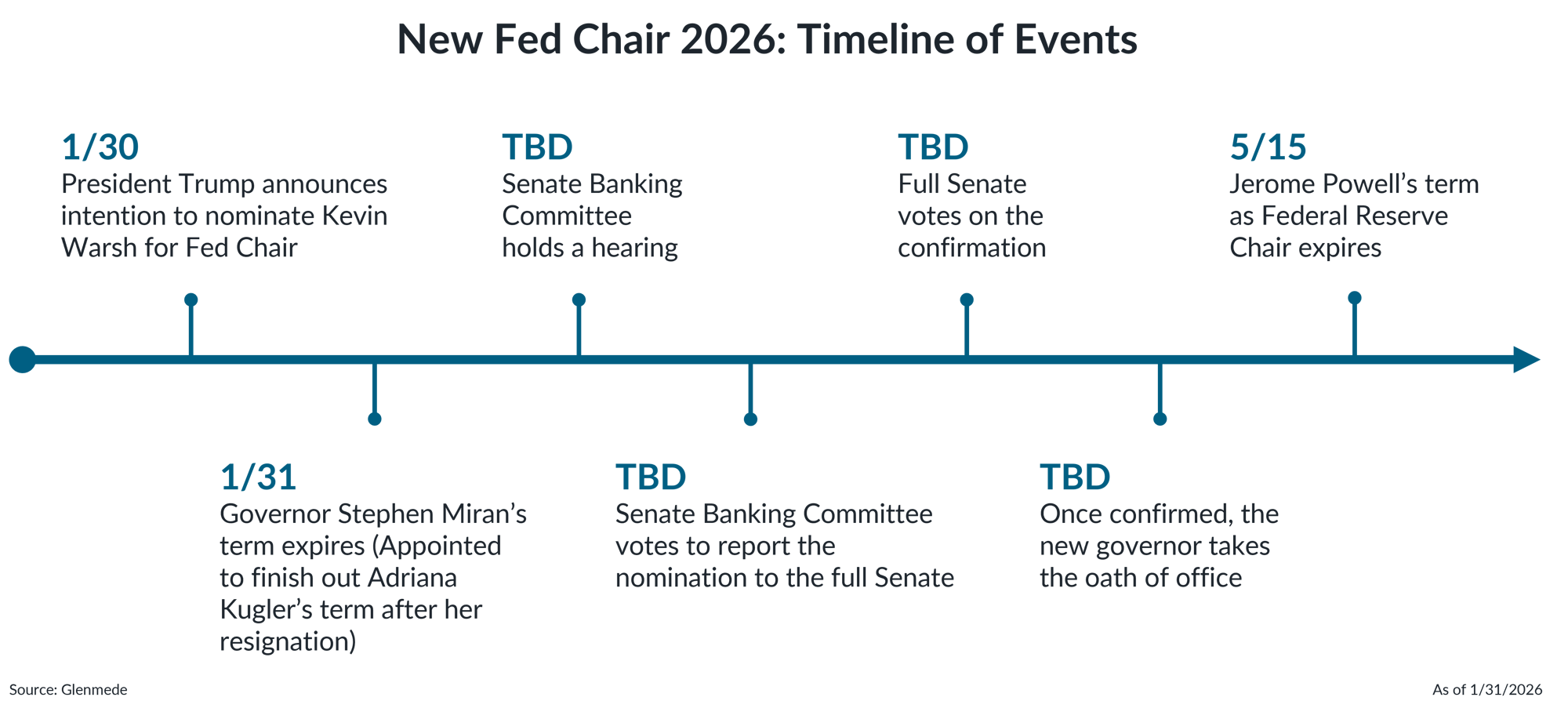
Federal Reserve Chair appointments require Senate confirmation, and timing may vary based on procedural, legal, or scheduling factors. If confirmation is delayed, the incumbent may continue serving or the position may remain vacant. Board composition and individual service decisions may also influence the transition timeline. This visual was created for informational purposes only and is subject to change after the date of publication.
- There is still a long road until Warsh can assume his role, beginning with a formal nomination to the Senate from the President, a committee hearing, and a confirmation vote.
- Some senators have signaled they may delay any Fed nomination until the investigation into its spending is resolved, potentially affecting the confirmation timeline.
- If the confirmation is not completed by the end of Powell’s term in May, he could remain as chair or the position could remain vacant until confirmation.
Markets may price in a modest acceleration of rate cuts, but an aggressive easing cycle appears unlikely
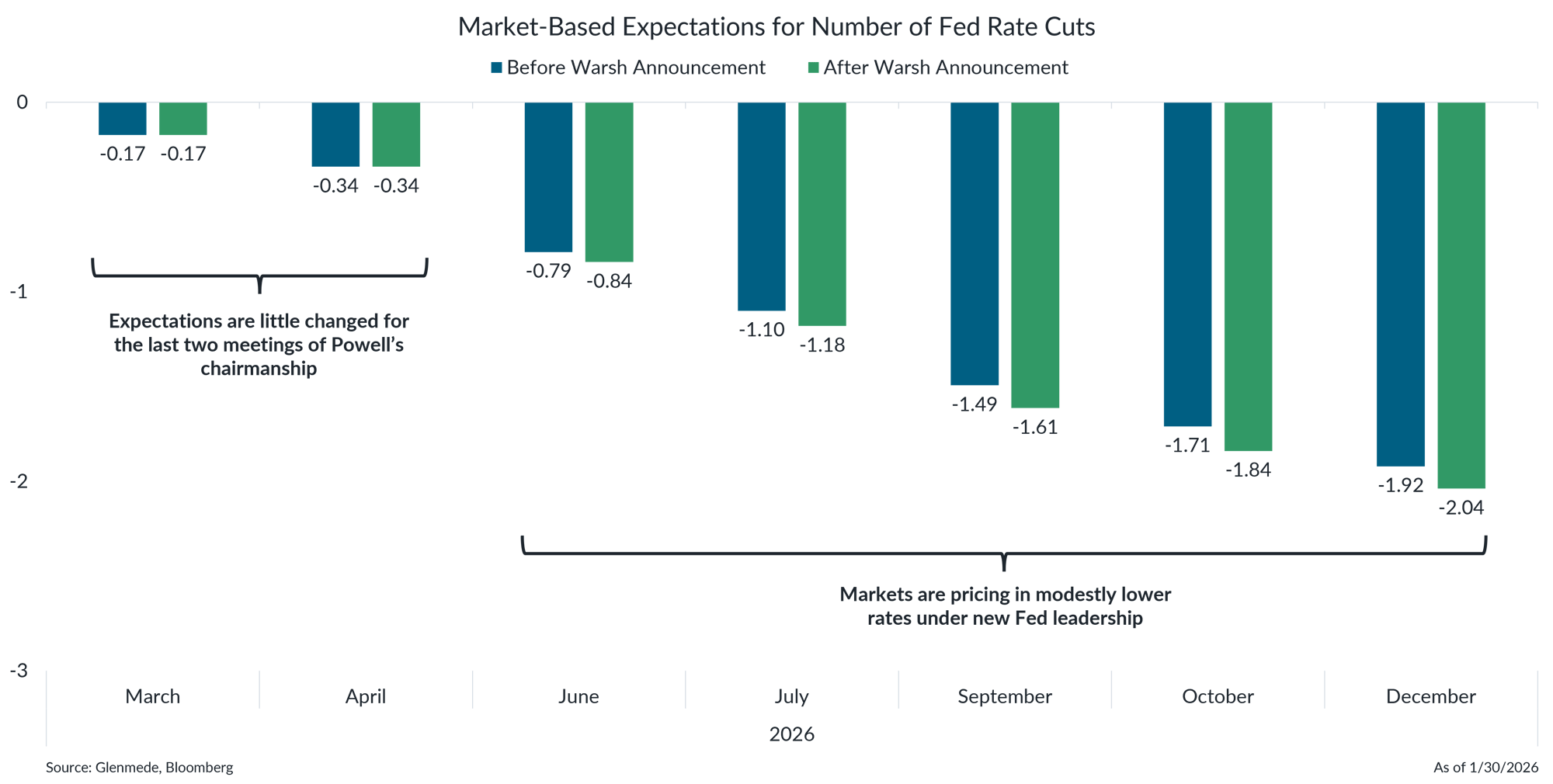
Shown are market-based expectations via fed funds futures for the number of Federal Reserve rate cuts (in quarter-point increments) expected at each regularly scheduled session of the Federal Open Market Committee in 2026. Blue figures are as of January 29th, and green figures are as of January 30th at 9:35 am. Actual results may differ materially from expectations.
- In the immediate aftermath of the announcement, changes in market-based expectations for Fed rate cuts have been relatively marginal, highlighting the perception that Warsh is unlikely to pursue aggressive policy changes.
- A potential Chair Warsh would likely lean toward a preference for modestly easier Fed policy, but the base case for the path of rate cuts from here remains a gradual one.
Fed rate cuts are expected to be more gradual in 2026, even under the leadership of a new chair
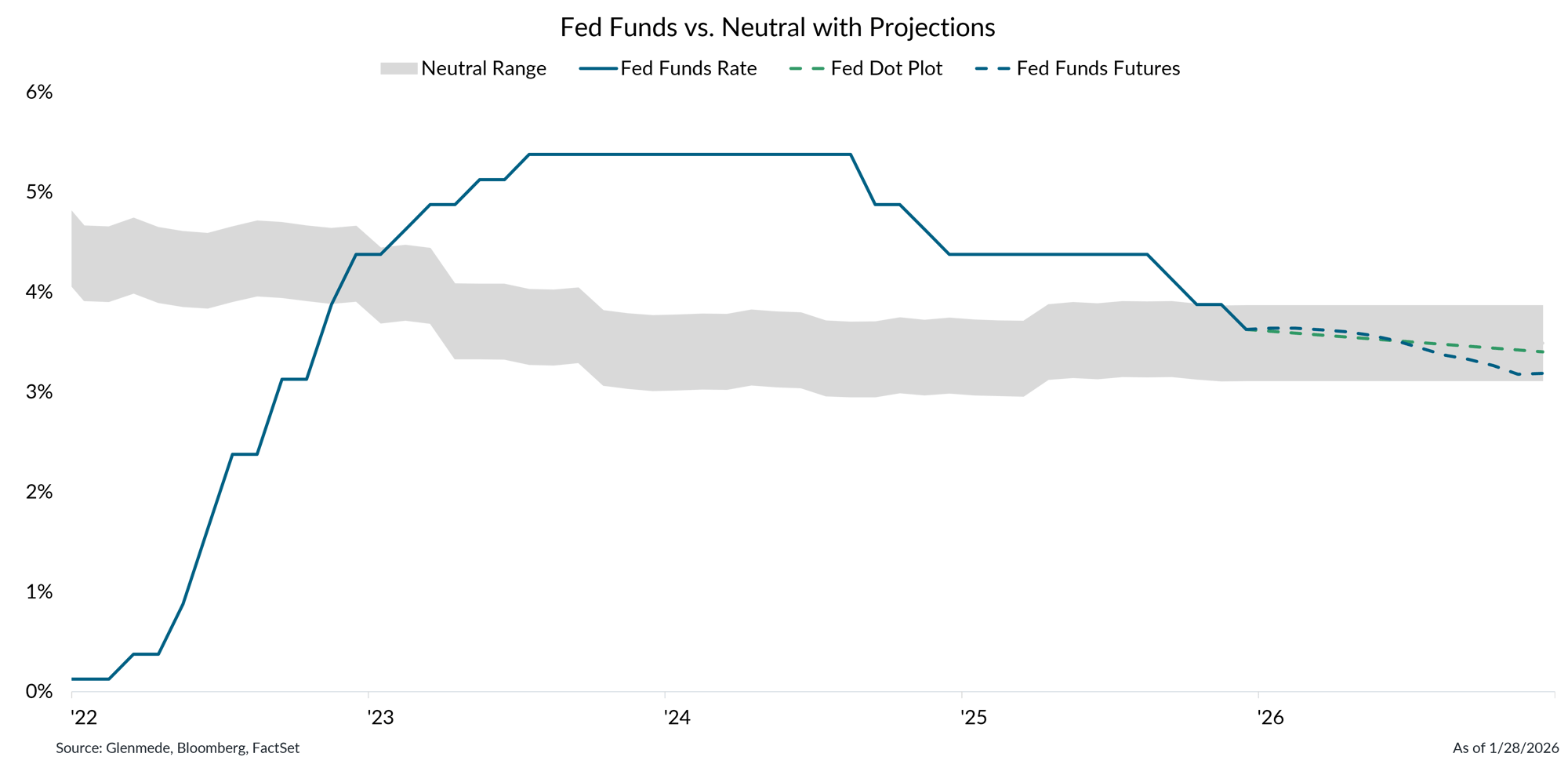
Data shown in gray are Glenmede’s estimates of the neutral federal funds rate over time (i.e., the level of rates that is neither economically stimulative nor restrictive) based on expectations for real interest rates via the Holston-Laubach-Williams model and Glenmede’s inflation expectations. Fed Funds Rate in blue is the target rate midpoint. The dashed blue line represents expectations for the forward path of rates based on fed funds futures pricing. The dashed green line represents expectations for the forward path of rates based on the median respondent in the Federal Open Market Committee’s dot plot projections.
- The Fed is likely to keep rates on hold through the remainder of Powell’s term, as policymakers wait to assess how economic conditions evolve before taking further action.
- Under a potential Chair Warsh, rate cuts are expected to progress gradually toward the lower end of neutral in 2026, consistent with current Fed projections and market expectations.
For more in-depth information on this topic, please reach out to your Glenmede Relationship Manager.

This material is provided solely for informational and/or educational purposes and is not intended as personalized investment advice. When provided to a client, advice is based on the client’s unique circumstances and may differ substantially from any general recommendations, suggestions or other considerations included in this material. Any opinions, recommendations, expectations or projections herein are based on information available at the time of publication and may change thereafter. Information obtained from third-party sources is assumed to be reliable but may not be independently verified, and the accuracy thereof is not guaranteed. Any company, fund or security referenced herein is provided solely for illustrative purposes and should not be construed as a recommendation to buy, hold or sell it. Outcomes (including performance) may differ materially from any expectations and projections noted herein due to various risks and uncertainties. Any reference to risk management or risk control does not imply that risk can be eliminated. All investments have risk. Clients are encouraged to discuss any matter discussed herein with their Glenmede representative.