

Investment Strategy Brief | May 10 , 2026
Why Diversification Matters

Executive Summary
-
Diversification is the act of spreading investments across assets, regions, and styles to help manage risk.
-
A diversified mix of assets has historically offered higher return potential for a given level of risk.
-
Diversified portfolios have consistently outpaced inflation while individual asset classes have not.
-
Diversification has historically helped mitigate losses during periods of volatility and market downturns.
-
A diversified portfolio can help reduce risk and improve the likelihood of more consistent long‑term outcomes.
Diversification is the act of spreading investments across assets, regions, and styles to help manage risk
-
A diversified portfolio spreads allocations across a broad range of assets, regions, and styles, helping reduce reliance on any single company, sector, or investment theme while preserving long‑term return potential.
-
Asset allocation can be shaped around each individual’s goals and risk tolerance, with diversification achieved both across and within asset classes through broad underlying exposure.
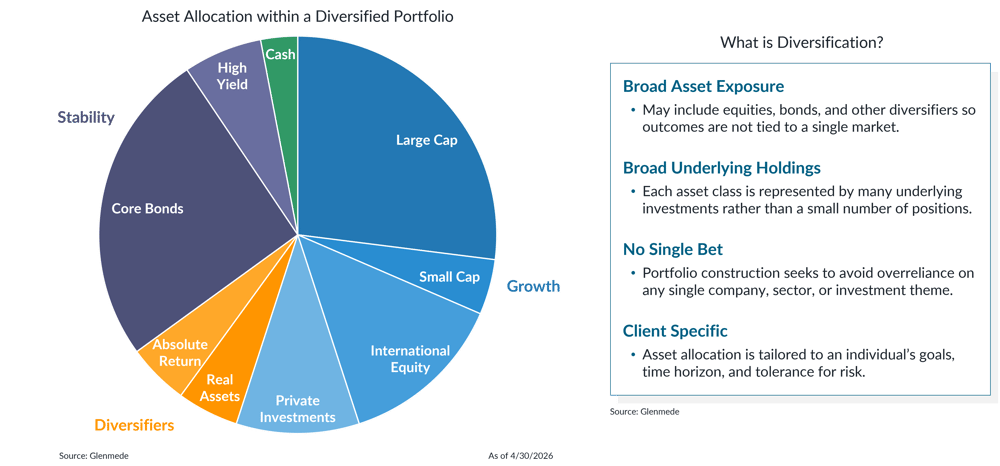
The chart on the left is provided solely for illustrative purposes to depict a hypothetical portfolio diversified across various asset classes (represented by Glenmede’s All Asset+ Growth with Income policy allocation for clients) and should not be construed as a recommendation to invest in any particular asset class or combination of asset classes. Investors should consult with their advisor to determine an appropriate asset allocation for their particular circumstances.
A diversified mix of assets has historically offered higher return potential for a given level of risk
-
Modern portfolio theory suggests that investing in only a single asset class is suboptimal.
-
The most efficient outcomes are potentially achieved through well‑diversified portfolios that combine assets across the risk spectrum, balance return potential vis-à-vis risk, and benefit from owning non-correlated assets.
-
Most individual asset classes sit meaningfully below the efficient frontier, which is the set of “optimal” portfolios that maximize return per unit of risk, indicating that each by themself represent an inefficient trade-off between risk and return.
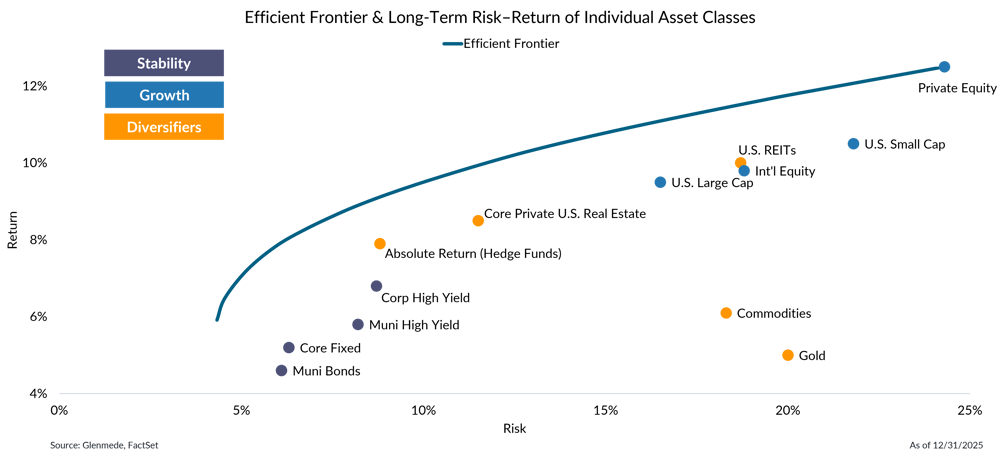
The chart illustrates the efficient frontier based on forward-looking long-term normal capital market assumptions, showing the relationship between expected return and risk (measured as the standard deviation of annual returns) for selected asset classes. Proxy indices for the asset classes shown are Muni Bonds (Bloomberg Municipal Bond), Core Fixed (Bloomberg U.S. Aggregate Bond), Muni High Yield (Bloomberg Municipal High Yield 2% Issuer Cap), Corp High Yield (Bloomberg U.S. Aggregate Credit Corporate High Yield BB), U.S. Large Cap (MSCI USA), Int’l Equity (MSCI AC World ex USA), U.S. Small Cap (Russell 2000), Core Private U.S. Real Estate (NCREIF Open End Diversified Core Equity), U.S. REITS (FTSE EPRA NAREIT USA), Absolute Return (Hedge Funds) (HFRI Fund of Funds Composite), Commodities (Bloomberg Commodity), Gold (Gold Composite ($/oz)), and Private Equity, by a pooled composite of U.S. funds categorized as All Private Equity in the MSCI Burgiss Fund Universe. These estimates are projections made in good faith, do not represent actual or guaranteed performance, and may differ materially from actual results. One cannot invest directly in an index.
Diversified portfolios have consistently outpaced inflation while individual asset classes have not
-
Market leadership rotates over time as valuations, monetary policy, demographic trends, and innovation cycles evolve, making reliance on any single asset class or theme fragile.
-
A diversified portfolio, which delivers a mix of those individual outcomes, has historically provided a more consistent experience in outpacing the ever-rising cost of living (i.e., inflation).
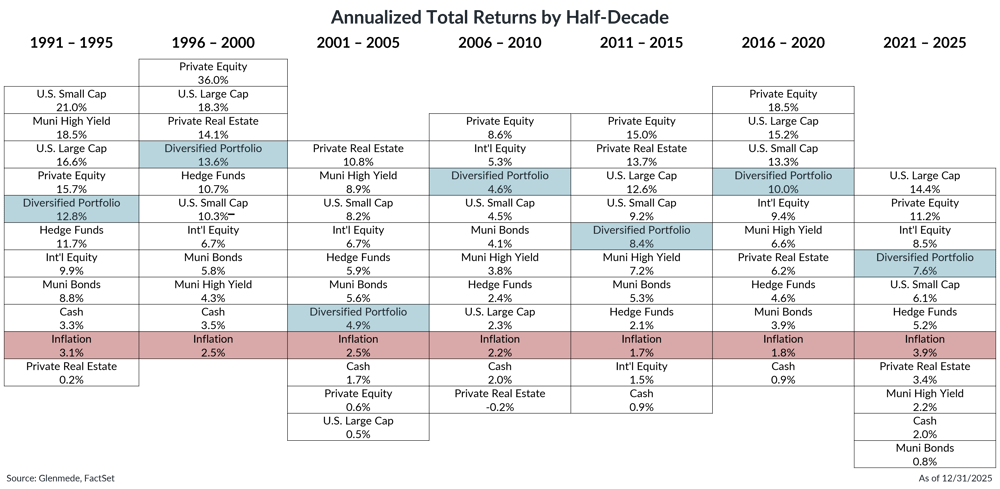
Shown are annualized returns across rolling five-year periods for selected asset classes and a Diversified Portfolio, a hypothetical blend of indices based on Glenmede’s All Asset Plus Taxable Growth with Income policy allocation for clients. Asset class returns are based on proxy indices, including: Cash (Bloomberg Treasury Bellwethers 3M), Muni Bonds (Bloomberg Municipal Bond), Muni High Yield (Bloomberg U.S. Aggregate Credit Corporate High Yield BB through 2008; Bloomberg Municipal High Yield 2% Issuer Cap thereafter), U.S. Large Cap (MSCI USA), U.S. Small Cap (Russell 2000), International Equity (MSCI AC World ex-U.S.), Private Real Estate (NCREIF Open End Diversified Core Equity), Hedge Funds (HFRI Fund of Funds), Private Equity (MSCI Burgiss All Private Equity through 9/30/25), and Inflation (Consumer Price Index). Past performance may not be indicative of future results. One cannot invest directly in an index.
Diversified portfolios have historically helped mitigate losses during market downturns
-
Episodes such as the dot‑com bust, the Global Financial Crisis, the COVID pandemic, the inflation‑driven selloff in 2022, and tariff‑related volatility in early 2025 illustrate how reliance on a single growth engine can expose portfolios to deeper and more persistent drawdowns.
-
In environments marked by narrow leadership and heightened optimism, diversified portfolios tend to be better positioned to withstand shifts in sentiment, earnings disappointments, or exogenous shocks affecting any single sector or style.
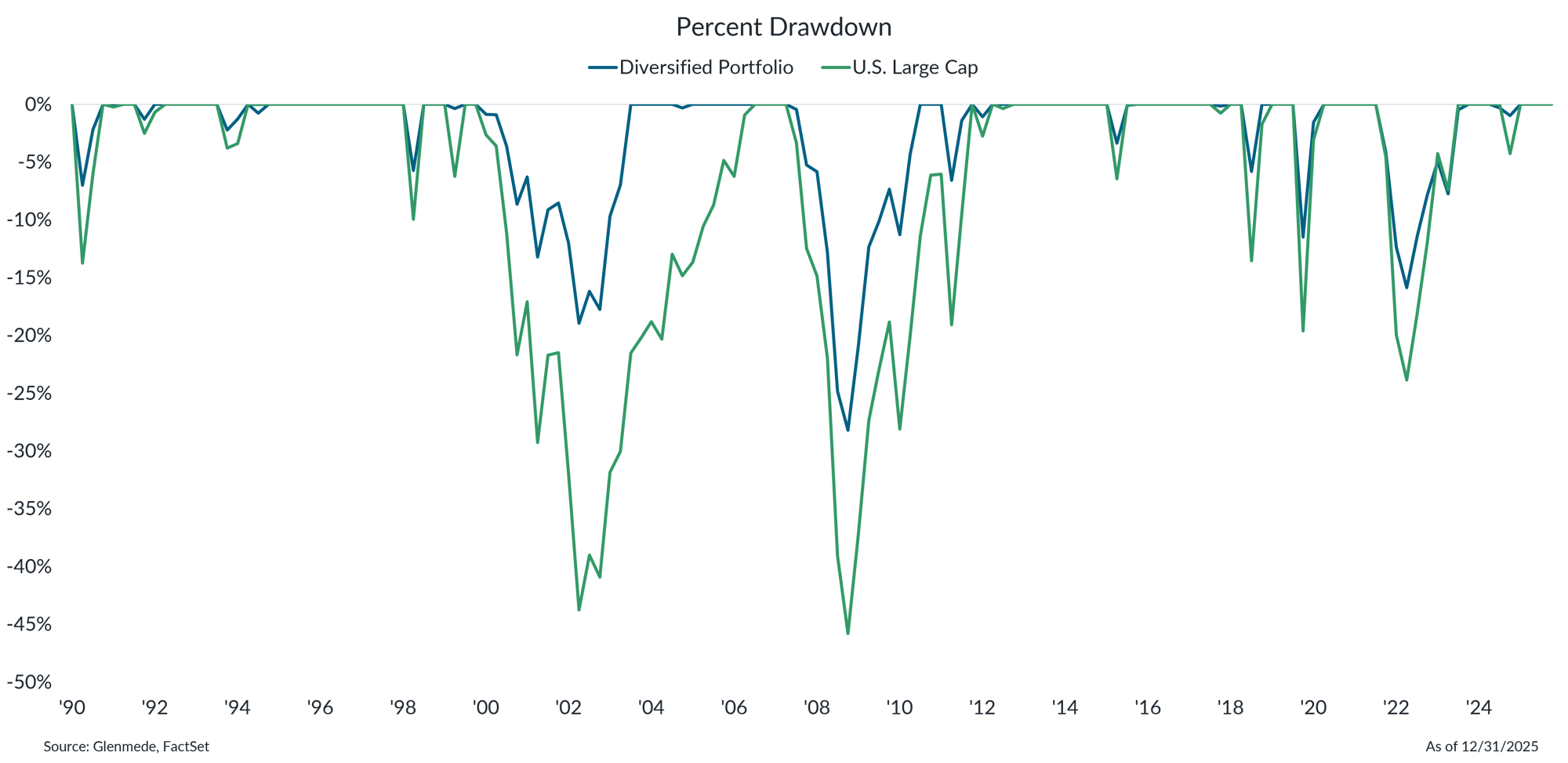
The chart shows the percentage drawdown from prior all-time highs for the Diversified Portfolio, which is represented by a hypothetical blend of indices based on Glenmede’s All Asset Plus Taxable Growth with Income policy allocation for clients and U.S. Large Cap represented by the S&P 500 Index. Drawdowns represent the peak-to-trough decline in portfolio or index value over time and are shown for illustrative purposes only. The All Asset Plus Taxable model reflects a diversified, taxable-oriented allocation constructed of indices. Past performance may not be indicative of future results. One cannot invest directly in an index.
A diversified portfolio improved the likelihood of goal attainment by managing risk and enhancing returns
-
Over long horizons, investment outcomes tend to be driven less by short‑term winners and more by the ability to deliver steady, inflation‑adjusted results across changing economic and policy environments.
-
By spreading risk across assets, regions, and styles, diversified portfolios offer a higher likelihood of meeting long‑term spending goals compared with concentrated, single‑bet allocations.
-
Based on Glenmede’s long‑term capital market assumptions, a diversified portfolio is expected to offer comparable return potential to a U.S. large‑cap‑only allocation with materially lower risk.
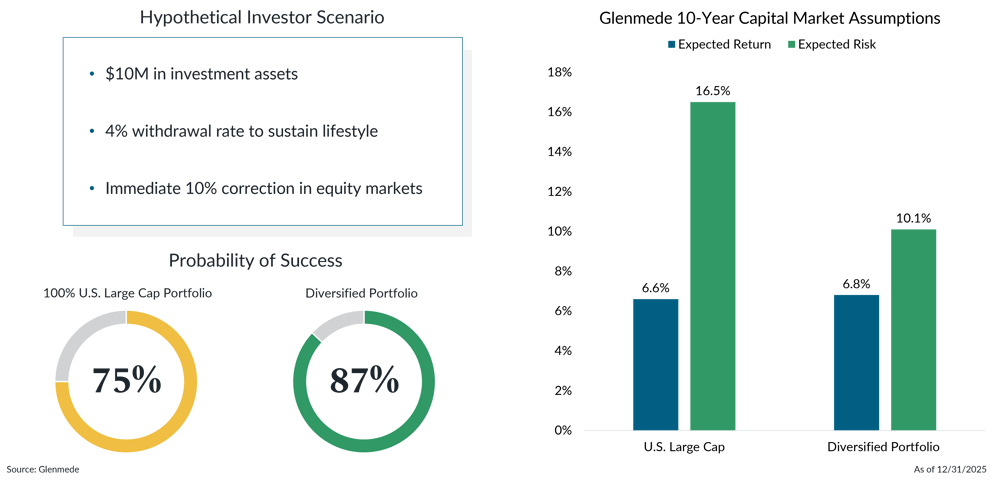
The information shown on the left reflects the likelihood that a hypothetical investor is able to meet their lifestyle goals based on two asset allocation strategies, applying a Monte Carlo simulation in which results shown constitute hypothetical, projected performance based on Glenmede's proprietary capital market assumptions, which are estimates and not guarantees. Diversified Portfolio is represented by a hypothetical blend of indices based on Glenmede’s All Asset Plus Taxable Growth with Income policy allocation for clients. Data shown on the right reflect Glenmede’s proprietary capital market assumptions for the next 10 years for U.S. Large Cap (represented by the S&P 500) and a Diversified Portfolio (represented by Glenmede’s All Asset+ Growth with Income model portfolio). Expected risk reflects the standard deviation of Glenmede’s expected asset class returns. Actual results may differ materially from expectations.
For more in-depth information on this topic, please reach out to your Glenmede Relationship Manager.

This material is provided solely for informational and/or educational purposes and is not intended as personalized investment advice. When provided to a client, advice is based on the client’s unique circumstances and may differ substantially from any general recommendations, suggestions or other considerations included in this material. Any opinions, recommendations, expectations or projections herein are based on information available at the time of publication and may change thereafter. Information obtained from third-party sources is assumed to be reliable but may not be independently verified, and the accuracy thereof is not guaranteed. Any company, fund or security referenced herein is provided solely for illustrative purposes and should not be construed as a recommendation to buy, hold or sell it. Outcomes (including performance) may differ materially from any expectations and projections noted herein due to various risks and uncertainties. Any reference to risk management or risk control does not imply that risk can be eliminated. All investments have risk. Clients are encouraged to discuss any matter discussed herein with their Glenmede representative.